
How data-center demand turned a commodity component into a contested resource, and why Europe, which designs memory chips but does not make them, is exposed.
On September 30, 2026, Micron reported revenue of $54.23 billion for the quarter ended September 3, up from $11.32 billion a year earlier, with a GAAP gross margin of 86.8%. It was the highest quarterly revenue in the company’s history. The same demand for artificial intelligence chips that drives those numbers is raising what consumers and companies pay for RAM and SSDs. This guide explains the mechanism, who is profiting, how long the cycle could last and what it means for Europe.
What is the memory supercycle?
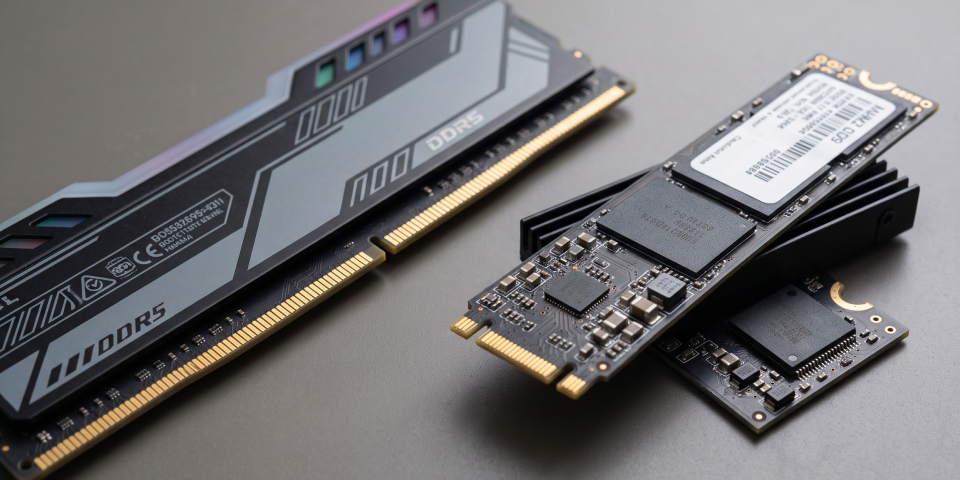
Memory comes in two main families. DRAM is working memory: the RAM in PCs, phones and servers. NAND keeps data when the power is off and sits inside SSDs and smartphone storage. HBM, the memory AI accelerators rely on, is a form of DRAM: several dies stacked vertically and mounted next to the processor.
A supercycle is an upswing that lasts longer and runs higher than the industry’s usual cycles. Micron’s revenue for the fiscal year ended in September reached $133.19 billion, up from $37.38 billion the year before, and the company guided to $61.5 billion, plus or minus $1.5 billion, for the current quarter. SK Hynix booked 40.35 trillion won of net profit in the first quarter of 2026 alone, close to the 42.95 trillion won it earned in all of 2025, according to the prospectus it filed with the US Securities and Exchange Commission in July.
Why does AI make DRAM more expensive?
HBM consumes far more silicon than conventional memory. In August 2026, Micron executive vice president Sumit Sadana said that 100 bits of HBM3E cost roughly 300 bits of DDR, and that the ratio will approach 4 to 1 with HBM4 and HBM4E, according to TrendForce. SK Hynix’s prospectus makes the same point in general terms: HBM is more complex than traditional DRAM and requires more wafer input and specialized materials.
The path from data-center demand to DRAM prices has four steps:
- Dies are stacked. HBM layers DRAM dies connected by through-silicon vias (TSVs), microscopic channels that run through the silicon.
- Capacity goes to servers. In its second-quarter 2026 results, Samsung said it achieved record memory earnings by prioritizing server products under limited capacity.
- Fewer bits are left for devices. Every wafer allocated to HBM is one less for PC DDR5, smartphone LPDDR and SSD NAND.
- Contract prices rise. Memory is sold mostly at prices negotiated with large customers. SK Hynix states in its prospectus that demand has exceeded its available supply in recent quarters.
The imbalance shows up on balance sheets. In fiscal 2026 Micron collected $12.75 billion in customer deposits tied to supply agreements, against none the year before: buyers are paying upfront to secure volume.
Who is making money from the memory shortage?
Three companies control almost all of the world’s DRAM. According to TrendForce, Samsung, SK Hynix and Micron together held 89.7% of industry revenue in the first quarter of 2026, with China’s CXMT fourth at 7.6%. SK Hynix leads in HBM, with 56.4% of the market in the first quarter of 2026 according to IDC, or 58% according to Counterpoint.
| Company | Latest figure | Period | Source |
| Micron (US) | Revenue $54.23bn, GAAP gross margin 86.8% | Quarter ended Sep 3, 2026 | Earnings release, Sep 30, 2026 |
| SK Hynix (South Korea) | Revenue 52.58tn won, net profit 40.35tn won | Jan–Mar 2026 | SEC prospectus, Jul 2026 |
| Samsung (South Korea) | Chip division: revenue 127.5tn won, operating profit 89.2tn won | Apr–Jun 2026 | Earnings release, Jul 30, 2026 |
| CXMT (China) | Expected first-half net profit of 50–57bn yuan, against a 2.3bn yuan loss a year earlier | Jan–Jun 2026 | TrendForce, citing the IPO prospectus |
The link to consumers runs through Micron’s Mobile and Client unit, which sells memory for PCs and phones: it posted $13.11 billion of revenue in the quarter at a 90% gross margin, up from 36% a year earlier. On the other side of the supply chain, Samsung’s smartphone division posted a 0.7 trillion won operating loss in the second quarter of 2026, which the company attributed to rising component costs across the industry. Samsung pays as a phone maker for the scarcity it profits from as a memory maker. PC makers are adjusting too: TrendForce reports that PC brands are cutting SSD capacities in mainstream models to contain costs.
The newcomer is Chinese. CXMT listed in Shanghai on July 27, 2026, raising at least 57.9 billion yuan, about $8.6 billion, according to TrendForce.
How does the memory cycle work?
The cycle comes from a lag. Years pass between the decision to build a memory fab and the start of production, and in periods of strong demand critical equipment can arrive more than a year after it is ordered, SK Hynix notes in its prospectus. When prices rise, producers invest; the new capacity comes online after demand has slowed, and prices fall.
The last downturn is recent. After strong demand in 2021 and the first half of 2022, memory prices fell sharply from the third quarter of 2022, according to SK Hynix, which ended 2023 with a net loss of 9.14 trillion won and a negative gross margin. Micron’s annual revenue shows two slumps in eight years: down 23% in fiscal 2019 after the 2018 peak, and down 49.5% in fiscal 2023 after the 2022 peak. In fiscal 2026 it was 4.3 times the previous cycle’s peak.
This upswing’s investments are already under way. SK Hynix began processing wafers at its new M15X plant in Cheongju in the first quarter of 2026 and expects to open the clean room of its first Yongin fab in the first quarter of 2027. In August its board approved about 54.3 trillion won of investment through 2031, according to Reuters. In past cycles, spending like this set up the glut that followed.
Why do memory stocks fall even after record earnings?
In July 2026 SanDisk shares, a pure play on NAND flash and SSDs, lost 47% in a month, according to S&P Global Market Intelligence data cited by The Motley Fool. Reasons cited included SK Hynix missing expectations in its first results since its US listing and doubts about how long the big cloud companies can sustain their spending. We covered the SanDisk sell-off in a separate analysis.
In a cyclical industry the stock market tries to price the turning point before it shows up in earnings. That is why memory stocks move ahead of chip prices, and swing harder: in the June–August quarter, while SanDisk shares slumped, Micron’s revenue grew 31% from the previous quarter. This is not a view on what to do with these stocks. It is the reason their price alone says little about where memory prices are heading.
When will memory prices come down?
Nobody knows for sure, and the longest forecasts come from the companies that profit from scarcity. The table sets each forecast next to the interest of whoever made it.
| Who | Forecast | When | Interest at stake |
| SK Hynix, CEO Kwak Noh-Jung | Shortage through the end of 2030; any slowdown would be gradual | Aug 27, 2026, per Reuters | Producer |
| Samsung | Market undersupplied in the second half of 2026, with supply constraints even as output rises | Jul 30, 2026 | Producer |
| TrendForce | Contract prices still rising in Q4 2026 but more slowly: conventional DRAM +10–15%, NAND +15–20% quarter on quarter; PC DRAM supply could shrink in 2027 | Sep 30, 2026 | Research firm selling analysis to producers and buyers |
Five factors could end the cycle earlier than producers expect:
- Chinese supply. According to the German think tank MERICS, YMTC announced two new fabs in April 2026 and expects to more than double its capacity by 2027. CXMT has just raised fresh capital.
- Inflated orders. SK Hynix warns in its prospectus that customers may order ahead out of fear of shortages. If inventories build up, real demand is lower than order books suggest.
- More efficient software. The same prospectus cites TurboQuant, compression algorithms Google unveiled in March 2026, among technologies that could reduce how much memory AI models need.
- Slower AI spending. That fear drove the July 2026 sell-off in memory stocks.
- Legal pressure. On June 25, 2026, indirect purchasers of conventional DRAM filed an antitrust class action in the United States, disclosed by SK Hynix in its prospectus. The claims have not been tested in court.
Producers argue that this time the cycle will be less violent, because multi-year contracts and customer deposits shift part of the risk onto buyers. Kwak said, according to Reuters, that he expects any slowdown to involve moderating rather than sharply falling demand. It is a plausible argument, but it comes from those with an interest in making it, and no downturn has tested it yet.
What does the memory shortage mean for Europe?
Europe designs memory chips but does not make them. Micron recruits engineers in Italy, at Arzano near Naples, Avezzano in Abruzzo and Vimercate near Milan, and in Munich, for roles ranging from process development to solution design, according to its 2026 recruiting material for the University of Naples Federico II. Manufacturing happens elsewhere: MERICS writes that Europe has no domestic memory chip production and no new capacity on the horizon, because the EU Chips Act focuses on logic and power chips.
For Europe’s industrial base, the pressure point is less HBM than the ordinary memory inside automotive electronics, industrial automation and medical equipment. MERICS expects China’s YMTC and CXMT to gain share in Europe in exactly these segments thanks to low prices and availability, and advises European companies to build stockpiles and keep Western suppliers qualified, citing the Nexperia case.
Consumers already see it in retail prices. In Germany, a 32 GB Kingston Fury Beast DDR5-6000 kit cost €549 on August 31, 2026, against €114 in mid-September 2025, according to Geizhals price data reported by PC Games Hardware. Final device prices also depend on other components, currencies and brands’ pricing choices, so a rise in DRAM costs does not pass through one for one.
Frequently asked questions
What is HBM?
High Bandwidth Memory is DRAM made of several dies stacked vertically and linked by through-silicon vias. It sits next to AI processors, which need to move large amounts of data very quickly. According to Micron, producing it takes roughly three times the wafers of DDR for the same number of bits.
Why are RAM prices so high in 2026?
Because producers are shifting capacity to HBM and server memory for AI data centers. Fewer wafers are left for PC and smartphone memory, and contract prices rise: TrendForce expects conventional DRAM to climb 10–15% in the fourth quarter of 2026.
When will DRAM prices drop?
There is no reliable date. SK Hynix expects a shortage through the end of 2030; TrendForce sees slower increases in late 2026 and shrinking PC DRAM supply in 2027. In past cycles, prices collapsed when new capacity arrived as demand slowed.
Who are the largest memory makers?
Samsung, SK Hynix and Micron, which together held 89.7% of global DRAM revenue in the first quarter of 2026, according to TrendForce. China’s CXMT ranks fourth at 7.6%. In NAND, SanDisk, Kioxia and China’s YMTC are also significant producers.
Does Europe make memory chips?
No. Micron has engineering and design sites in Italy and Germany, but according to MERICS Europe has no domestic memory chip production, and the EU Chips Act focuses on logic and power chips.
What is CXMT?
ChangXin Memory Technologies is China’s leading DRAM maker, ranked fourth worldwide by revenue in the first quarter of 2026 according to TrendForce. It listed in Shanghai on July 27, 2026. Its expansion is one of the factors that could add conventional DRAM supply and cool prices.
Sources
- Micron, fourth-quarter and fiscal 2026 results, release filed with the SEC, September 30, 2026
- SK Hynix, F-1/A prospectus, SEC, July 6, 2026
- Samsung Electronics, second-quarter 2026 results, July 30, 2026
- TrendForce, DRAM and NAND contract prices for 4Q26, September 30, 2026
- TrendForce, Micron on the HBM-to-DRAM trade ratio, August 12, 2026
- TrendForce, CXMT’s stock market debut, July 27, 2026
- Reuters via The Star, SK Hynix sees memory shortage through 2030, August 28, 2026
- PC Games Hardware, German memory retail prices with Geizhals data, September 1, 2026
- The Motley Fool via Nasdaq, SanDisk’s July decline, August 3, 2026
- MERICS, Chinese memory makers and Europe’s dependence, June 3, 2026
- Macrotrends, Micron annual revenue 2016–2024, accessed October 2026
- Micron, 2026 career day profile for the University of Naples Federico II, 2026