

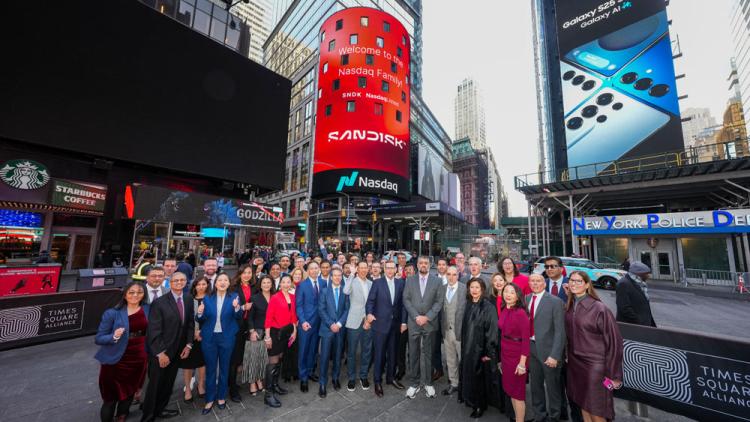
Shares of SanDisk (NASDAQ: SNDK) extended losses beyond -14% in Monday’s session, July 27, deepening the decline from its June 22 all-time high to -47%. Over the past month, the NAND flash memory maker has lost roughly $170 billion in market capitalization, one of the most violent corrections among this year’s AI-linked stocks.
From record high to capitulation
On June 22, SanDisk touched an intraday all-time high of $2,354.39, capping an extraordinary run. Since its spin-off from Western Digital in February 2025 — when it began trading at $36 a share — the stock had delivered a total return of roughly 6,000%, making it one of the best performers in the entire S&P 500 in 2026.
From that peak, the fall has been as fast as the rise. After forming a technical double top near $2,300, the stock repeatedly broke key support levels, sliding below $1,300 on Monday and touching an intraday low of around $1,227 — its lowest level since early May.
What’s driving the sell-off
Unlike many stock corrections, SanDisk’s collapse doesn’t appear tied to a company-specific problem: there has been no profit warning, no guidance cut, and no negative news on earnings. Analysts instead point to a mix of external factors:
- A sell-off across Asian semiconductor markets: overnight between July 27 and 28, markets in South Korea and Japan suffered a heavy sell-off, with Samsung down more than 7% and SK Hynix down more than 9%. The KOSPI fell 7.24%, triggering automatic trading suspensions.
- Chinese competition: on July 27, Chinese memory maker ChangXin Memory Technologies (CXMT) debuted on the Shanghai Stock Exchange in an $8.6 billion IPO, closing its first day up 466% with a market cap of roughly $487 billion. The arrival of a Chinese competitor in the NAND/DRAM market has reignited concerns over the durability of SanDisk’s operating margins, currently around 70%.
- Doubts over the sustainability of AI demand: also weighing on sentiment are reports of a new Nvidia AI infrastructure push worth more than $750 billion, reviving the debate over whether the AI investment boom reflects genuine structural demand growth or a form of inflated vendor financing.
- Pre-earnings profit-taking: SanDisk will report fourth-quarter fiscal results on August 5, and many investors are trimming exposure after a roughly 500% rally since the start of the year, in a window of typically higher volatility ahead of earnings.
The fundamentals remain solid
Despite the severity of the correction, SanDisk’s underlying business picture hasn’t materially changed. The company has an estimated $42 billion order backlog, strong gross margins, and robust revenue growth tied to NAND demand from AI data centers. Several Wall Street analysts, including those at Citigroup and Susquehanna, have recently raised price targets rather than cutting them — a sign that consensus on future earnings remains constructive even as the stock was crashing.
One key caveat remains, though: much of the recent revenue growth has come more from higher selling prices than from a real increase in shipped volumes, a detail that leaves the stock’s valuation multiple more exposed should the memory pricing cycle slow down.
What comes next
With earnings set for August 5, traders are pricing in a move of up to 25% in either direction, according to implied options-market estimates. In the near term, technical analysts point to the psychological $1,000 level as the next possible support should selling pressure continue.
The SanDisk case is shaping up as a stress test for the entire AI-memory sector: the underlying question — whether the 2026 rally reflects a genuine structural AI supercycle or speculative euphoria that has reached a turning point — remains unresolved.
Note: the information in this article is current as of July 28, 2026 and is provided for informational purposes only; it does not constitute financial advice or an investment recommendation.