
Who says a humanoid robot must blindly mimic human anatomy? On the path toward commercialization and real-world industrial deployment, engineering efficiency is rapidly taking precedence over biological mimicry.
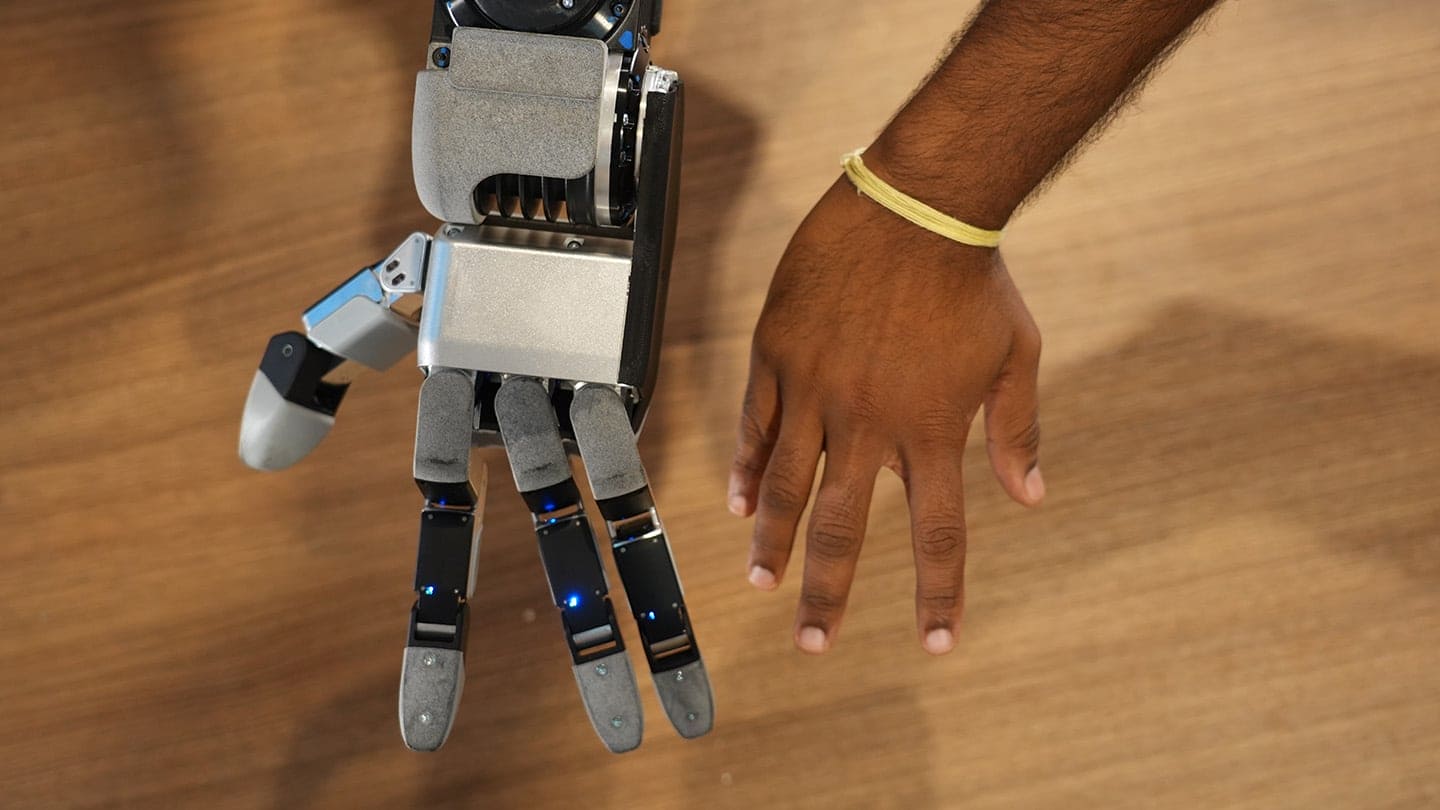
The most striking example of this shift comes from the latest evolution of Atlas, the renowned electric humanoid robot developed by Boston Dynamics. A closer look at its newly redesigned hands reveals a surprising detail: the pinky finger is gone, replaced by a streamlined four-digit configuration.
This is neither a manufacturing compromise nor a cost-cutting shortcut, but the result of a design choice as radical as it is brilliant.
The Empirical Test: A Day Spent with Taped Fingers
The decision to eliminate the fifth digit didn’t stem from computer simulations or theoretical software models, but from a practical real-world test conducted by the development team.
To evaluate whether the pinky was truly indispensable for daily handling, assembly, and maintenance tasks, engineers were asked to spend an entire working day with their pinky and ring fingers taped together.
The findings were remarkable: across the vast majority of heavy-duty grasping (power grip) and precise manipulation (pinch grip) operations—such as lifting structural components, handling materials, or manipulating tools—the lack of independent pinky mobility had zero negative impact on grip stability or force. The engineering team reached a unanimous conclusion: the pinky was entirely expendable.
The New Hand Architecture: 13 Degrees of Freedom for the Factory Floor
Removing a finger allowed Boston Dynamics to concentrate mechanical complexity where it delivers maximum functional value, redesigning the hand specifically for automotive manufacturing and heavy industrial applications:
- 13 Degrees of Freedom (DoF): A highly articulate joint configuration that ensures precise positioning without overloading the control system.
- High-Agility Thumb: Re-engineered in geometry and torque output to provide optimal opposability against each of the other three fingers.
- Ergonomic Tool Handling: Geometrically optimized to securely hold power tools like drills, impact drivers, and spray guns, positioning the index finger to pull the trigger while the remaining fingers maintain a firm grip on the tool body.
“Less is More”: The Engineering Benefits of Simplification
In advanced robotics, every additional mechanical component represents a potential point of failure. Eliminating a finger yields three immediate operational advantages:
- Reduced Failure Rate (Point of Failure): Fewer actuators, cables, gears, and dedicated sensors mean lower maintenance requirements and higher resistance to impact.
- Dynamic Efficiency: Decreasing mass at the arm’s distal end reduces rotational inertia during high-speed movements, improving overall battery energy efficiency.
- Faster Motion Planning: Simplified kinematics allow artificial intelligence perception models and motion planners to compute optimal contact points in fractions of a second.
To stay updated on the latest breakthroughs in industrial robotics and emerging technologies, explore the latest insights at INTNews.
Shaping a New Standard for Industrial Robotics
Boston Dynamics’ design choice reflects a broader industry trend seen across advanced humanoid platforms (from Tesla Optimus to Figure and Unitree): while the torso and legs retain human-like proportions to navigate spaces designed for people, the end-effectors are evolving toward pure functional utility.
Atlas demonstrates that the future of automation isn’t about blindly copying nature, but about streamlining it to work smarter.
Frequently Asked Questions (FAQ)
Why does Boston Dynamics’ Atlas robot only have four fingers?
Boston Dynamics removed the pinky finger to reduce mechanical complexity, weight, and potential points of failure. Practical workplace testing demonstrated that three fingers and a high-agility thumb provide sufficient grip stability and tool actuation for industrial tasks.
How many degrees of freedom do the new Atlas hands have?
The newly designed electric hands on Atlas feature 13 degrees of freedom (DoF), offering high dexterity for grasping, positioning, and operating power tools such as drills and drivers.
How does eliminating the pinky impact robot performance?
Removing the fifth digit reduces arm inertia, improves battery efficiency, and simplifies AI grip-planning algorithms, enabling faster, more reliable performance in manufacturing environments.
Can Atlas use tools designed for human workers?
Yes. The new hand configuration is engineered specifically to hold standard power tools and operate triggers with the index finger without slipping.
Sources & References
- Boston Dynamics Official News: Boston Dynamics – Atlas Electric Humanoid Updates
- IEEE Spectrum (Robotics): IEEE Spectrum – How Boston Dynamics Redesigned the Hands of Atlas
- TechCrunch Robotics: TechCrunch – Boston Dynamics details new dexterity features for Atlas