
What’s changing in Serie A 2026/27: the quick version
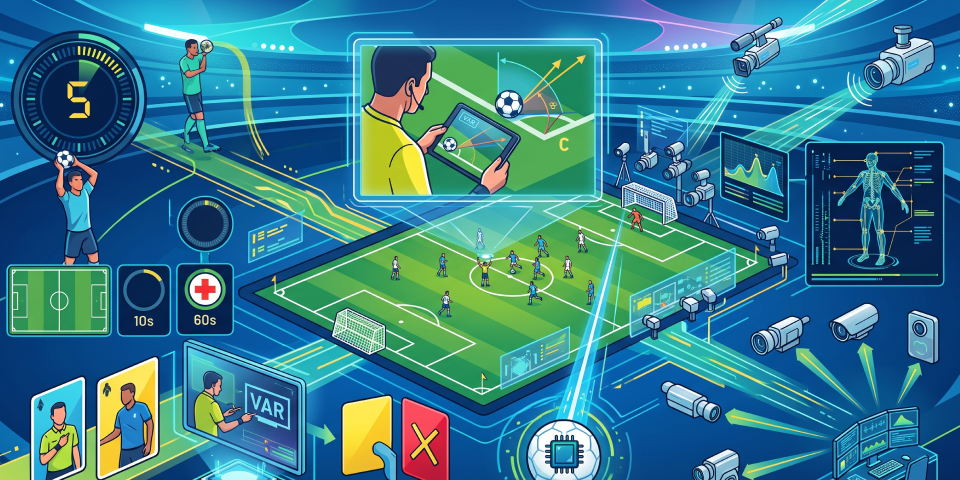
The season kicking off on 22-23 August brings six concrete changes, almost all of them born during the 2026 World Cup and then filtered through Italy’s Federal Council with a few local adjustments. VAR will now be able to correct corner kicks awarded in error and disallow goals scored following a foul committed just before play resumed. It can also step in on second yellow cards that are clearly wrong, while staying out of single-caution decisions. On top of that comes a 5-second countdown against time-wasting on throw-ins and goal kicks, a 10-second cap on substitutions, and a one-minute limit for players leaving the pitch after medical treatment. One high-profile World Cup rule, though, Italy has chosen not to adopt: the automatic red card for players who cover their mouth while talking on the pitch.
All these changes stem from IFAB Circular No. 33 the body that sets football’s Laws of the Game and were formally adopted by the FIGC at the Federal Council meeting in late July. Many had already been tested during the World Cup across the United States, Mexico and Canada: as it has done since 2017, Serie A is once again among the first leagues in Europe to roll out new refereeing technology, but it picks and chooses carefully what to import and what to leave out.
When it starts and where to watch it
Serie A Enilive 2026/27 begins on the weekend of 22-23 August 2026 and wraps up on 30 May 2027. Twenty clubs will take part, with Venezia, Frosinone and Monza newly promoted in place of Cremonese, Hellas Verona and Pisa.
| Where | What’s covered |
|---|---|
| DAZN | All 10 matches every matchday, exclusive or co-exclusive |
| Sky / NOW | 3 matches per matchday in co-exclusivity with DAZN |
The broadcasting deal between Lega Serie A, DAZN and Sky spans the whole 2024/25-2028/29 cycle, so this season falls under the same rights package already in place. With the “where to watch” question out of the way, it’s worth turning to what actually sets this season apart: the technology on the pitch.
VAR on corner kicks: how the new rule works
This is the headline change of the summer. Until last season, corners sat among the few decisions VAR couldn’t touch, unless they were part of a passage of play leading directly to a goal, a penalty or a straight red. From this season, if the referee awards a corner in clearly mistaken fashion, VAR can call for a review and overturn the call.
The mechanism designed to keep the game’s rhythm intact is a fast silent check: the video room has to intervene before the corner is taken. Once play has restarted, the correction is no longer possible the same trade-off between accuracy and not constantly interrupting the action that has underpinned the entire VAR protocol for years.
The detail worth flagging, and the one almost nobody covers: the new rule is, for now, exclusive to Serie A. Serie B and Serie C are left out (Serie C instead continues trialling the Football Video Support system), because lower divisions simply don’t have enough camera coverage to establish with geometric certainty whether the ball touched a player before going out of play. In other words, refereeing certainty comes with an infrastructure price tag and that cost, not a regulatory choice, is what currently separates Serie A from the rest of the Italian football pyramid.
VAR on the second yellow: stopping wrongful red cards
The second extension concerns dismissals for a second caution. If a second yellow card looks clearly mistaken and therefore results in an unfair red VAR can now call the referee over to review the incident. It’s a fix that’s been a long time coming: in recent seasons the protocol allowed reviews of straight reds but not of second yellows, leaving out of video review exactly the kind of dismissals that spark the most controversy, such as the Bastoni-Kalulu case, often cited as an example of a wildly disproportionate caution.
The boundary, though, stays firm: single yellow cards standalone cautions remain outside the protocol, except in the borderline case of mistaken identity (the referee cautioning the wrong player). The logic is deliberate: widening VAR’s scope too far would slow matches down without a real payoff, since most single cautions don’t decisively change a match’s outcome. A second yellow, which ends in a sending-off, is considered serious enough to justify the technological intervention.
The war on time-wasting: countdowns and stopwatches
The third package of changes has nothing to do with VAR and everything to do with managing dead time and it’s the one with the most immediate impact on how fluid matches feel. If the referee believes a throw-in or a goal kick is being deliberately delayed, they raise an arm and start a 5-second countdown: once time’s up, the throw-in is awarded to the opposing team and the goal kick becomes a corner for them.
Two further time limits come with it: a maximum of 10 seconds to complete a substitution, and a one-minute limit off the pitch for a player receiving medical attention before they can return to play. On the technical side, timing isn’t handled by any new automated device but by the fourth official or the referee themselves, working off the same standard timings already used to calculate added time. No new sensors, then just a stricter application of common-sense rules that had largely gone unenforced in recent years.
The World Cup rules Italy is NOT adopting
Not everything that debuted at the 2026 World Cup is making the trip to Serie A, and this is where the difference shows between a league that simply copies the latest regulatory trend and one that weighs each change on its own merits. The FIGC has chosen to follow the approach already taken by UEFA and not adopt the so-called “Vinicius Law”: the rule, born out of the controversy between Vinicius Junior and Gianluca Prestianni in a Champions League Benfica-Real Madrid match, which mandates a straight red card for any player who covers their mouth with their shirt while speaking to an opponent, to prevent lip-reading.
In Italy, as already decided by UEFA, no automatic sanction will apply in these situations: no red, and no yellow either, unless the referee or their assistants can otherwise make out what was actually said. The reasoning behind this “no” is more precautionary than ideological: presuming guilt from a gesture covering one’s mouth without certainty over the words actually spoken opens up a margin of error that IFAB itself hasn’t fully resolved in its own discussions. Better, for now, to leave the judgment to the referee case by case rather than introduce an automatism that risks punishing innocent gestures or, conversely, missing genuine incidents. The same more flexible approach, compared with FIFA competitions, also applies to players who leave the pitch to protest a decision.
Semi-automated offside and tracking: what’s already under the hood
Readers coming to this article looking for offside news will actually find a confirmation rather than a revolution: semi-automated offside technology (SAOT) has already been a stable part of the Italian league for several seasons now, not a 2026/27 debut. The system relies on twelve dedicated cameras installed in stadiums, on top of broadcaster cameras, tracking dozens of data points for every player on the pitch, cross-referenced with a chip built into the ball. The software generates each player’s position relative to the last defender in real time, but the final call punishable or not still rests with VAR and the video assistant, since not every geometrically detected offside position is actually sanctionable under the rules.
For readers following the league from abroad who land on this page without the context of previous seasons: Serie A was the first of Europe’s five major leagues to adopt this technology on a permanent basis, after already being the first to introduce VAR back in 2017 and goal-line technology before that.
The broadcast: what Serie A inherits from DAZN’s World Cup production
The last legacy of the 2026 World Cup has less to do with refereeing and more with television production. To cover the tournament, DAZN deployed up to 45 cameras per match, combining traditional shots, PoleCam, CableCam, cinematic cameras and 360-degree rigs, alongside RefCam the camera that shows the game from the referee’s point of view. The entire signal workflow runs through an international hub in the United States and reaches Europe partly through Italy’s innovation hub in Cologno Monzese, which supports production for matches broadcast domestically.
Much of this equipment, in fact, isn’t an upcoming novelty but an inheritance already banked: RefCam had already made its Serie A debut in the 2025/26 season, first used in a marquee match between two of the league’s biggest clubs. What the World Cup adds is more of a refinement of the production machine — more cameras, more angles, a more cinematic broadcast that will gradually filter into domestic coverage over the coming seasons, rather than a technological leap visible from matchday one.
FAQ
Can VAR review a single yellow card? No. VAR only steps in for a clearly mistaken second yellow that leads to a sending-off, not for single cautions, except in cases of mistaken identity.
Does the Vinicius Law apply in Italy? No. The FIGC follows UEFA’s approach and has not introduced an automatic red card for players covering their mouth while speaking to an opponent.
When does Serie A 2026/27 start? On the weekend of 22-23 August 2026, running through to 30 May 2027.
What happens if a goalkeeper wastes time on a goal kick? The referee starts a 5-second countdown with a raised arm: if time runs out, the goal kick becomes a corner for the opposing team.
Where can I watch Serie A 2026/27? Every match is on DAZN, with 3 games per matchday shown in co-exclusivity on Sky and NOW, under the broadcasting rights deal running through 2029.
The changes at a glance
| Change | How it works | Where it comes from |
|---|---|---|
| VAR on corner kicks | Silent check before the kick is taken, corner overturned if clearly mistaken | IFAB / 2026 World Cup, adopted by the FIGC |
| VAR on second yellow | Review of a dismissal for a second caution if clearly wrong | IFAB / 2026 World Cup, adopted by the FIGC |
| 5-second countdown | Throw-in reversed or corner awarded if throw-ins/goal kicks are delayed past 5 seconds | IFAB, anti-time-wasting package |
| Substitution limit | Maximum 10 seconds to complete a substitution | IFAB, anti-time-wasting package |
| One minute off the pitch | After treatment from medical staff | IFAB, anti-time-wasting package |
| “Hand over mouth” red card | Not adopted: no automatic sanction, referee’s judgment case by case | Italian choice, following UEFA |
| Semi-automated offside | 12 dedicated cameras + chip in the ball, final call rests with VAR | Already active from previous seasons |