

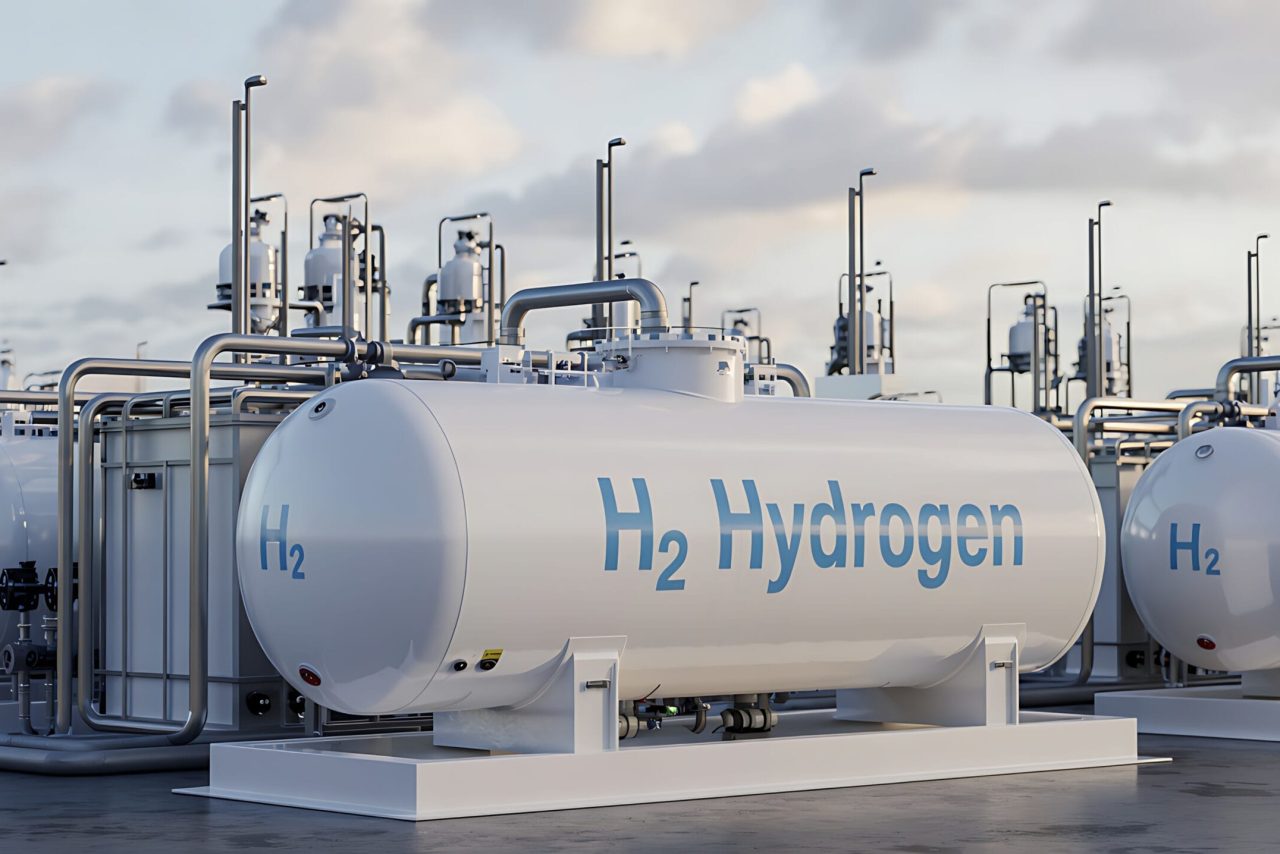
Natural hydrogen, also called white or geologic hydrogen, is hydrogen gas (H₂) that forms on its own underground instead of being manufactured. Italy’s first national assessment, published in August 2026, ranks where it is worth looking. It found no proven reserves, and was never designed to.
What is natural hydrogen, and how is it different from green or grey hydrogen?
Almost all hydrogen used today is made in industrial plants, split from natural gas or water at an energy cost. Natural hydrogen forms in rocks instead: when water reacts with iron-rich minerals, or when buried organic matter breaks down at high temperature. Under the right conditions it migrates and gets trapped beneath impermeable layers, much like natural gas.
That difference is the whole point. Manufactured hydrogen is an energy carrier: it holds energy that was spent to make it, and some is lost at every conversion. Natural hydrogen, if it accumulates in exploitable volumes, would be a primary energy source, drilled rather than produced. Our coverage of nuclear fusion and of Terra Innovatum’s microreactors follows the clean power that could make hydrogen; our guide to electric mobility covers the competing option in transport.
| Type | How it is obtained | CO2 from production | Status |
| Grey | From fossil fuels (natural gas, coal) without carbon capture | High | Dominates global production (IEA, 2026) |
| Blue | As grey, with CO2 capture and storage | Lower, depending on the share captured | One new large plant started operating in 2025 (IEA, 2026) |
| Green | Water electrolysis powered by renewables | Close to zero in the process | Over 4 GW of electrolysers installed worldwide in 2025 (IEA, 2026) |
| Natural (white) | Forms underground, extracted through wells | Depends on the deposit: the gas can contain methane and CO2 | About 60 announced projects, most at an early stage (Wood Mackenzie, via QualEnergia.it, March 2026); one producing field, in Mali |
What did Italy’s first natural hydrogen assessment find?
The study, by researchers at Sapienza University of Rome, Italy’s National Research Council (CNR) and the National Institute of Geophysics and Volcanology (INGV), appeared in the International Journal of Hydrogen Energy (vol. 266) and went online on 12 August 2026. It belongs to NHEAT, a project funded by Italy’s research ministry through the PRIN 2022 programme of the national recovery plan. The authors call it the first quantitative evaluation of natural hydrogen prospectivity in Italy.
The team combined geological maps, heat flow, magnetic anomalies, alkaline springs and gas measurements into one score from 0 to 1, the H2 Prospectivity Index. Above 0.75 an area counts as high prospectivity; between 0.50 and 0.75, moderate. The score ranks where further work is justified. It does not measure how much hydrogen is there.
| Area | Hydrogen-generating process | Index | Class |
| Tuscany (Larderello, Mount Amiata) | Hydrothermal alteration of iron-rich granites | 1.00 | High |
| Ligurian-Emilian-Tuscan Apennines | Hydrogen from ancient serpentinization, possibly still trapped | 0.83 | High |
| Po Basin | Thermal breakdown of buried organic matter | 0.77 | High |
| Voltri Massif (Liguria-Piedmont) | Ongoing serpentinization | 0.72 | Moderate |
| Sardinia and Calabria-Peloritani arc | Alteration of iron-rich granites, with lower heat flow | 0.60 | Moderate |
Source: Schirripa Spagnolo et al., International Journal of Hydrogen Energy, 2026.
Serpentinization is the reaction between water and ultramafic rocks such as peridotite: iron in olivine oxidises and the water releases hydrogen. Tuscany tops the list because it combines large granite volumes, heat flow reaching 400 milliwatts per square metre and hydrogen already measured in the gases of the Larderello geothermal field, at 2.5–6.4% by volume.
Italy’s highest measured concentration, up to 13% by volume on the volcanic island of Pantelleria, stays off the ranking: the study excludes active volcanic areas, where technical and regulatory constraints limit any exploitation. The authors also warn that hydrogen at the surface is a clue, not proof of an accumulation, and that its absence does not rule one out at depth.
How much natural hydrogen is under Italy?
Nobody knows, and the study does not try to say. It calculates instead what a reference volume of 100 km³ of suitable rock could yield, to test whether exploration could ever pay off.
| Scenario | Peridotite | Biotite-rich granite | Assumptions |
| Theoretical maximum | About 310 Mt | 85–120 Mt | Complete reaction, all gas retained |
| More realistic, still optimistic | 3–25 Mt | 1–10 Mt | 10–80% reaction, 10% of the gas trapped, little lost to microbes and other reactions |
| Italy today | No accumulation identified | No accumulation identified | Site-by-site gas data and 3D subsurface models still needed |
Mt = million tonnes, for a hypothetical 100 km³ of rock. Source: Schirripa Spagnolo et al., 2026.
The theoretical maximum would equal 3,900–10,500 TWh, depending on the rock, or 2–6% of the world’s annual energy demand. That is the kind of figure that makes headlines; the authors treat it only as an upper bound.
Some Italian coverage turned the two upper values of the middle row into a national total of “35 million tonnes”. The study gives no national figure: the two values refer to different rocks, each in a hypothetical volume, and the authors stress that they are theoretical numbers, not identified resources.
Why does Italy’s method matter beyond Italy?
The ranking is the headline; the method is the part other countries can reuse. Earlier screening approaches were largely qualitative, and the most advanced probabilistic model, calibrated on Albania’s Bulqizë massif, only applied to ophiolites, slices of ancient ocean floor now on land. The Italian workflow extends that approach to two more hydrogen sources: iron-rich granites altered by hot fluids, and buried organic matter.
Italy suits the test because its geology hosts several hydrogen-generating processes at once; the authors call it a natural laboratory. Three design choices stand out.
- Conditions outweigh clues. Geological prerequisites, above all suitable source rock at depth, count more than surface hydrogen readings, which can be missing even above a real accumulation.
- Data gaps are scored. A completeness factor records how much of the needed evidence exists for each area, so the map also shows where to collect data before anyone drills.
- Results survive reweighting. The calculations are matrix-based and editable, and sensitivity tests that change the weights leave the top areas on top.
The authors are explicit about the limits. Only a few natural hydrogen reservoirs have been identified worldwide, which constrains calibration, and the science of how hydrogen migrates, gets trapped and survives underground is still thin. For now, they write, nobody can reliably predict where accumulations sit.
Is natural hydrogen actually clean?
Potentially cleaner than grey hydrogen; clean by definition, no.
- Use. A fuel cell running on hydrogen creates no air pollution at the point of use, according to the UK government’s Air Quality Expert Group (2023). Burned in boilers, engines or turbines, hydrogen emits nitrogen oxides (NOx), its only major combustion pollutant.
- Leaks. Hydrogen is not a direct greenhouse gas, but its reactions in the atmosphere raise levels of methane, ozone and stratospheric water vapour. A five-model study (Sand et al., 2023) puts its 100-year global warming potential at 11.6 ± 2.8 times that of CO2, mass for mass.
- Gas quality. Many deposits also hold methane, CO2 or nitrogen that must be separated. In Lorraine, gas sampled at 600–800 metres was over 96% methane (CNRS, 2023); Mali’s main reservoir, by contrast, yields 98% hydrogen (Maiga et al., 2023).
- Benchmark. The comparison that matters is with today’s supply. Global production remains dominated by unabated fossil fuels: low-emissions hydrogen reached almost 1 Mt in 2025 and should pass 1% of output only in 2026 (IEA, Global Hydrogen Review 2026).
Where is natural hydrogen found or produced today?
The reference case is Bourakébougou in Mali: hydrogen was found there by accident in 1987 and has supplied the village’s electricity since 2012. The other widely cited cases are an accidental find in Albania and an estimate still to be confirmed in France.
| Country | Site | What is known | Status |
| Mali | Bourakébougou | Found in 1987 while drilling for water; 98% hydrogen; no pressure decline after 11 years of production (Maiga et al., Scientific Reports, 2023) | Producing since 2012, supplies the village’s electricity |
| Albania | Bulqizë chromite mine | At least 200 tonnes a year of hydrogen escaping, at 84%: the highest natural flux on record at the time (Truche et al., Science, 2024) | Not exploited |
| France | Lorraine mining basin | 1–6% hydrogen at 600–800 m, over 15% at 1,100 m; the 46-million-tonne figure is an extrapolation still to be confirmed (CNRS, 2023) | La Française de l’Énergie applied for an exploration permit in 2023 |
| Italy | Tuscany, Apennines, Po Basin, Voltri | Priority areas for exploration, no accumulation identified (Schirripa Spagnolo et al., 2026) | No dedicated exploration rules |
At planetary scale, a global mass-balance model cited by the Italian study (Ellis and Gelman, 2024) suggests that some 5.6 million megatonnes of hydrogen may be preserved underground over geological time. It is a geology number, not a market one: it says nothing about how much is reachable, or at what cost.
Market analysts are cautious too. Wood Mackenzie sees a technical potential of up to 20 Mt a year by 2050 if exploration succeeds, about 12% of global low-emissions supply, but its base case includes no natural hydrogen at all (QualEnergia.it, March 2026).
What stands between a map and production?
Data, rules and economics, in that order.
- Data. The authors’ next steps are more gas analyses at the surface and in deep fluids, using Italy’s dense network of existing wells, and high-resolution 3D geological models to locate reactive rock volumes and traps.
- Rules. Italy has no dedicated framework for commercial exploration of natural hydrogen; any application would fall under general mining and hydrocarbon law (QualEnergia.it, March and September 2026). France moved earlier: its first exclusive natural hydrogen exploration permit was signed on 23 November 2023, for five years over about 225 km² in the Pyrénées-Atlantiques, to TBH2 Aquitaine, and drilling needs further approvals (AFP, December 2023). A QualEnergia.it review (March 2026) contrasts Spain’s restrictive drilling rules with more permissive regimes in Australia and the United States.
- Economics. Flow rates, purity, extraction and transport costs are all unproven. Hydrogen holds far less energy per unit of volume than natural gas, so a field far from refineries and chemical plants would see transport eat into its cost advantage.
- Scale. The authors size their 100 km³ threshold, at least 0.5 Mt a year for about 20 years, against the EU’s 2030 goal of 10 Mt of hydrogen a year. One such field would cover a twentieth of that goal (our arithmetic). It would also roughly match Italy’s entire current hydrogen use: 1.5 million tonnes of oil equivalent according to the national hydrogen strategy of November 2024, about 0.5 Mt of hydrogen by our conversion.
Frequently asked questions
What is white hydrogen?
Another name for natural hydrogen: H₂ that forms underground when water reacts with iron-rich rocks, or when buried organic matter breaks down. It is neither made by electrolysis nor extracted from methane.
Does Italy have natural hydrogen reserves?
None has been identified. The August 2026 study ranks the areas most worth exploring, but its figures are theoretical estimates for a reference volume of rock, not proven resources.
Where in Italy is natural hydrogen most likely to be found?
According to the study, in Tuscany, above the still-hot granites under Larderello and Mount Amiata. The Ligurian-Emilian-Tuscan Apennines, the Po Basin and the Voltri Massif, between Liguria and Piedmont, follow.
Is natural hydrogen renewable?
That is still debated. The Italian authors see systems where reactions are still active as potentially renewable, and pressure in Mali’s field has not dropped after 11 years of production. The team that studied Albania’s Bulqizë mine considers geologic hydrogen non-renewable, and no one has shown recharge fast enough for large-scale extraction.
Can companies explore for natural hydrogen in Italy?
There is no dedicated framework yet: an application would fall under general mining and hydrocarbon rules. France granted its first exclusive natural hydrogen exploration permit in November 2023.
Sources
- G. Schirripa Spagnolo et al., “Quantifying natural hydrogen prospectivity in Italy: A novel pre-exploration workflow for the energy transition”, International Journal of Hydrogen Energy, vol. 266, online 12 August 2026: doi.org/10.1016/j.ijhydene.2026.156933
- HydroNews, “Natural hydrogen: the first assessment of Italy’s potential identifies Tuscany as the most promising area for exploration”, 31 August 2026, with CNR statements: hydronews.it
- QualEnergia.it, “Idrogeno naturale, una mappa delle aree da esplorare in Italia”, 3 September 2026, in Italian: qualenergia.it
- QualEnergia.it, “L’idrogeno naturale tra potenziale e vuoti normativi”, 5 March 2026, in Italian: qualenergia.it
- IEA, Global Hydrogen Review 2026, Production chapter, 2026: iea.org
- M. Sand et al., “A multi-model assessment of the Global Warming Potential of hydrogen”, Communications Earth & Environment, June 2023: doi.org/10.1038/s43247-023-00857-8
- Air Quality Expert Group (Defra), note on emissions from hydrogen combustion, 2023: uk-air.defra.gov.uk
- Italy’s national hydrogen strategy, Rome, 26 November 2024, text published by QualEnergia.it, in Italian: qualenergia.it
- O. Maiga et al., “Characterization of the spontaneously recharging natural hydrogen reservoirs of Bourakebougou in Mali”, Scientific Reports, July 2023: pmc.ncbi.nlm.nih.gov
- ISTerre, Université Grenoble Alpes, press release on L. Truche et al. in Science, February 2024: isterre.fr
- CNRS News, article on the Lorraine hydrogen deposit, 26 July 2023: news.cnrs.fr
- AFP via L’Info Durable, “La France autorise pour la première fois des recherches de réserves d’hydrogène naturel”, 3 December 2023, in French: linfodurable.fr