

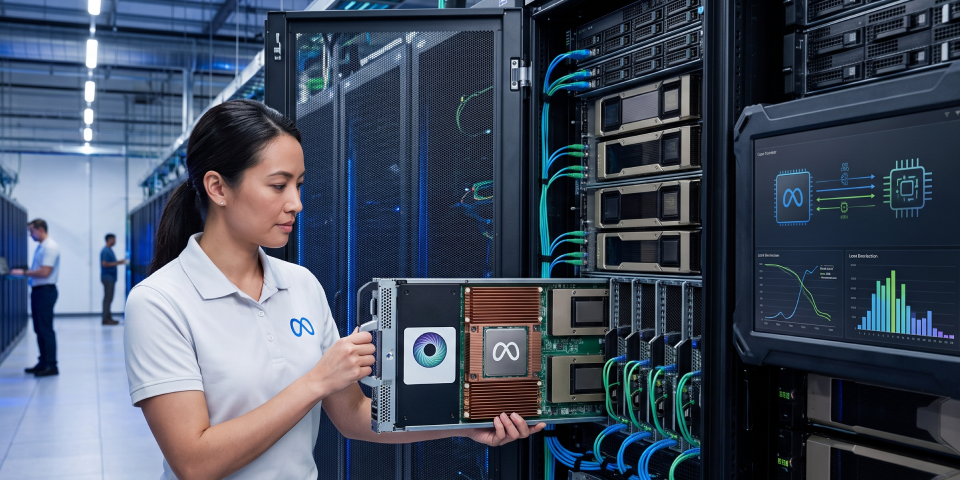
In September, Meta will begin producing Iris, its first proprietary AI chip built for the data centers that power Facebook and Instagram. Designed with Broadcom, manufactured by TSMC, tested in just six weeks without major hiccups. Numbers that, read in isolation, tell a story of flawless execution. But for anyone working in AI infrastructure — as a founder, an investor, or a CTO planning next year’s capex — the interesting part of this story isn’t the chip itself. It’s why it exists.
The real issue: a 75% margin is an invitation
Nvidia currently posts gross margins above 75% on its data center products, with an estimated 70-90% share of the AI accelerator market depending on the metric used. These are numbers any entrepreneur recognizes for what they are: a rent position. And rent positions, once the buyer is large enough to absorb the fixed cost of designing its own chip, don’t last indefinitely.
That’s precisely the calculation Meta, Google, Amazon, and Microsoft are making in parallel. Meta aims to grow its computing capacity from 7 to 14 gigawatts between 2026 and 2027, backed by capital expenditure of up to $145 billion this year. At that cost base, even a 20-30% saving per query — the kind of figure some operators report after shifting inference workloads to proprietary silicon — translates into billions of dollars a year. This isn’t marginal optimization. It’s a rewrite of the cost structure.
Iris doesn’t replace Nvidia. It disciplines it.
One point needs to be made clear right away, because the “Meta ditches Nvidia” narrative is misleading: Iris will supplement, not replace, the Nvidia and AMD GPUs in Meta’s data centers. The same holds for Google (TPU), Amazon (Trainium), and Microsoft (Maia): none of these programs yet has the scale or maturity to handle frontier model training on its own.
What’s changing isn’t the technological dependency — it’s the negotiating power. Having a credible in-house alternative, even a partial one, shifts leverage on price, allocation, and roadmap. That’s the same reason some analyses point out that the very buyers funding half of Nvidia’s data center revenue are also the ones investing the most in proprietary alternatives. Nvidia’s biggest customer is also its most credible competitor.
Who else is playing the same game
Iris isn’t an isolated case — it’s the latest piece of a pattern that solidified throughout 2026:
- Google extended its design partnership with Broadcom for TPUs through 2031, with the TPU v7 generation already handling a large share of internal inference workloads.
- Amazon has turned Trainium into a multi-billion-dollar business, expanding its use beyond training into high-throughput inference.
- Microsoft is scaling up Maia for Azure OpenAI workloads.
- OpenAI, despite being Nvidia’s flagship customer, unveiled its own first proprietary chip in June — Jalapeno — also designed with Broadcom.
Three of these programs run through the same design partner. All of them, without exception, are fabricated by TSMC, which remains the real bottleneck — and the real winner — no matter whose name ends up printed on the chip.
What this means for anyone building on top of this stack
For an AI-native founder, the operational takeaway is twofold:
In the short term, nothing changes. Nvidia’s Blackwell capacity remains supply-constrained rather than demand-constrained, and the custom programs at the major tech companies remain reserved for internal workloads — no third party will ever be able to buy an Iris chip. Anyone relying on rented GPUs (AI cloud, inference-as-a-service) will keep paying prices set by Nvidia and cloud resellers.
In the medium term (3-5 years), margin pressure is the variable to watch. Some projections suggest custom ASICs could erode Nvidia’s inference market share from roughly 90% down to a 20-30% range by 2028, as two-thirds of AI compute shifts toward inference — the segment where general-purpose chips have the least advantage. If this scenario plays out even partially, the price of rented AI compute could fall faster than many current business plans assume. Anyone building pricing models for B2B AI services would do well to stress-test their cost assumptions on a three-year horizon, not just on today’s prices.
The risk of reading Iris as a definitive victory
A note of caution is warranted, because the market reacted with enthusiasm — Meta’s stock rose about 6% on the news — but that enthusiasm needs calibrating. Developing a data center chip costs between $300 and $500 million and takes years to reach the maturity of products Nvidia has been refining for a decade. The fact that Iris cleared bug-testing in six weeks is a positive execution signal, not a guarantee of competitive performance under real production loads. The real test will come once the first chips roll off TSMC’s lines and go to work on the recommendation systems serving billions of users every day.
Bottom line
Iris isn’t the end of Nvidia. It’s confirmation that the AI infrastructure market is entering a phase where the cost of compute — not just its availability — becomes the decisive competitive variable. For anyone investing or building in this space, the useful question isn’t “will Nvidia lose ground?” but “does my cost structure hold up if compute prices drop 20-30% over the next three years?” With Iris, Meta has just given its answer.
Sources: Reuters, CNBC, TechCrunch, Yahoo Finance, Reuters (Meta internal memo), market analyses on Nvidia margins and market share (multiple sources, July 2026)