
Introduction
Traditional data centers face three main constraints. The first is cooling cost, measured with an index called PUE (Power Usage Effectiveness). The second is the thermal density of the racks. The third is the cost of land.
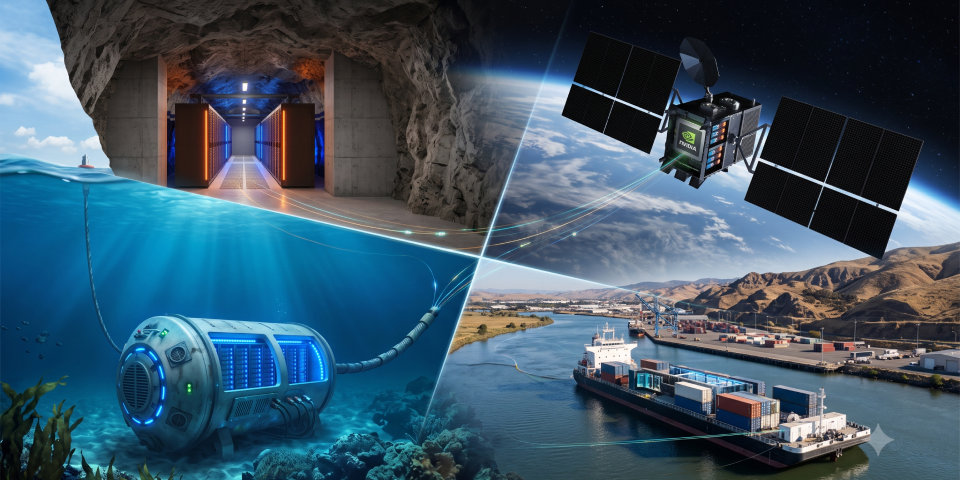
For this reason, some companies have moved their infrastructure to unconventional locations. For example, underwater, in orbit, or underground. This way, they tap into a natural, free heat sink. Below you’ll find one in-depth case study per category, with other examples briefly mentioned.
Underwater
Underwater data centers are chosen mainly for cooling. Seawater, in fact, absorbs heat naturally and for free, with no need for chillers or cooling towers. On top of that, deep-sea temperatures stay stable all year round, regardless of the surface climate. There’s another benefit too: the near-total absence of human intervention reduces vibration, impact, and dust — three of the leading causes of failure in traditional data centers.
The Microsoft Project Natick case
Between 2015 and 2020, Microsoft lowered an underwater data center off the coast of the Orkney Islands, in Scotland. The capsule sat 117 feet below the surface. Inside were 12 racks and 864 servers. The atmosphere was made of dry nitrogen instead of air, to eliminate corrosion and humidity.
The test results
After two years, the results were clear. Out of 855 submerged servers, only 6 had failed. As a comparison, on land 8 out of 135 servers had failed. The result is a reliability rate 8 times higher. In addition, deployment time dropped from 2 years to just 90 days. Finally, water consumption for cooling was zero.
Despite these numbers, Microsoft shut down the project in 2024. However, the expertise gained was redirected to other research efforts.
Other underwater cases
- Highlander (China) — a commercial cluster off Hainan, at 35 meters of depth. The stated PUE is 1.1, and the system is expanding to handle AI workloads.
- Subsea Cloud (USA) — uses pressure-equalized pods, instead of Natick’s rigid hull.
Floating
Floating data centers exist to combine the benefits of water cooling with the practicality of staying on the surface. Unlike underwater sites, in fact, a barge remains accessible for routine maintenance at all times. It can also be moored near existing ports, cutting connectivity and power grid costs. For this reason, it’s a solution particularly suited to countries with limited available land, such as Singapore.
The Nautilus Data Technologies case
The Stockton 1 site sits on a 90-meter barge, moored on the San Joaquin River in California. It has been operational since 2021 and offers 7 MW of IT capacity. Its PUE is 1.15, so no cooling towers are needed.
The proprietary TRUE/CDU system draws water from the river. It then runs it through a closed-loop heat exchanger for 15-16 seconds. Finally, it returns the water with a temperature rise of just 2.5 °C. Unlike underwater data centers, this site remains accessible for routine maintenance.
Other floating cases
- Google — was the pioneer of the concept, with a 2008 patent and a few barges built between 2010 and 2012. The project was later abandoned due to regulatory complexity.
- Aikido Technologies (USA) — co-locates data centers with offshore wind turbines.
- Keppel (Singapore) and Highlander offshore (China) — are wind-powered variants, designed for markets with strong land constraints.
Orbital and lunar
Orbital data centers rely on two unlimited resources: continuous solar energy and the vacuum of space as a heat sink. In orbit, in fact, solar panels don’t experience day-night cycles or cloud cover. At the same time, the extreme cold of space allows servers to be cooled without any active system. Another major advantage is the absence of land constraints or terrestrial building permits. However, this solution remains costly for now, since it depends on the price of space launches.
The Starcloud case
In November 2025, Starcloud launched the Starcloud-1 demonstration satellite, equipped with an Nvidia H100 GPU. As a result, it became the first company to train an LLM directly in orbit.
The design is “chiller-free”: solar panels and passive black radiators, with no active refrigeration at all. According to the company’s estimates, a 40 MW orbital cluster would cost 8.2 million dollars over 10 years. As a comparison, the terrestrial equivalent would cost 167 million. However, this projection depends on an assumption still to be verified: Starship launch costs would need to drop below 100 $/kg.
Other orbital cases
- SpaceX/xAI — filed a request with the FCC for a constellation of up to 1 million satellites, based on Starlink and Starship.
- Lonestar — runs data storage on the lunar surface, with future plans for lunar lava tubes.
- Axiom Space — integrates data center modules into a pressurized space station accessible to crew.
- Blue Origin (TeraWave) and China’s state-backed constellation (200,000 satellites) — are the direct competitors in this segment.
Underground
Underground data centers take advantage of the thermal stability of rock, which keeps a constant temperature all year round. Thanks to this, cooling requires far less energy than an above-ground building. Mines and bunkers also already offer a solid, secure physical structure, capable of withstanding external events such as explosions or natural disasters. There’s one more benefit related to land: building underground frees up large surface areas that would otherwise be occupied by technical buildings.
The Intacture case, in Trentino
Intacture is the first European data center built inside a dolomite mine that is still active. It’s located in Val di Non, at a depth of 100 meters. Here the temperature stays constant at 12 °C, and is used as passive pre-cooling.
The total investment was 50.2 million euros, of which 18.4 million came from the PNRR (Italy’s national recovery plan). The site was built to host a supercomputer for the University of Trento. Thanks to the underground structure, its land footprint equals just 1 Olympic-size swimming pool, instead of the 21 that would be needed above ground. On top of that, power comes entirely from renewable sources.
Other underground cases
- Bahnhof Pionen (Sweden) — a former Cold War nuclear bunker in Stockholm, with a 40 cm blast door. It hosted WikiLeaks’ servers for a period.
- Iron Mountain (USA) — a former limestone mine, located 60 meters below ground.
- Green Mountain (Norway) — a former NATO ammunition depot, powered by hydroelectricity.
Architectural conversions
Architectural conversions stem from a different need than the other categories: not so much cooling, but reusing structures that already exist. Churches, factories, or historic buildings, in fact, offer large, ready-made spaces, with lower construction times and costs than a new building. This choice also makes it possible to give value to an architectural heritage that would otherwise sit abandoned, combining a technological function with strong symbolic or cultural value.
The MareNostrum case
The Barcelona Supercomputing Center’s supercomputer sits in a surprising location: a deconsecrated chapel from the 1900s. The racks are visible through glass walls, inside the historic nave. In this case, heritage preservation constraints required non-invasive cooling and cabling solutions.
Another similar case
- Switch “The Pyramid” (Michigan, USA) — a former pyramid-shaped R&D center, built by Steelcase in 1989 and later converted into a data center.
The limit case: why the North Pole doesn’t work
In theory, the North Pole would seem like the ideal spot for a data center: near-freezing temperatures almost year-round, and free cooling all the time. In practice, though, this thermal advantage isn’t enough. The geographic North Pole doesn’t rest on solid ground. Instead, it sits on floating sea ice, suspended over roughly 4,000 meters of ocean. For this reason, no permanent infrastructure can be built there.
Here are the main reasons why:
- the ice moves, cracks, and thins over time, so there’s no stable foundation;
- there’s no pre-existing power grid or fiber-optic backbone;
- logistics are only possible during certain seasons;
- finally, there’s no clear sovereign jurisdiction, since these are international waters (UNCLOS).
The RUVDS case study
RUVDS, a Russian hosting provider, tested a server at the Barneo Ice Camp, near the North Pole. Data connectivity ran through a proprietary pico-satellite. The test was meant to last a month.
However, after just one week, the experiment came to a halt. The cause was an emergency evacuation, triggered by a crack in the ice. This directly confirms the structural problem described above. As a result, RUVDS moved its next test to Antarctica, on continental ice rather than floating sea ice.
Note: real “Arctic” data centers, such as Meta’s in Luleå or Verne Global’s in Iceland, sit within the Arctic Circle but on stable land. This makes them a completely different category from the true geographic North Pole.
Comparative summary
| Category | Leading case | Key benefit |
|---|---|---|
| Underwater | Microsoft Project Natick | 8× higher reliability |
| Floating | Nautilus Stockton 1 | PUE 1.15, accessible maintenance |
| Orbital | Starcloud | Continuous solar power, zero water |
| Underground | Intacture (Trentino) | 95%+ land savings |
| Architectural conversion | MareNostrum | Reuse of architectural heritage |
| Failed limit case | RUVDS (North Pole) | None — ice instability |
Conclusion
Across all these cases, the same underlying logic emerges. Companies shift the thermal load toward a free environmental heat sink, whether water, rock, or the vacuum of space. This way, they cut down on cooling and land costs.
The North Pole case, however, teaches an important lesson: an extreme environment alone isn’t enough. What’s always needed is a stable physical foothold — whether that’s the seabed, a moored barge, or the rock of a mine.