

Key Takeaways
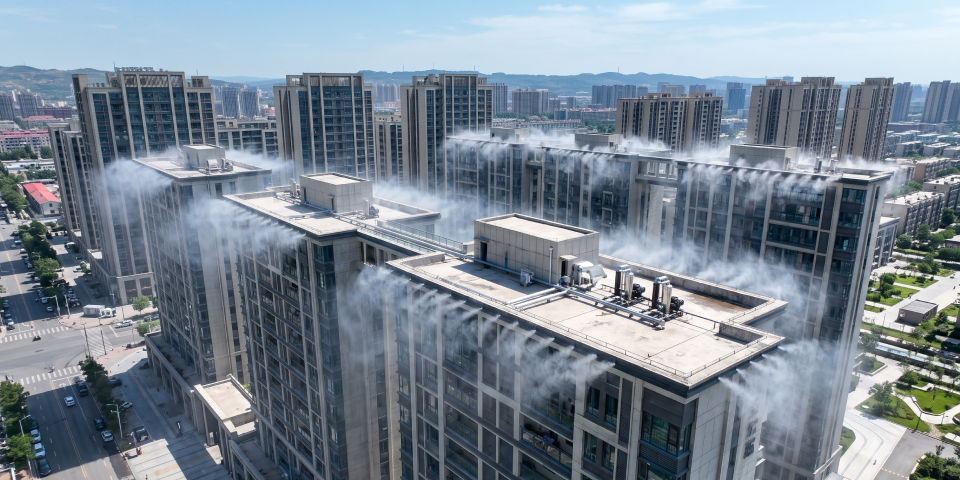
- Scenario: Residential complexes in China’s Shanxi province have integrated rooftop centralized ultra-fine misting systems to counteract extreme heatwaves at a district level.
- Business Impact: Drastic reduction of peak loads on metropolitan electricity grids and substantial lowering of cooling OpEx for the Real Estate and Smart Cities sectors.
- Data Point: Surface temperature drops between 5 and 8 degrees Celsius recorded within fifteen minutes of circuit activation.
The Shanxi Model: Scalability of Ultra-Fine Misting
Managing thermal anomalies in large urban areas requires a paradigm shift away from traditional thermomechanical air conditioning systems. In China’s Shanxi province, the installation of high-pressure micro-misting systems directly onto the exterior architecture of high-rises has proven that climate mitigation can be applied on a macroscopic scale. This centralized infrastructure forces water at elevated pressures through microscopic nozzles positioned on roofs. Consequently, the entire residential complex is enveloped in a cooling blanket of mist that accelerates the thermal phase transition process.
The adoption of this technology moves far beyond the localized cooling concepts typical of hospitality venues. Urban districts currently face severe thermal storage challenges due to asphalt and concrete, materials known to retain heat and release it during nocturnal hours. However, the micro-droplet barrier acts preemptively on building envelopes, blocking radiative heat absorption before it penetrates structural walls. For this reason, monitoring systems have registered immediate surface temperature drops ranging from 5 to 8 °C.
Evaporative Thermodynamics and Grid Resilience
The physical principle driving this system relies entirely on the latent heat of water vaporization. When atomized particles interact with hot air, they flash-evaporate, absorbing ambient thermal energy without requiring mechanical compressors. Furthermore, the complete absence of fluorinated chemical refrigerants eliminates the direct contribution of these plants to global warming. The efficiency of the water vector thus translates into drastically lower electricity consumption compared to standard gas-compression HVAC cycles.
Power grid stability represents the primary financial return for regional transmission system operators. During heatwaves, the simultaneous activation of millions of domestic HVAC units creates peak demand spikes that threaten energy grid resilience. Conversely, implementing the Shanxi model stabilizes the industrial and civil load curves effectively. Institutional investors are closely monitoring these metrics, given that integrating passive and semi-passive cooling solutions significantly improves the environmental performance of real estate portfolios.
Infrastructure Impact on Energy Grids and ESG Mitigation
Analysis of operational cash flows for assets equipped with these systems reveals a net energy savings estimate between 25% and 30%. These performances stem directly from the reduced workload imposed on indoor air conditioning units, which operate within a pre-mitigated outdoor microclimate. From a regulatory perspective, this technological transition complies with stringent international mandates regarding the decarbonization of high-density metropolitan areas. Shanxi thus establishes a scalable blueprint for the development of future global resilient infrastructure.