
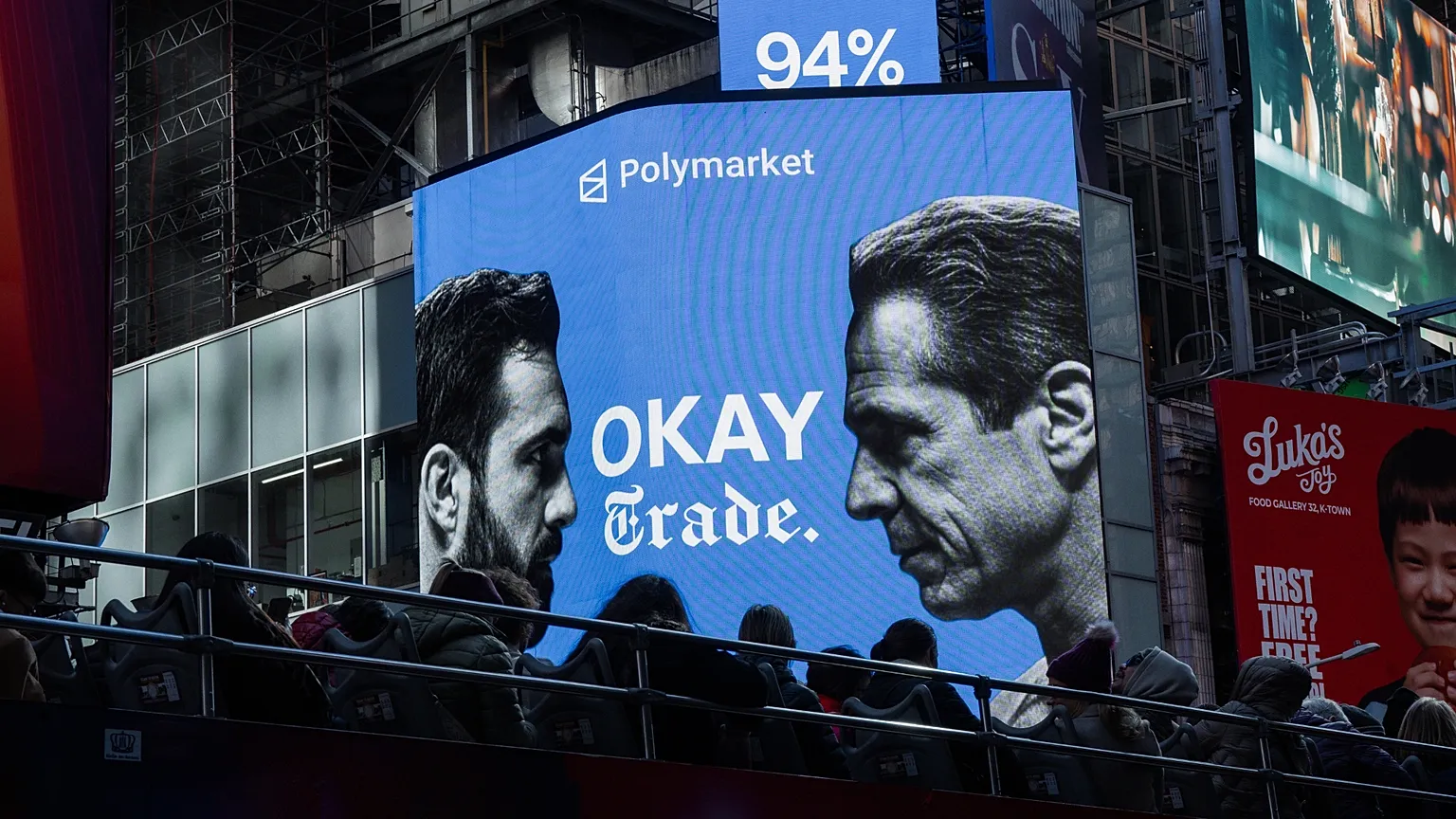
In November 2024, a website “predicted” Donald Trump’s victory while pollsters showed Kamala Harris leading. It wasn’t a wizard, nor an exit poll: it was a marketplace where millions of strangers bet real money on the outcome. That site is Polymarket. Today, it is valued at around $15 billion and sponsors the Italian football club S.S. Lazio with a €22 million deal—yet, in Italy, it is illegal. However, the story is far more convoluted than that, and much more interesting than the word “betting” implies.
It’s Not a Casino. It’s a Survey with a Price Tag!
Forget the traditional bookmaker. On Polymarket, you buy shares in a future event—such as “Will Government X fall by June?”—and the price of that share represents the probability the market assigns to the event. A share priced at $0.63? The market is signaling a “63% probability.” There is no house setting the odds; they are determined by supply and demand, just like on the stock exchange. This is why these tools are called prediction markets, not “betting slips.”
The idea was not born in a gambling hall, but at a university. In Iowa during the late 1980s, researchers discovered something counterintuitive: if instead of asking people who they will vote for, you have them wager five dollars, the forecasts become far more accurate than traditional polls. The reason boils down to pure incentive. A poll collects opinions for free, which often reflect personal biases and wishful thinking; a bet collects paid convictions, and anyone putting down their own money has every incentive to be honest with themselves. Consequently, the price aggregates information scattered across thousands of minds. It works: those predictions consistently outperformed traditional research centers.
Under the Hood: A Self-Executing Smart Contract
The mechanics here are elegant and worth explaining, as they are the key to everything. Every market is a yes/no question managed by a smart contract on the Polygon blockchain. You click “yes,” and the system mints a token representing your position. If the event occurs, that token becomes your ticket to cash out; if it doesn’t, it becomes worthless. Payments are made in USDC, a stablecoin pegged to the US dollar (1 USDC ≈ $1). Those who were right are paid automatically by those who were wrong.
There are two details that headlines always skip. First, there is no house, meaning Polymarket doesn’t profit when you lose—it only collects a small transaction fee (around 1%) on trades. Second, and more importantly, the only decisive human intervention involves how the question is phrased and which external source determines who won: the oracle, in tech jargon. Keep this word in mind, because that is where the machine breaks down.
The Gray Area: Bet or Financial Derivative?
If every wager is a contract that pays out upon the fulfillment of a specific condition, then it closely resembles a binary option—a derivative. And derivatives are regulated financial instruments (governed by the CFTC in the US); in Italy, this would fall under CONSOB (the financial markets regulator), not the State Monopolies (ADM). For years, Polymarket lived in the cracks: by operating with crypto-assets not yet classified as financial products, it was neither entirely a bet nor a regulated derivative.
The bill arrived in January 2022. The US CFTC ruled that those “event markets” are, for all intents and purposes, derivatives offered without a license. This resulted in a $1.4 million fine and a ban on US users. The principle mattered far more than the figure: it is the economic substance of the contract that counts, not the technology you wrap it in. Paying in stablecoins on a blockchain changes nothing. Consider its rival, Kalshi, which took the opposite route—registering before launching—and operated without issues. Same technology, opposite fates: one crossed the rules, the other bypassed them.
And in Italy? Illegal, Yes—But with a Plot Twist
Clarity is needed here, because contradictory information is everywhere online. Let’s reconstruct the facts, which have evolved rapidly.
On October 22, 2025, the ADM (the Italian Customs and Monopolies Agency) added polymarket.com to its blacklist of banned websites, at position 3223—citing a lack of a license for remote gambling, which requires Italian ISPs to block the domain. On November 4, 2025, the Lazio Regional Administrative Court (TAR) rejected an urgent injunction, confirming the legitimacy of the block by invoking Article 102 of Decree-Law 104/2020, which allows the Agency to order the removal of non-compliant gambling services. Companies linked to Polymarket tried to defend themselves by arguing that the site was not a gambling platform but an information service, used—according to them—by 94% of users for polls and data. The judges didn’t buy it: the ADM measure was ruled fully legitimate.
Then came the plot twist. On December 15, 2025, the ADM itself removed Polymarket from the blacklist and ordered access to be restored. Pay close attention here, because almost everyone reports this incorrectly: this was not a victory for Polymarket. The TAR closed the case without ruling on the merits because the platform declared it no longer had an interest in pursuing the lawsuit—meaning it complied with the objections, agreeing to deactivate the real-money betting feature for Italy. ADM removed it from the list precisely because the platform surrendered on that point.
This explains why it is not a contradiction. Today, the exact formula is this: betting money on Polymarket from Italy is and remains illegal. The platform holds no ADM license, playing on it offers no legal protection, and unlicensed gambling activities are prohibited. However, the domain is no longer blocked because it turned off the gambling function for Italy, leaving only the informational component accessible. As an industry agency noted, an unblocked site is not automatically a legal site. This is why the sponsorship with Lazio is formally untouchable: a partnership is not a license, but the site is no longer on the blacklist. For the user, the core reality remains: you can look, but you can’t play.
And the most fascinating part is that Polymarket’s real issue cannot be solved by either banning it or unblocking it.
The Flaw is in the Design, Not the Law
Let’s go back to Iowa. Back then, people bet five dollars; the only way to win was to reason soundly. On Polymarket today, a single account can move hundreds of millions. And when the stakes grow by six zeros, the question the player asks themselves changes. It is no longer “How will this turn out?” but “How can I make things turn out my way?”
This is a subtle yet lethal reversal. A prediction market measures reality accurately only as long as participants limit themselves to observing it. The moment the reward becomes large enough to justify taking action in the real world, the sensor stops measuring and starts distorting. Economists call this Goodhart’s Law: When a measure becomes a target, it ceases to be a good measure.
And this isn’t just theory. It has already happened:
- April 2026: A member of the US Special Forces was indicted for pocketing over $400,000 by betting—using classified information and a VPN to bypass blocks—on the secret operation to capture Maduro in Venezuela.
- May 2026: A Google engineer was indicted for making nearly $1.2 million through bets based on confidential data.
- An analysis by the Anti-Corruption Data Collective revealed that 52% of “unlikely” bets on military actions (wagers of at least $2,500 with a probability below 35%) turned out to be winning bets, compared to a 14% historical average. In other words: when it comes to wartime outcomes, someone knows something.
Follow the logic. In a market with unlimited stakes and open-ended questions, using insider information—or, in extreme cases, actively influencing the event—becomes a rational strategy. Anyone who can tip the scale even slightly (a sensor, a vote, a decision) has the financial incentive to do so. The risk is not that someone cheats at a game; it is that the game, at a massive scale, creates the incentive to manufacture the event being bet on. A market predicting the fall of a government doesn’t just forecast instability. If the stakes are high enough, it finances it.
Two Cracks That No Gambling Law Can Plug
The Italian debate focuses heavily on whether Polymarket constitutes gambling—and to that, a practical answer has already arrived: yes, and as such, it is prohibited without a license. But the truly novel challenges are twofold, and they are matters of engineering.
- The Oracle: A “yes/no” outcome requires an external source of truth. But who decides when an event has occurred, and using what source? In 2026, an anecdotal but emblematic story circulated about a bet on the temperature in Paris being resolved because someone artificially heated a sensor to cross the threshold and cash out. It might make you smile, but a smart contract executes code; it doesn’t have common sense, and a decentralized market has no referee to appeal to when a rule yields an absurd result.
- The Attack Surface: Solid on-chain code is not enough. In June 2026, Polymarket lost $3.1 million in a supply chain attack on its front-end—the exact type of vulnerability that no smart contract audit catches. Furthermore, a Wall Street Journal investigation that same month estimated that roughly 70% of over 1,100 promotional videos featured simulated winnings: a fabricated perception of “easy money.” Unsurprisingly, the CFTC has reopened an investigation.
What Remains Beyond the Hype
Polymarket is two things at once, and the confusion—including that of regulators—stems from trying to view it as only one. It is a powerful informational tool: a continuous, money-weighted poll that often outperforms traditional pollsters. Yet, beyond a certain scale, it becomes an incentive engine that stops reading the world and starts pushing it.
This second aspect cannot be governed by simply banning “bets on the weather.” It must be managed using position limits, oracle transparency, insider trading surveillance, and rules for markets that touch upon national security. In other words, with the tools of finance, not just those of gambling. For now, Italy’s line is clear and understandable—no license, no betting—but it is a defensive response to a phenomenon that our current categories (gambling, finance, information) cannot yet fully contain. The real news isn’t that a website was blocked and then unblocked. It is that innovation is running faster than regulations, and the next generation of these markets will raise questions that no gambling law, on its own, can answer.