
See-through solar glass is turning the outer shell of buildings into a power plant. For years, many people doubted it. Now new tools have changed the game: luminescent solar concentrators (LSCs), perovskite cells and tiny silicon grids. Thanks to them, BIPV (Building Integrated Photovoltaics) can turn the glass fronts of skyscrapers and the windows of our homes into clean power sources. And it does this without blocking light or spoiling the look of the building.
Introduction: The transparency paradox
For years, many people saw a fully clear window that makes power as a hoax. Some even thought it broke the basic laws of optics. The doubt seems to make sense: if light passes through the window to light up the room, how can the glass keep the energy it needs to make power?
Standard solar panels absorb visible light to free electrons. Logic says a fully clear material should let light pass through without turning it into power.
But science and industry show a very different picture. Solar glass is real, well regulated and selling fast.
The real turning point is a change of mindset. The solar panel is no longer an “add-on” fixed to the roof (BAPV). It becomes a building material that makes energy by itself (BIPV). We no longer mount heavy panels on outside brackets. Instead, we make glass walls, skylights and tiles that insulate, keep out the weather and make clean power, all at once.
BOX 1: TECH DICTIONARY – What is BIPV?
- BIPV (Building Integrated Photovoltaics): Parts of a building’s shell (glass, facades, roofs, cladding) with built-in solar cells. They do two jobs: they are part of the building and they make power.
- How it differs from BAPV (Building Applied Photovoltaics): BAPV means classic solar panels fixed onto an existing structure, such as roof panels. If you remove a BAPV panel, the building stays whole. If you remove a BIPV part, the building loses a wall, a window or part of its roof.
The Science Behind Glass: How Does It Work?
How can glass be clear and still make power? Engineers use a basic fact about sunlight: the human eye sees only a small part of it.
Visible light is about 43% of all solar energy (wavelengths between 380 nm and 750 nm). The other 57% is light we cannot see: ultraviolet (UV, about 7%) and infrared (IR, about 50%). Smart solar glass lets visible light through, so the room stays bright and the view stays clear. At the same time, it absorbs or redirects UV and IR light.
The three main types on the market are:
- Luminescent Solar Concentrators (LSC): The glass or plastic sheet is treated with special dyes, organic molecules or quantum dots. These absorb UV and IR light and give it off again at a different wavelength. This light stays trapped inside the glass, bouncing off its inner faces. It travels to the edges of the window. There, thin strips of high-yield solar cells turn it into power.
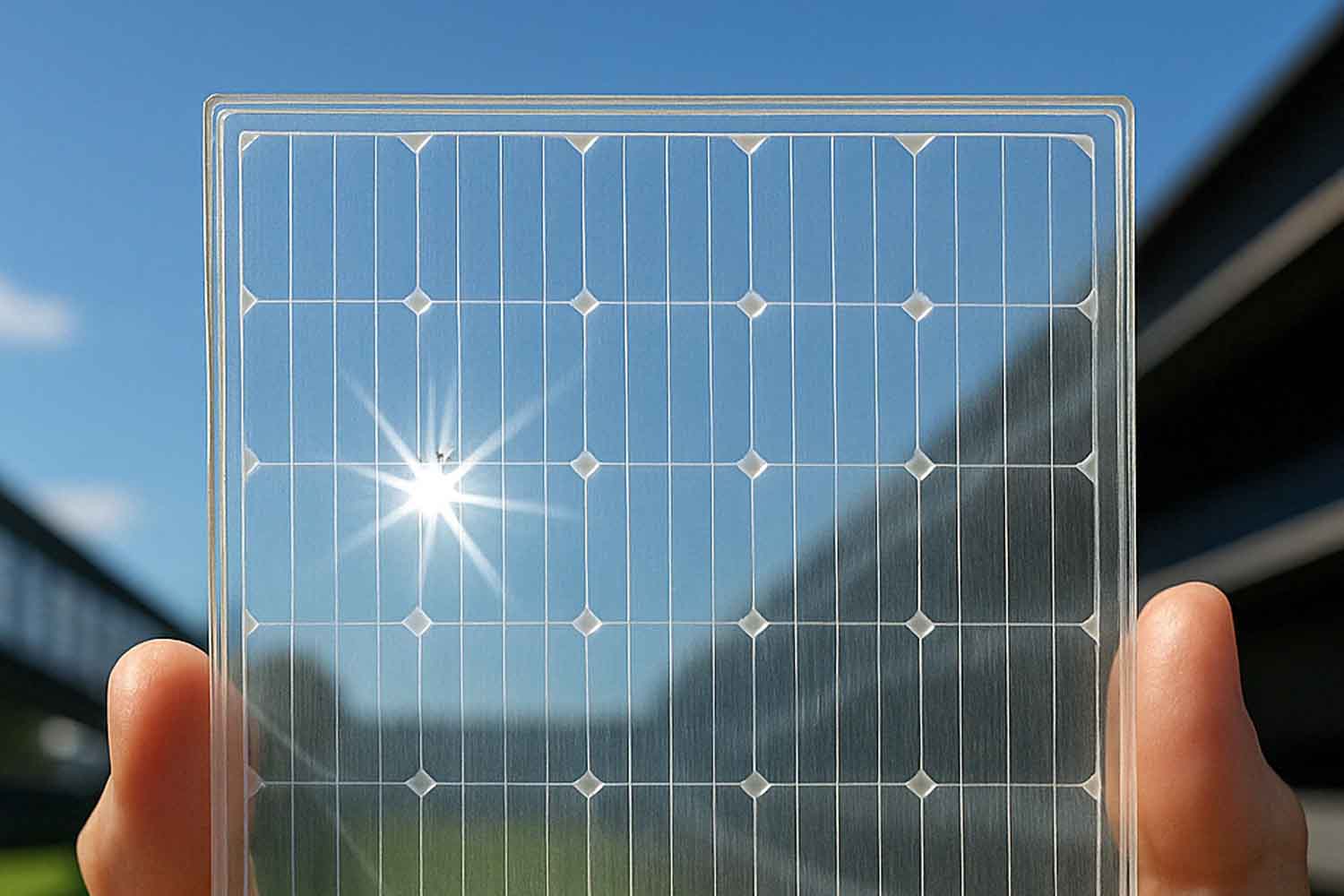
- Amorphous silicon / micro-cells: This is a clever trade-off in shape. Very small silicon cells are laid out in a grid, or cut with lasers, inside the laminated glass. Because they are tiny and evenly spaced, the eye sees only a light smoky film or an even tint. The view stays clear.
- Selective perovskite films: Perovskite is the big breakthrough of third-generation solar tech. It is laid on glass in ultra-thin layers, just a few nanometres thick. Its chemistry can be tuned to catch only the light we cannot see. It is very clear, cheap to make and works well even with soft light, cloudy skies or poor angles.
BOX 2: PHYSICAL FOCUS – The Miracle of the Luminescent Solar Concentrators (LSC)
An LSC panel works like a “light pipe”. Dyes or quantum dots inside the glass absorb UV and IR light. Once a particle of light is absorbed, the molecule gets excited and gives off new light at a longer wavelength.
Glass and air bend light in different ways (glass n = 1.5, air n = 1.0). Because of this, about 75-80% of the new light hits the glass faces at a steep angle (above 41.8°) and cannot escape. So the light stays trapped between the two faces of the glass. It “bounces” until it reaches the window frame. There, tiny, high-yield cells made of gallium arsenide or silicon turn this focused light into power.
Result: The centre of the window stays up to 70% clear to the eye, while the edges quietly make power.
3. The Engineering Tradeoff: Efficiency vs. Transparency
Solar glass follows one basic rule of physics: the clearer it is, the less power it makes. The more visible light passes through, the less energy is left to turn into power.
So it makes no sense to compare clear solar glass with roof panels. A roof panel made of single-crystal silicon reaches 20-22% efficiency, but you cannot see through it. Solar glass aims to strike a balance between the light it lets through (VLT) and the power it makes.
BOX 3: THE TRANSPARENCY NUMBERS – Comparative Table
| Type of Form | Transparency Degree (VLT) | Energy efficiency | Estimated Power for m2 |
| Traditional Roof Module (Single-Crystal Silicone) | 0% (Matt) | 20% – 23% | 200 – 230 W/m² |
| Semi-transparent / Shaded Solar Glass (Amorphous Silicium / Perovskite) | 20% – 35% | 8% – 12% | 80 – 120 W/m² |
| High Transparency Solar Glass / LSC Neutral | 50% – 70% | 2% – 5% | 20 – 50 W/m² |
The law of large numbers
At first, 4% efficiency may seem tiny. But the strength of BIPV lies in how much surface is available:
On an office tower, the roof is often less than 5% of the building’s outer shell. Glass walls, on the other hand, cover tens of thousands of square metres. Covering 10,000 m² of facade with 4%-efficient solar glass gives between 200 and 400 kW of peak power.
There is another bonus. By absorbing infrared light, solar glass keeps the sun’s heat out. This greatly cuts the greenhouse effect inside. In summer, it can cut the energy needed for air conditioning by up to 30%.
The market and the urban impact
Two main needs are driving the move to BIPV: rules and the look of the landscape.
- New rules (the EPBD “Green Homes” Directive): EU directives set strict targets for near-zero emission buildings (ZEBs). In tall buildings, the roof alone is not big enough to supply the required share of renewable energy.
- Solving heritage limits: In Italy’s historic centres and old villages, heritage rules often ban classic black or blue silicon panels. Clear solar tiles, solar terracotta tiles and active windows make power while respecting the medieval or Renaissance look.
- Real-world uses: Besides skyscrapers, the tech works well in ventilated facades, balcony railings, noise barriers and high-tech greenhouses (clear agrivoltaics). In greenhouses, visible light passes through for the plants to grow. Infrared light is turned into power to heat or cool the structure.
BOX 4: CASE STUDY – From Copenhagen Skyscrapers to Italian Historic Centers
- Copenhagen: Landmark projects such as the Copenhagen International School use over 12,000 solar glass panels. They cover more than 50% of the school’s yearly power needs and give the building an even, modern look.
- Italy: Several Italian firms have patented clear resin and solar ceramic roof tiles that hide high-yield cells. These replace the classic terracotta tiles of historic centres. They meet heritage rules and allow the energy shift even on protected roofs.
5. Market Obstacles and Future Horizon
Despite the benefits, clear solar glass still faces some practical hurdles:
- Cost today (ROI): Solar glass costs about 1.8 to 2.5 times more per square metre than top-quality triple-glazed glass. The average payback time is 8 to 12 years, based on the extra cost.
- Installation issues: Different trades must work together. Window fitters and facade builders must work closely with electricians to run cables through the aluminium frames.
- Durability: Classic silicon panels are guaranteed for 25-30 years. Organic LSC coatings and perovskites used to wear out faster because of moisture and UV light. Sealing them inside laminated safety glass has changed this. The latest products now come with guarantees of over 15-20 years.
BOX 5: BUYER’S GUIDE – How Much Does It Really Cost?
- Average material price: 250 to 450 euros/m² (compared to 100 to 180 euros/m² for standard high-performance glass that does not make power).
- Fitting and wiring costs: +20-30% for cables, micro-inverters and hidden channels in the frames.
- In Italy, BIPV work on homes can use the Home Bonus (50%) or the Ecobonus for new windows, on the full cost of the active glazing. Businesses should check whether the Transition 5.0 tax credits and the Nuova Sabatini scheme apply.
6. Conclusion: The Vision
Solar glass will not replace large solar farms on the ground. But it will change architecture for good. Our planet is more and more urban. Cities use energy that causes over 70% of global emissions. So turning the walls of buildings into sources of power is a needed step.
In the future, a building that does not make energy from its own materials will be seen as a basic design mistake.
Insights recommended by INT News
Want to learn more about the green transition, clean tech and energy innovation? Read our other guides:
- For all the news on city energy policies and their impact on built-up areas, read our articles on INT News – Sezione Innovazione e Ambiente.
- Keep up with the latest tech trends and energy market analysis on INT News.
Sources and resources
- Italian Standards Body (UNI): European standard on the mechanical, electrical and building rules for solar systems built into buildings (Building Integrated Photovoltaics). 🔗 Catalogo UNI – Norma UNI EN 50583
- Construction Products Regulation (CPR 305/2011/EU): EU law on safety, fire and stability rules for building glass and glass walls. 🔗 EUR-Lex – Regolamento UE 305/2011
- CEI 0-21 / CEI 0-16 standards: Technical rules for connecting low and medium voltage power plants to the grid. 🔗 Comitato Elettrotecnico Italiano (CEI)
- NREL Interactive Cell Efficiency Chart: The world’s main data hub for up-to-date efficiency records of third-generation solar tech (perovskites, organic cells, LSC). 🔗 NREL Interactive Cell Efficiency Chart
- ENEA: Official guidelines for the energy upgrade of buildings and for adding renewables to historic and protected buildings. 🔗 ENEA – Efficienza Energetica e BIPV
- SUPSI – BIPV Status Report (Swiss BIPV Competence Centre): Europe’s leading research centre and database on the performance, durability and case studies of solar facades and glass. 🔗 SUPSI BIPV Competence Centre Portal
- GSE (Gestore dei Servizi Energetici S.p.A.): The Italian body that manages shared self-consumption, the Dedicated Withdrawal scheme (RID) and access to Renewable Energy Communities (CER). 🔗 GSE – Servizi per il Fotovoltaico e CER
- Agenzia delle Entrate – Tax portal and guide to incentives: Rules for the 50% Home Bonus (Art. 16-bis TUIR), the Ecobonus and reduced VAT rates (4% and 10%) for active windows and roofs. 🔗 Agenzia delle Entrate – Guida alle Agevolazioni Edilizie
- EU Directive 2024/1275 (EPBD – Energy Performance of Buildings Directive / “Green Homes Directive”): The EU law that requires renewables to be built into building shells, to bring the emissions of the building stock to zero. 🔗 EUR-Lex – Direttiva EPBD (UE) 2024/1275