

In summary
- The Combo product: not a prototype but an already commercial device, made by Shenzhen Shanyi Technologies, capable of moving a car in as little as 15 seconds.
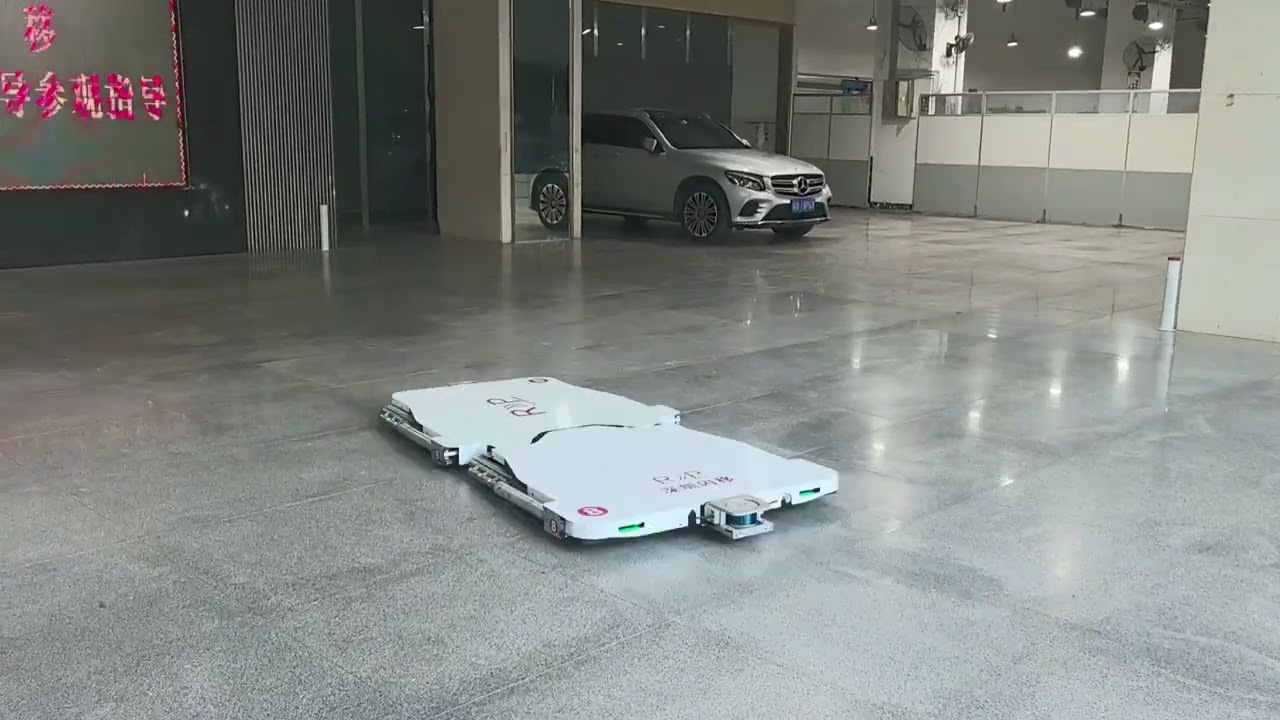
- The lifting mechanism: a robotic platform slides under the vehicle and lifts it hydraulically by gripping the wheels, without any contact with the bodywork.
- Omnidirectional movement capability: the robot can move the car forward, backward, sideways, and even rotate it 360 degrees on the spot.
- Applications beyond illegal parking: the same technology is already used in highway roadside assistance, automaker yards, and automated AGV parking systems.
- The broader Chinese context: authorities are investing heavily in traffic robotics — in Hong Kong, police are preparing dedicated robots for parking fines, after 3.3 million illegal-parking tickets in one year (+20% since 2020).
- A journalistic limitation worth noting: coverage of this specific technology comes mainly from trade press, without confirmation from top-tier international news agencies or official statements from Chinese police.
A local manufacturer, Shenzhen Shanyi Technologies, has developed a robotic platform capable of sliding under a vehicle, lifting it, and repositioning it within seconds. The system is part of a broader strategy by Chinese authorities to automate urban traffic management.
The product and who makes it
The device at the center of this story is called Combo, produced by Shenzhen Shanyi Technologies, a company based in Shenzhen specializing in vehicle transport technology and automated parking systems. On its official website, the company describes Combo as a machine capable of moving a car in as little as 15 seconds, available in both remote-controlled and fully automated versions. The company’s catalog also includes a second model, Turbo, configurable in either manual or autonomous mode. Shanyitechs
This is therefore not an isolated experimental prototype, but a commercial product already deployed — according to the manufacturer — in contexts ranging from highway roadside assistance (a cited case in Wenzhou) to vehicle handling in automaker yards, and even AGV-based automated parking in Nanjing.
How the lifting mechanism works
Trade outlets that documented the system in action — autoevolution, which describes a wheeled platform equipped with a hydraulic system that slides under the vehicle, expands, grips the wheels, and lifts the car off the ground, moving it under the guidance of an officer with minimal human intervention — agree on a four-step sequence: identifying the vehicle, inserting the platform, hydraulic lifting, and repositioning. The unit can move forward, backward, sideways, and even rotate 360 degrees if necessary.
The bigger picture: China and traffic robotics
The valet-robot case fits into a broader trend also documented by tier-1 sources. In Hong Kong, the South China Morning Post reported that police are preparing to deploy an “Intelligence Traffic Enforcement Robot” designed by officers from the Hong Kong Island traffic unit to book motorists who ignore road markings and stop illegally, in response to a volume of illegal-parking fines that rose to about 3.3 million tickets in the past year, up more than a fifth from about 2.7 million in 2020.
In Shenzhen too, local government sources confirm a structural investment in this direction, albeit with devices different from Combo: Shenzhen’s traffic police recently set up an integrated task force — drones, driverless vehicles, wheeled robots, and quadruped robots — for large-scale surveillance and deterrence of illegal parking, including “nest” drones capable of autonomous takeoff and patrolling preset routes.
Why it beats the tow truck
The economic and logistical advantage is widely emphasized by trade press: the process reportedly takes a few minutes instead of up to an hour, without blocking the street during hookup and without the risk of bodywork damage typical of chains or mechanical arms. Chinese authorities also frame the intervention not as a punishment but as assistance to the driver: the vehicle is simply repositioned, and only afterward does the fine arrive.
Limits of the available information
It’s worth noting that media coverage of this specific technology (Combo) has so far come mainly from automotive trade outlets and social media channels, not from top-tier international news agencies. It was not possible to find direct confirmation from Chinese police of Combo’s operational, systematic adoption for removing illegally parked vehicles: the only verifiable primary source remains the manufacturer itself. A more solid picture would require independent on-the-ground reporting or an official statement from local public security authorities.