
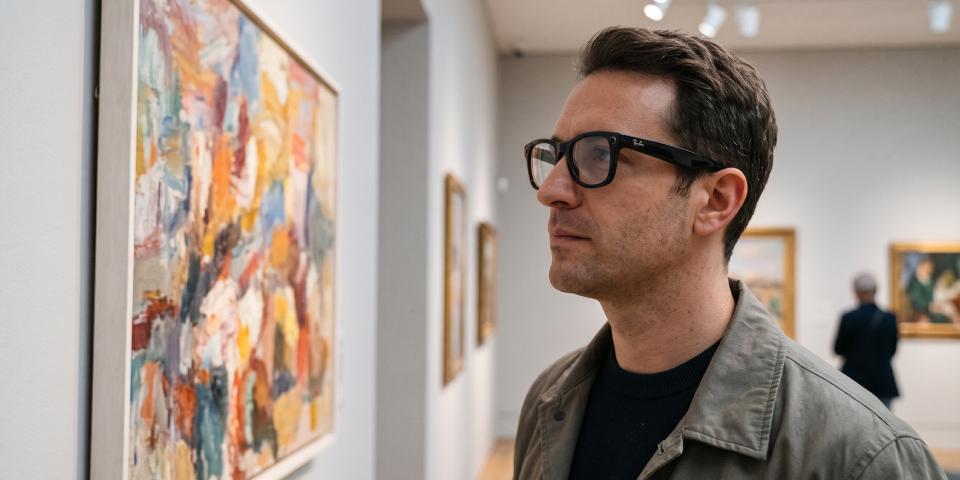
Sensing Art is a pilot at Milan’s Pinacoteca di Brera where Ray-Ban Meta glasses recognise eight paintings and play a human-written description.
The project launched on 13 October 2026. It is run by Meta, EssilorLuxottica and the museum, with Italy’s National Association for the Partially Sighted (ANS), the Italian Union of the Blind and Partially Sighted (UICI) and Milan’s Institute for the Blind Foundation. Brera lends 10 pairs of glasses free of charge, by booking, Tuesday to Friday.
Some coverage framed them as glasses that let blind people see art. They don’t. The more interesting story is where the value actually sits: the AI identifies the painting, but everything the visitor hears about it was written, tested and certified by people over a decade. For museums elsewhere weighing a similar move, that is the part worth copying.
How do the AI glasses at Brera work?
Visitors collect a pair of Ray-Ban Meta glasses and a paired smartphone running the museum’s Grande Brera app from the information desk. Standing in front of one of the eight works, they trigger recognition from the frame; the front camera identifies the painting and the matching audio track starts through open-ear speakers in the arms, so the room and any companion stay audible.
Each painting has three tracks: a detailed visual description, an art-historical commentary and the artist’s biography. Short audio cues guide the visitor from one work to the next. The glasses’ standard features remain available: spoken questions to Meta AI about the surroundings, and a hands-free call to a sighted Be My Eyes volunteer who sees through the camera.
The practical gain is free hands. Before, Brera offered the same descriptions through a phone and headphones along a fixed route. Meta’s global head of accessibility, Maxine Williams, told Il Sole 24 Ore that blind visitors often have one hand on a cane or a guide dog, so removing the phone from the other changes how they move through a gallery.
For the hardware itself, see our guide to smart glasses in 2026.
Who writes what: human content versus AI output
| Feature | Source of the content | Reliability |
| Visual description of the painting | Brera’s education team with ANS, DescriVedendo method | Fixed text, checked by volunteer validators before certification |
| Art history and biography | Brera’s education team with ANS | Fixed text |
| Wayfinding between works | Audio cues built into the route | Fixed, limited to the route |
| Recognising the painting | The glasses’ AI | Automatic; no accuracy figures published |
| Open questions about the room | Meta AI, generated live | Can be wrong, as Meta itself acknowledges |
| Remote assistance | Be My Eyes volunteers | Human, live |
Do the glasses let blind people see the paintings?
No. They turn an image into words, not into sight. DescriVedendo, a method devised by Marco Boneschi and promoted by ANS, puts each description through several drafts reviewed by volunteer validators, and certifies it only once it meets set standards of precision and clarity. ANS director Rosa Garofalo described the aim as building a coherent mental image of the work.
Vision-restoring technology does exist, in a different category. Science Corporation’s PRIMA retinal implant, which gained a CE mark and began its European roll-out in 2026, restores partial central vision to adults with geographic atrophy caused by age-related macular degeneration. It requires surgery and a specific diagnosis.
Information on medical devices is provided for general interest and is not medical advice.
How is Brera different from other smart-glasses accessibility programmes?
| Smithsonian, Washington (2019) | Meta donations (2026) | Brera Sensing Art (2026) | |
| What the visitor gets | Free calls to a remote human agent (Aira) via phone or glasses | A personal pair of Ray-Ban Meta glasses | Loaned glasses linked to a museum route |
| Who describes the art | A remote agent, live | Meta AI, generated live | Fixed texts written and validated by the museum and ANS |
| Scale | All Smithsonian museums in Washington and the National Zoo | About 130,000 eligible US blind veterans (per Meta); 15,000 pairs for Vision Ireland | 10 pairs, 8 paintings |
| Cost to the user | Free inside the museums | Free for eligible recipients | Free loan, by booking |
The donation programmes put a general-purpose assistant on people’s faces. Brera puts curated, verified content behind a familiar device. The two are complementary: a visitor who already owns the glasses gets something at Brera that the AI alone would not give them, namely a description someone has checked.
What are the limits of the pilot?
- Italian only, for now. Brera says the content is in Italian and an English version is coming. Blind or partially sighted visitors from abroad cannot use the route yet.
- Small scale. Ten pairs, eight works, four days a week from 10:00 to 16:30, booked by email.
- Imperfect AI, by Meta’s own account. Williams told Il Sole 24 Ore that accuracy, response time and battery life have improved but are not where users want them, and that the glasses add to a cane or guide dog rather than replacing them.
- Privacy in the gallery. The glasses carry a camera that also captures other visitors. Meta signals recording with an LED and, according to Engadget, has pledged to disable cameras on glasses whose LED has been tampered with. The launch materials we reviewed do not explain how images captured during painting recognition are handled.
- No public success metrics. Brera calls the project a first step to be refined with user feedback, without stating how results will be measured.
Why does this matter beyond Milan?
The World Health Organization estimates that 1.3 billion people, about 16% of the world’s population, live with a significant disability, and its 2019 World Report on Vision put the number of people with near or distance vision impairment at no fewer than 2.2 billion. In Italy, ANS puts the number of people with visual disabilities above one million; the country has no recent official count.
Italy has also been spending on museum access. Its recovery plan allocated €300 million to removing physical, cognitive and sensory barriers in museums, libraries and archives; according to figures reported by Avvenire in July 2026, the programme funded 1,128 projects across 797 cultural sites. Brera’s pilot runs on a different, lighter model: donated hardware, sponsor-funded descriptions and an association’s method. Because it relies on donated hardware rather than public funds, it is easier to replicate elsewhere, provided museums write and validate the descriptions first.
How do you book the glasses at Brera?
Email educazione@pinacotecadibrera.org with the day, time and any logistical support needed. Glasses are available Tuesday to Friday, 10:00 to 16:30, and are collected at the museum’s information point. The loan is free; normal admission rules apply.
Frequently asked questions
Do the Brera glasses restore sight?
No. They recognise the painting in front of the wearer and play an audio description written by the museum’s education team with the National Association for the Partially Sighted.
Is the Brera route available in English?
Not yet. The museum says the content is currently in Italian and an English version is planned.
Which paintings are included?
Eight: Mantegna’s Lamentation over the Dead Christ, Tintoretto’s Finding of the Body of Saint Mark, Piero della Francesca’s Montefeltro Altarpiece, Raphael’s Marriage of the Virgin, Caravaggio’s Supper at Emmaus, Annibale Carracci’s Christ and the Samaritan Woman at the Well, Giacomo Ceruti’s Porter and Francesco Hayez’s The Kiss.
Do I need my own Ray-Ban Meta glasses?
No. The museum lends 10 pairs with a paired smartphone, donated by EssilorLuxottica. Brera has not said whether visitors can use their own glasses; ask when booking.
How much does it cost?
The loan is free and must be booked in advance. Standard museum admission rules apply.
Sources
- Pinacoteca di Brera, “DescriVedendo Brera” page, updated 13 October 2026
- Il Sole 24 Ore, Luca Salvioli’s interview with Maxine Williams (Meta), 13 October 2026
- ANSA, 13 October 2026
- Finestre sull’Arte, 13 October 2026
- Panorama, Mark Perna, 13 October 2026
- Meta Newsroom, 15,000 glasses for Vision Ireland, August 2026
- Engadget, Meta’s Vision Ireland donation and LED policy, August 2026
- WVUE Fox 8, blind veterans at the National WWII Museum, 13 July 2026
- Deseret News, Meta’s programme for US blind veterans, 7 July 2026
- Smithsonian / G3ict, Aira at Smithsonian museums, 7 March 2019
- MobiHealthNews, PRIMA European launch after CE marking, 2026
- World Health Organization, Disability fact sheet (2023) and World Report on Vision (2019)
- Avvenire, Italian museums and accessibility funding, 12 July 2026