
For over a century, the “poker face” has been the last line of defence for professional players. It means suppressing every involuntary body signal that could reveal the strength of a hand. This year, for the first time, that defence has met a new kind of opponent: AI in poker, a system built to read it frame by frame. The World Series of Poker (WSOP) returned to ESPN after its absence since 2021. Peyton Manning’s Omaha Productions integrated a computer vision model into the broadcast. It was built by independent AI engineer Luke Geel, who also develops AI systems for the U.S. Air Force.
What the AI in poker system actually does
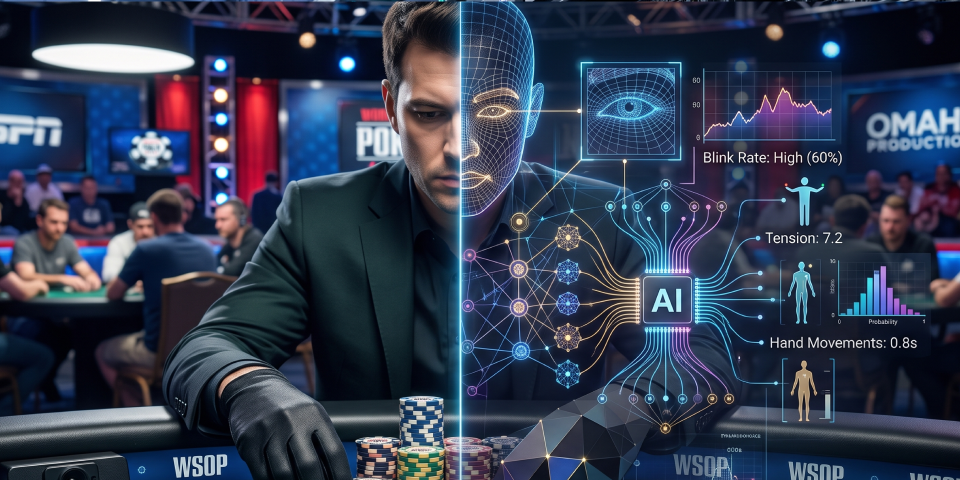
The model doesn’t look at players’ hole cards. Poker broadcasts already show those to viewers through the hole card cam. Instead, the system analyzes a set of behavioral signals extracted in real time from the video feed: blink rate, eye gaze direction, body posture, and the way a player handles chips. In addition, Geel added smile-symmetry analysis. According to the engineer, a symmetric smile usually signals a more genuine expression.
The system works in two distinct phases:
- Training phase: the team trained the system on a large archive of historical poker footage. They correlated the visual signals detected with the actual outcomes of each hand, meaning the cards players really held once revealed.
- Inference phase: during the live broadcast, the model compares behavioral patterns observed in real time with the ones it learned. From that comparison, it estimates the probability that a player is bluffing or holding a strong combination (the “nuts,” in poker slang).
The engineering challenges behind it
Geel said the project, built over roughly six months, turned out far more complex than expected. In fact, feeding the system raw footage and getting player “tells” as output wasn’t enough. The main difficulty lies in how noisy and individual behavioral signals are. Every player has their own body language, which many have trained deliberately to deceive opponents. As a result, generalizing the model becomes a much harder problem than a typical computer vision recognition task.
Geel himself admits the system’s limits against elite players. Top professionals spend years eliminating any recognizable physical tell. One example is professional player Daniel Negreanu. The engineer said he hasn’t tested the model on him yet, because he expects Negreanu to have deliberately suppressed these kinds of signals.
A cautious deployment: keeping AI away from live play
One technically important part of the solution has nothing to do with the algorithm itself. Rather, it’s about how it’s integrated into the broadcast. Omaha Productions chose to activate the system only for players who have already been eliminated from the tournament. This avoids letting the model’s predictions influence the game: showing this information to viewers during an active hand would create a real risk. Therefore, this design choice turns the AI from a live predictive tool into a narrative, post-hoc analysis tool. It reduces the risk of interfering with competitive dynamics, but it also reduces the system’s immediate informational value.
Criticism from the poker community
Not everyone in the poker world has welcomed the innovation. Part of the community calls the tool a solution to a problem that doesn’t really exist. Broadcasts already show each player’s hole cards through the hole card cam. For many viewers, an extra layer of probabilistic prediction feels redundant. Critics also raise another point: at high-stakes tables, math and board composition have historically mattered far more than behavioral tells. Physical signals, moreover, can be misleading. Experienced players often fake them on purpose.
Not just poker: ESPN’s second AI front
Geel’s project isn’t the only AI investment ESPN is pursuing right now. It’s worth distinguishing it from a separate, quite different initiative built together with Accenture.
The Accenture-ESPN Edge project
ESPN launched the ESPN Edge Innovation Center in 2021, an innovation hub built with Accenture and Microsoft. Through this center, the network developed a generative AI solution. Unlike Geel’s model, this one doesn’t analyze player behavior at all. Its job is to automatically produce editorial content. Readers interested in the hardware side of these systems may also want our deep dive on why Zuckerberg’s AI chip move signals a structural problem in the AI market.
How the content generation works
The system generates written game recaps. It draws on a combined dataset that includes proprietary ESPN data and league-licensed data: box scores, play-by-play stats, rosters, standings, schedules and, where available, audio transcripts. The stated goal is to extend editorial coverage to sports that get less mainstream media attention, such as the Premier Lacrosse League and the National Women’s Soccer League. The system makes this possible without a proportional increase in editorial staff.
The role of human review
One technically significant piece of the system is its governance model. AI-generated content isn’t published automatically. It first goes through human editorial review before appearing on ESPN.com and the ESPN app. This is a classic “human-in-the-loop” pattern, now well established in journalistic uses of generative AI. The model scales content production, but final editorial responsibility stays human.
Two approaches compared
Side by side, the two projects show complementary but quite different applications of AI in sports broadcasting. On one side, Geel applies predictive computer vision to live analysis. On the other, the Accenture project applies generative natural language to large-scale editorial content production. In both cases, one thing stays constant: caution in deployment. The first limits use to eliminated players. The second requires mandatory editorial review. It’s a clear signal: major sports broadcasters are introducing generative and predictive AI without giving up editorial control of the final product.
What’s next: beyond the felt table
According to Geel, the poker application is only a first test case. He envisions the same predictive computer vision approach applied to other settings where non-verbal behavior anticipates a decision. One example is analyzing customers at car dealerships, to understand which vehicle features generate the most interest. Another comes from sports: researchers have already tested predictive models based on body signals to estimate, in advance, which direction a penalty taker will shoot. In some studies, these models outperform professional goalkeepers’ instincts.
The ESPN-WSOP case remains an interesting test bed for the broadcast industry. It shows how AI in poker, and computer vision applied to behavioral analysis more broadly, is moving out of research labs. It’s entering mainstream sports television production, carefully and not without controversy. The same computer-vision logic applied to real-world settings also underlies other projects we’ve covered, such as Circus SE’s CA-1 autonomous robotic kitchen system. To keep up with these topics, follow the Technology section of INT News.