
Transparent photovoltaics is transforming the building envelope from a simple passive barrier to a fully-fledged distributed power plant. Overcoming historical skepticism thanks to innovations in Luminescent Solar Concentrators (LSCs), perovskite cells and micro-silicon matrices, BIPV (Building Integrated Photovoltaics) technology today allows the conversion of imposing glass facades of skyscrapers and residential windows and doors into clean energy generators, without compromising the light transmission or aesthetic impact of buildings.
Introduction: The transparency paradox
For years, the idea of a perfectly transparent window capable of generating electricity has been branded by the general public as a technological hoax or a blatant violation of the fundamental laws of optics. Readers’ common doubt arises from a seemingly unassailable conceptual short circuit: if light passes through the window to illuminate the room, how does glass retain the energy needed to generate current?
Traditional solar panels use direct absorption of visible radiation to release electrons. Logica would like a completely transparent material to let photons pass through without converting them.
However, scientific and industrial reality defines a markedly different picture: photovoltaic glass technology is real, widely regulated, and booming commercially.
The real turning point lies in the paradigm shift: the transition from the solar panel understood as “roof-added object” (BAPV) to a true intrinsically energetic building material (BIPV). We are no longer talking about mounting heavy modules on external brackets, but about manufacturing structural glazing, curtain walls, skylights and tiles that simultaneously perform the function of thermal insulation, protection from the elements and clean energy production.
BOX 1: TECH DICTIONARY – What is BIPV?
- BIPV (Building Integrated Photovoltaics): A set of building envelope components (glass, facades, roofs, cladding) that integrate solar cells and perform a dual function: structural/aesthetic building material and power generator.
- Conceptual difference from BAPV (Building Applied Photovoltaics): BAPV concerns classic solar modules mechanically anchored to existing structures (e.g. roof panels). Removing a BAPV module does not compromise the integrity of the property; removing a BIPV element deprives the building of a wall, window, or piece of roofing.
The Science Behind Glass: How Does It Work?
To overcome the limit of visual transparency, materials engineering exploits a fundamental feature of solar radiation: the human eye sees only a narrow fraction of the electromagnetic spectrum.
Visible light accounts for about 43% of total solar energy (wavelengths between 380 nm and 750 nm). The remaining 57% is composed of invisible radiation: the ultraviolet (UV, ~7%) and infrared (IR, ~50%) spectra. Selective photovoltaic glasses allow them to cross the visible band (ensuring brightness and optical transparency) and selectively absorb or deflect UV and IR photons.
The three dominant technological architectures on the market are:
- The three technological architecturesLuminescent Solar Concentrators (LSC): The glass or polymer plate is treated with fluorophores, organic molecules or quantum dots (quantum dots). These substances absorb UV and IR light and re-emit it at a different wavelength. The re-emitted light remains trapped inside the glass by total internal reflection and is guided towards the perimeter edges of the window, where tiny strips of high-efficiency photovoltaic cells convert it into current. The dominant ones on the market are:
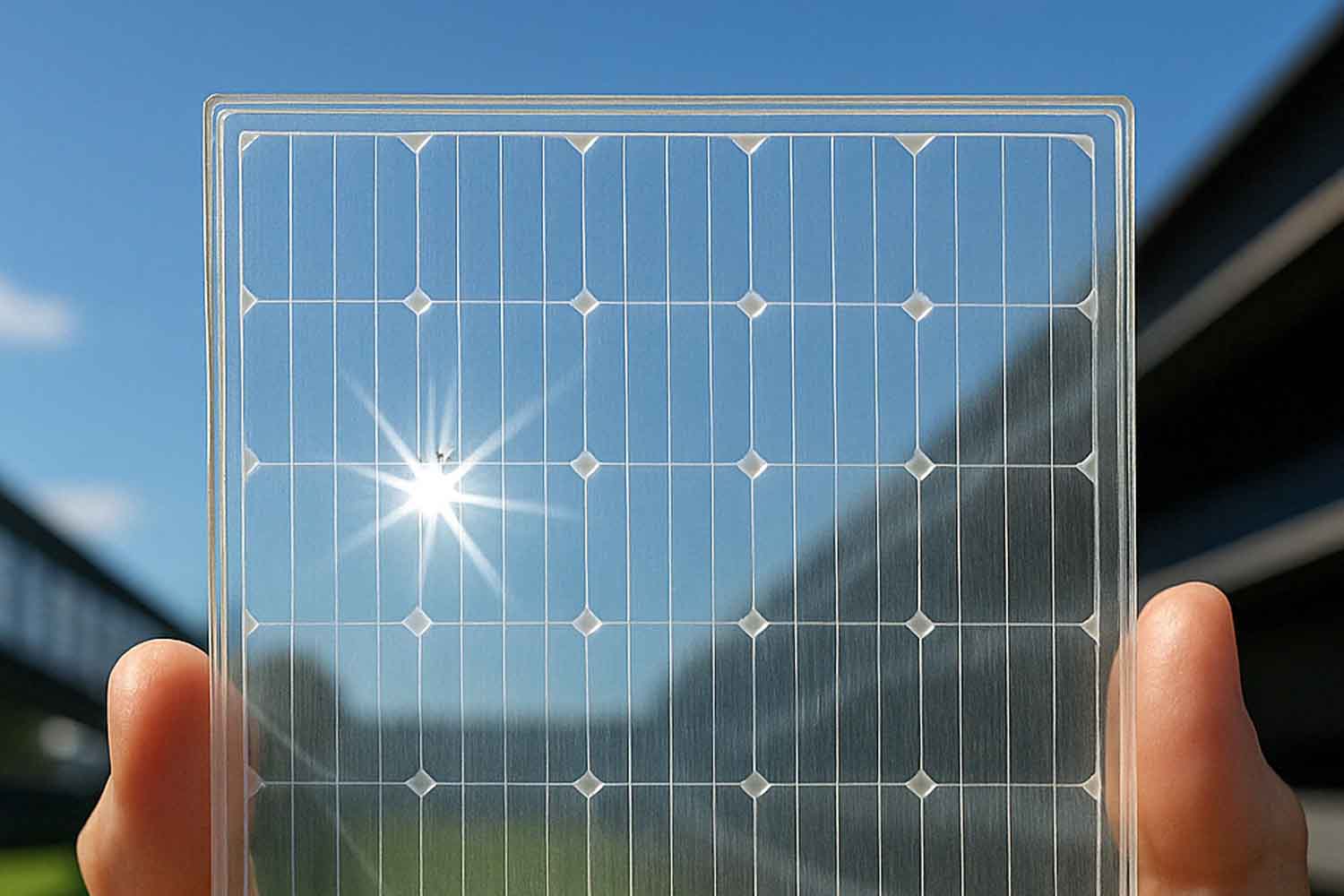
- Silicio amorfo / Micro-celle: This is a geometric compromise. Very small monocrystalline or amorphous silicon cells are arranged in a grid pattern or laser perforated inside the laminated glass. Being microscopic and evenly spaced, the human eye perceives the whole as a light smoky film or homogeneous transparency, maintaining excellent global visibility.
- Pellicole a Perovskite Selettiva: Perovskite represents the true revolution of third-generation photovoltaics. Applied in ultra-thin layers (on the order of nanometers) on glass, it can be chemically tuned to capture only invisible frequencies. It offers high transparency, low production costs and excellent yield even in the presence of diffused light, overcast skies or unfavorable angles of incidence.
BOX 2: PHYSICAL FOCUS – The Miracle of the Luminescent Solar Concentrators (LSC)
An LSC module functions as a true “optical waveguide”. Chromophores or quantum dots embedded in the substrate absorb UV and IR photons. Once the photon is absorbed, the molecule becomes excited and re-emits it at a longer wavelength.
Due to the difference between the refractive index of glass (n = 1.5) and that of air (n = 1.0), approximately 75-80% of the re-emitted light exceeds the total critical internal reflection angle (>41.8°). Photons thus remain confined within the two faces of the glass, “bouncing” until they reach the window frames, where tiny, highly efficient gallium arsenide or silicon cells transform the concentration of light into electricity.
Result: The central surface of the window remains up to 70% transparent to the human eye, while the perimeter produces energy invisibly.
3. The Engineering Tradeoff: Efficiency vs. Transparency
In the photovoltaic glass sector, there is a fundamental physical rule: transparency and energy efficiency are inversely proportional quantities. The more visible light passes through the material, the less energy is available for photovoltaic conversion.
Comparing transparent photovoltaics with traditional roof modules is a conceptual error. A monocrystalline roof panel achieves an efficiency of 20-22%, but is completely opaque. Transparent photovoltaic glass instead aims to balance visible light transmission (VLT) with electrical output.
BOX 3: THE TRANSPARENCY NUMBERS – Comparative Table
| Type of Form | Transparency Degree (VLT) | Energy efficiency | Estimated Power for m2 |
| Traditional Roof Module (Single-Crystal Silicone) | 0% (Matt) | 20% – 23% | 200 – 230 W/m² |
| Semi-transparent / Shaded Solar Glass (Amorphous Silicium / Perovskite) | 20% – 35% | 8% – 12% | 80 – 120 W/m² |
| High Transparency Solar Glass / LSC Neutral | 50% – 70% | 2% – 5% | 20 – 50 W/m² |
The law of large numbers
At first glance, a 4% efficiency might seem irrelevant. However, the strength of the BIPV lies in the total surface area available:
In an executive skyscraper, the roof often represents less than 5% of the building’s envelope, while glass curtain walls cover tens of thousands of square meters. Covering 10,000 m² of facade with solar glass at 4% efficiency generates between 200 and 400 kW of peak power.
Furthermore, by absorbing infrared (IR) radiation, photovoltaic glass blocks the entry of solar heat. This dramatically reduces the greenhouse effect indoors and reduces the energy requirements of air conditioning systems by up to 30% in the summer months.
The market and the urban impact
The push towards BIPV materials is driven by specific regulatory and landscape needs:
- Regulatory pushes (EPBD “Case Green” Directive): European directives impose stringent requirements on buildings with near-zero emissions (ZEBs). In multi-storey properties, the roof area alone is not enough to guarantee the mandatory share of renewable energy.
- Resolving architectural constraints: In historic centers and Italian villages, the Superintendency’s constraints often prohibit the use of traditional black or blue silicon solar panels. The use of transparent solar tiles or photovoltaic terracotta tiles and active windows allows for energy production while respecting medieval or Renaissance aesthetic constraints.
- Real-world use cases: In addition to skyscrapers, the technology is successfully applied in ventilated facades, balcony parapets, acoustic barriers, and high-tech (transparent agrivoltaic) agricultural greenhouses, where visible light passes unchanged for photosynthesis, while IRs are converted into current to air-condition the structure.
BOX 4: CASE STUDY – From Copenhagen Skyscrapers to Italian Historic Centers
- Copenhagen: Iconic projects such as Copenhagen International School use over 12,000 panels of integrated solar glass to cover more than 50% of the facility’s annual electricity needs with a uniform, modern visual impact.
- Italy: Several Italian manufacturing companies have patented transparent polymer resin and photovoltaic ceramic cups that camouflage high-yield cells. These elements replace the traditional terracotta tiles of historic centers, overcoming landscape constraints and allowing the energy transition even on tethered roofs.
5. Market Obstacles and Future Horizon
Despite the advantages, the widespread diffusion of transparent photovoltaics faces some operational challenges:
- Current Costs (ROI): The cost per square meter of photovoltaic glass is approximately 1.8–2.5 times higher than a conventional high-end triple insulating glass. The average Return on Investment (ROI) is between 8 and 12 years, calculated on the differential marginal cost.
- Installation problems: Installation requires collaboration between different professional figures: window and door installers and face builders must work closely with electricians to manage pop-up wiring in aluminum profiles.
- Durability: Compared to the 25-30 years guaranteed by traditional silicon, organic LSC coatings and perovskites previously suffered from accelerated degradation caused by moisture and UV radiation. The use of security laminated glass encapsulation (laminated glass) has brought the commercial guarantees of the latest generation products to over 15-20 years.
BOX 5: BUYER’S GUIDE – How Much Does It Really Cost?
- Average material price: 250 – 450 euros/m² (compared to 100 – 180 euros/m² for a non-active performance camera glass).
- Laying and integration costs: +20-30% for dedicated wiring, micro-inverters and retractable channels in the frames.
- In Italy, residential BIPV interventions benefit from the Home Bonus (50%) or the Ecobonus for replacing window frames, applicable over the entire cost of active tightening. Are the Transition 5.0 tax credits and the Nuova Sabatini.osta really active for businesses?
6. Conclusion: The Vision
Photovoltaic glass will not replace large solar farms on the ground, but will change the concept of architecture forever. In an increasingly urbanized planet, where urban energy consumption accounts for over 70% of global emissions, transforming vertical building surfaces into active sources of generation is a necessary step.
In the future, designing a building that does not generate energy from its own materials will be considered an inconceivable design error.
Insights recommended by INT News
If you’d like to expand your analysis on the latest developments in ecological transition, sustainable technology, and energy innovation, check out the editorial staff’s other guides:
- To find out all the news on urban energy policies and the impact on built-up areas, read our articles on INT News – Sezione Innovazione e Ambiente.
- Stay up to date on the latest technology trends and energy market analyses by visiting INT News.
Fonti e risorse
- Ente Italiano di Normazione (UNI):Standard normativo europeo sui requisiti meccanici, elettrici ed edili per i sistemi fotovoltaici integrati negli edifici (Building Integrated Photovoltaics). 🔗 Catalogo UNI – Norma UNI EN 50583
- Regolamento Prodotti da Costruzione (CPR 305/2011/UE):Quadro legislativo dell’Unione Europea relativo ai requisiti di sicurezza, reazione al fuoco e stabilità per i vetri da costruzione e facciate continue. 🔗 EUR-Lex – Regolamento UE 305/2011
- Norme CEI 0-21 / CEI 0-16:Regole tecniche di connessione degli impianti di generazione di Bassa e Media Tensione alla rete elettrica di distribuzione. 🔗 Comitato Elettrotecnico Italiano (CEI)
- NREL Interactive Cell Efficiency Chart:Data-hub mondiale di riferimento per i record d’efficienza aggiornati delle tecnologie fotovoltaiche di 3ª generazione (Perovskiti, celle organiche, LSC). 🔗 NREL Interactive Cell Efficiency Chart
- ENEA:Linee guida ufficiali per la riqualificazione energetica degli edifici e l’integrazione delle rinnovabili nel patrimonio storico e vincolato. 🔗 ENEA – Efficienza Energetica e BIPV
- SUPSI – BIPV Status Report (Swiss BIPV Competence Centre):Il principale centro di ricerca e database europeo dedicato al monitoraggio delle prestazioni, durabilità e casi studio su facciate e vetri fotovoltaici. 🔗 SUPSI BIPV Competence Centre Portal
- GSE (Gestore dei Servizi Energetici S.p.A.):Ente regolatore italiano per la gestione dell’Autoconsumo Collettivo, Ritiro Dedicato (RID) e portale d’accesso alle Comunità Energetiche Rinnovabili (CER). 🔗 GSE – Servizi per il Fotovoltaico e CER
- Agenzia delle Entrate – Portale Fiscale e Guida alle Agevolazioni:Documentazione sui requisiti d’accesso al Bonus Casa 50% (Art. 16-bis TUIR), Ecobonus e aliquote IVA agevolata (4% e 10%) per serramenti e coperture attive. 🔗 Agenzia delle Entrate – Guida alle Agevolazioni Edilizie
- Direttiva UE 2024/1275 (EPBD – Energy Performance of Buildings Directive / “Direttiva Case Green”):Il testo europeo che stabilisce gli obblighi di integrazione delle fonti rinnovabili negli involucri edilizi per azzerare le emissioni del parco immobiliare. 🔗 EUR-Lex – Direttiva EPBD (UE) 2024/1275