

Key Takeaways
- Scenario: The ubiquity of microplastics in municipal water grids demands highly efficient, low-energy Point-of-Use (PoU) filtration solutions.
- Business Impact: Implementing magnetic separation methods minimizes operational maintenance, unlocking competitive advantages for water-tech manufacturers.
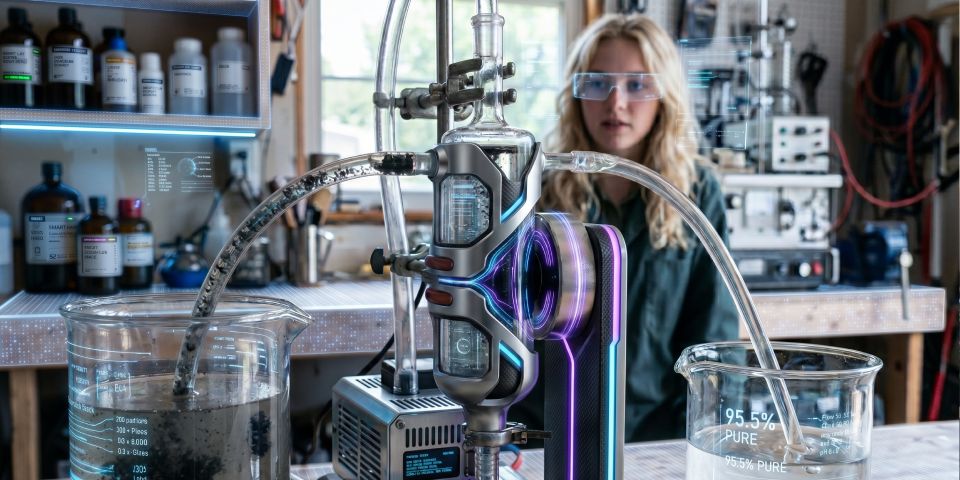
- Data Point: The prototype engineered by 18-year-old Mia Heller achieves a 95.5% microplastic removal rate utilizing a reusable ferrofluid matrix.
The Technology: Magnetic Separation Applied to Microplastics
The validation of novel methodologies for polymer contaminant mitigation has reached a critical milestone via Mia Heller’s research. Presented at the Regeneron International Science and Engineering Fair, this system diverges from conventional membrane-based separation. Consequently, the mechanism does not rely on mechanical retention but leverages the physiochemical attributes of a colloidal magnetic fluid.
This approach targets the polarization of suspended particles. Furthermore, injecting the ferrofluid into the aqueous solution facilitates selective bonding with the microplastics. Through the deployment of a targeted magnetic field, the entire contaminated cluster is sequestered from the water flow. Therefore, the architecture allows for continuous purification without hydraulic pressure drops, which remain a major flaw in osmosis systems. The integration of these vectors marks a pivotal shift within Trattamento acque industriali.
Operational Efficiency and Reusability of the Colloidal Framework
The core competitive advantage of this technology lies in the lifecycle sustainability of the media. Unlike saturated carbon-block filters that require frequent replacement and disposal, the magnetic liquid can be decoupled from the extracted microplastics and recycled.
Moreover, preliminary trials demonstrate that the 95.5% retention rate remains consistent across multiple filtration iterations. This operational capability drastically lowers the OPEX linked to residential maintenance. Consequently, adopting this architecture within distribution nodes optimizes overall plant throughput, positioning itself as an emerging benchmark in Nanotecnologie ambientali.
B2B Market Impact and Transition toward Point-of-Use (PoU)
The scalability of this design into Point-of-Use (PoU) commercial applications, such as under-sink residential units, alters the supply chain dynamics of water purification. Home appliance manufacturers must monitor the advancement of this technology to prevent product obsolescence.
However, industrial-scale engineering will necessitate the optimization of permanent magnets to ensure zero ferrous residue in the effluent stream. Overcoming this technical hurdle will enable the production of compact, cost-effective, high-yield devices compliant with forthcoming global regulatory mandates.