
Key Takeaways
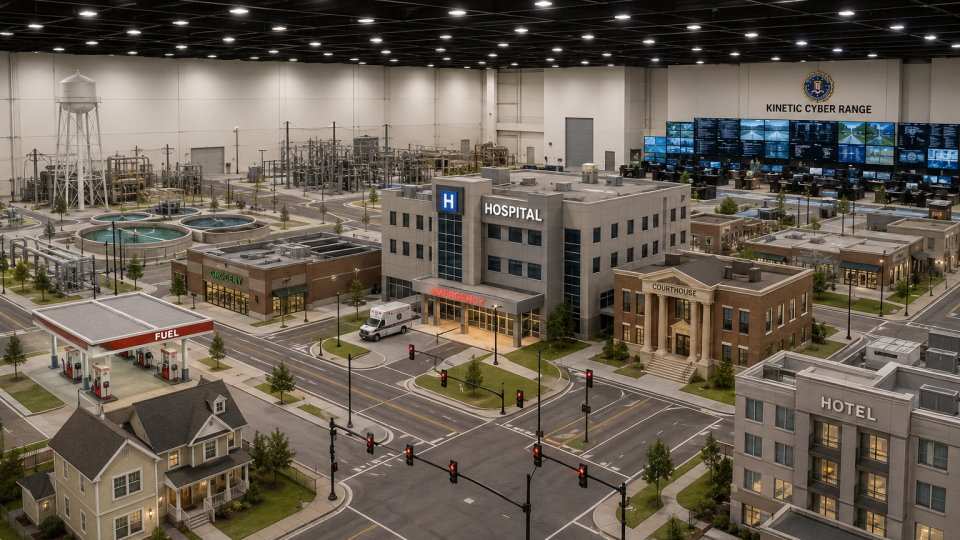
- Scenario: The FBI has unveiled the Kinetic Cyber Range at its Huntsville, Alabama campus, a 22,000-square-foot physical replica of an American town designed to simulate cyberattacks on critical infrastructure.
- Business Impact: The convergence of IT networks and Operational Technology (OT) exposes C-Suite executives to direct civil and criminal liabilities; validating incident response in physical environments slashes Recovery Time Objectives (RTO) and optimizes insurance premiums.
- Data Point: The facility integrates over 200 physical servers and a fully operational power grid to train more than 1,400 investigators annually against threats causing $20.9 billion in global damages.
Beyond the Keyboard: The Kinetic Architecture of the Cyber Range
The Federal Bureau of Investigation (FBI) has redefined the boundaries of cybersecurity training by introducing a fully functioning, high-tech ghost town. Located within the strategic Huntsville campus in Alabama, this 22,000-square-foot facility replicates a real-world urban environment. The site does not merely emulate software and terminals; instead, it hosts working replicas of hotels, gas stations, a hospital, a courthouse, and an independent power substation.
The core objective is to bridge the gap between digital response and the physical impact of a cyber breach. Consequently, investigators do not operate in sterile software labs, but rather inside a dedicated data center housing over 200 physical servers. These systems replicate the exact logistical stress conditions—such as cramped, noisy, and cold environments—that Digital Forensics teams face during real-world corporate crises.
Cascading Collapses: When IT Shutdowns Freeze Town Hardware
The focal point of testing at the Huntsville range lies in analyzing cascading effects across interconnected systems. Modern cyberattacks, particularly next-generation ransomware, exploit vulnerabilities in corporate IT networks to pivot into Industrial Control Systems (ICS) and SCADA environments. Through this technique, state-sponsored or independent cybercriminal groups can physically lock factory turbines or alter hospital ventilation systems.
By experimenting in a controlled yet physically active environment, the FBI analyzes how the failure of an authentication server can trigger a simultaneous shutdown of traffic lights and backup generators. Therefore, training focuses heavily on the resilience of Sicurezza delle Infrastrutture Critiche, preparing over 1,400 federal agents and international partners to isolate infection vectors before digital damage escalates into total logistical blackouts.
C-Suite Risk Asymmetry: The Lessons from Huntsville
The existence of the Kinetic Cyber Range highlights a profound shift in the risk landscape for corporate executives. Treating cybersecurity as an issue confined solely to digital endpoints represents a critical strategic miscalculation in the current threat environment. Should an attack paralyze production lines or public utilities, C-Level executives face not only financial losses but also immediate civil and criminal liabilities for property damage or personal injury.
Conversely, organizations that adopt kinetic defense protocols derived from government models secure a distinct competitive advantage. Testing business continuity on infrastructure that faithfully mirrors the interaction between hardware and software allows companies to minimize their Recovery Time Objective (RTO). Furthermore, this advanced state of readiness is recognized by insurance brokers as a major risk mitigation factor, yielding immediate leverage on cyber-insurance premiums.
Digital Forensics and Real-World Impact Management
Evidence gathered during the Huntsville simulations proves that the speed of evidence collection dictates recovery success. Analysts learn to preserve system logs while industrial machinery is still in a state of partial malfunction or kinetic lockdown. This hybrid approach prevents sophisticated malware from erasing digital footprints during the chaotic initial phases of a breach.
Global cybercrime damages have climbed to an unprecedented $20.9 billion. Consequently, the ability to conduct forensic investigations without disrupting physical power grid flows or logistical supply chains stands as the core cybersecurity skill for the coming years. The FBI plans to expand access to the Huntsville facility to security directors of major private energy and healthcare providers by the end of the next two-year cycle.