

Artemis II flew, the first landing slipped to 2028 and Gateway is paused: what NASA’s Moon program plans, Europe’s stake and the real payoffs on Earth.
Humanity’s return to the Moon is not merely “Apollo 2.0”, but a complex strategy for sustainable exploration, permanent presence, and industrial development in cislunar orbit. The Artemis program represents the most ambitious international space architecture ever conceived, led by NASA with fundamental contributions from the European Space Agency (ESA) and global industrial partners. This in-depth analysis is part of the special series produced for the INT Focus section.
The Real Mission Schedule
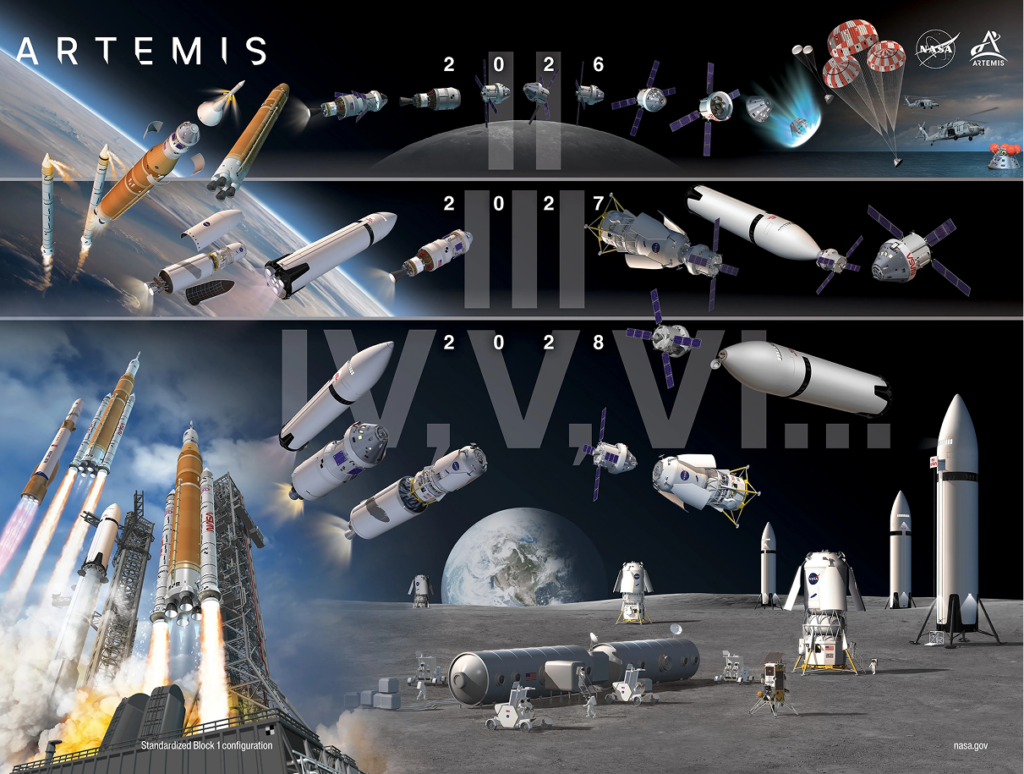
The architecture of the Artemis program is structured around a series of progressive missions whose timeline has been recently recalibrated based on operational tests as well as technical and financial constraints.
Mission | Primary Objective | Target Date | Status & Operational Details |
|---|---|---|---|
| Artemis I | Uncrewed integrated flight test of SLS and Orion capsule | November 2022 | Successfully completed; tested heat shield integrity and lunar orbit re-entry. |
| Artemis II | First crewed lunar flyby mission (free-return trajectory) | April 1, 2026 | Successfully completed. Trans-lunar injection thrust was provided by the European Service Module (ESM) engine. |
| Artemis III | Crewed orbital flight test in Low Earth Orbit | Late 2027 | Rescheduled: As of February 27, 2026, it no longer includes a lunar landing, serving instead as a Earth-orbit operational test. |
| Artemis IV | First crewed lunar landing of the Artemis program | 2028 | First official human landing near the Lunar South Pole region. In parallel, development continues with the heavy-lift Starship vehicle. |
Hardware Architecture: SLS, Orion, and Gateway
The program relies on three primary technological pillars:
- Space Launch System (SLS): NASA’s super-heavy launch vehicle designed to send the Orion spacecraft beyond low Earth orbit.
- Orion Spacecraft & European Service Module (ESM): Orion transports the crew. Life support, primary propulsion, and electrical power are supplied by the ESM built by ESA with strong European industrial leadership.
- Lunar Gateway: The cislunar space station. The Gateway program is currently “paused in its present form”, though not formally canceled. Specifically, the HALO contract is halted and treated as abandoned by the OIG.
The Strategic Role of Europe and International Partnerships
Europe plays a leading role in the Artemis program through ESA contributions and bilateral industrial partnerships:
- MPH Module (Multi-Purpose Habitation): Designed for the lunar surface with primary development led by European industry (Thales Alenia Space). Launch target set for 2033.
- Industrial Contributions to Gateway & Orion: Development of primary structural modules for habitats and the European Service Module (ESM). This fits into a global context that also includes projects like the Korean lunar base.
- European Astronaut Flight Opportunities: Bilateral and ESA agreements guarantee flight assignments for European astronauts on upcoming lunar missions.
Costs, Sustainability, and Health Payoffs
Unlike the Apollo era, Artemis emphasizes transparent budget reporting based strictly on official Office of Inspector General (OIG) audits, Congressional Research Service (CRS) reports, and confirmed government contracts.
Technological Spinoffs and Human Health
Space medicine and radiation protection research conducted under Artemis directly inform advancements in digital health and human biology. It is critical to distinguish between biomarkers and clinical endpoints to maintain analytical rigor. For instance, the AstroRad protective vest demonstrates a 60% radiation dose reduction based on model estimations rather than live solar storm measurements.
Frequently Asked Questions (FAQ)
When will humans land on the Moon again under Artemis?
The first crewed lunar landing under the Artemis program is currently scheduled for Artemis IV in 2028, following the repurposing of Artemis III as a LEO flight test.
What is Europe’s contribution to the Artemis program?
Europe provides the European Service Module (ESM) for Orion, key habitation structures such as the MPH module, and critical communications infrastructure, securing flight slots for European astronauts.
Has the Lunar Gateway been canceled?
No, Gateway is officially “paused in its current form.” However, the OIG considers the HALO contract to be functionally abandoned under its original scope.
What are common misconceptions about space spinoff technologies?
Products such as Velcro, Teflon, and Tang were not invented by NASA, although they were popularized and extensively deployed during early space missions.