
Books and films have always been good at seeing the future.
When it comes to hacking, AI and cybercrime, some films even seem to predict what cybersecurity teams face every day.
In today’s cyber-review, we change our usual format. We take a tour of iconic films and look at them through the lens of today’s digital threats.
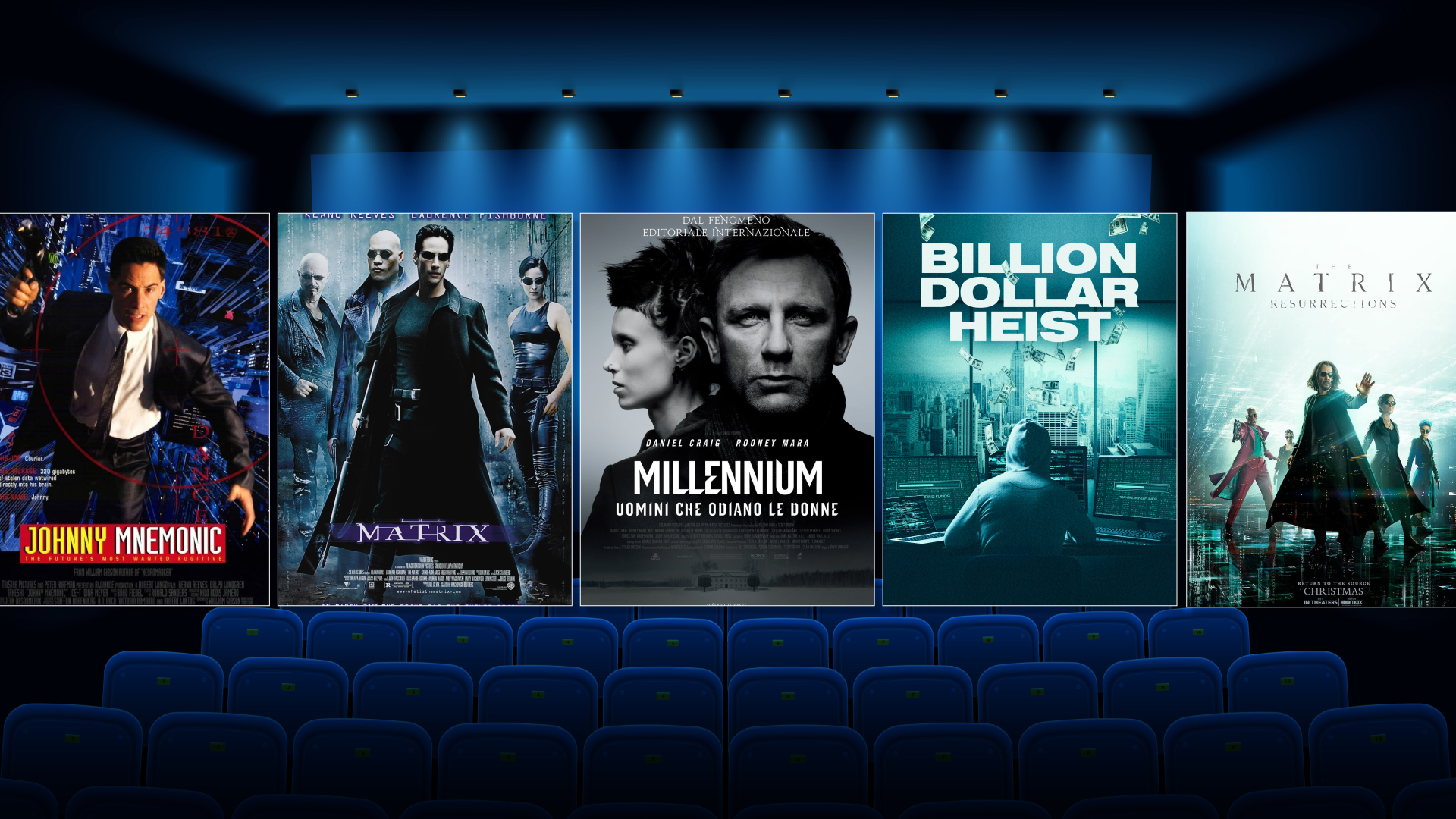
Johnny Mnemonic (1995)
The film is set in 2021, a year now behind us.
The setting is cyberpunk: a world ruled by mega-corporations, virtual reality and secret data trading. Johnny (Keanu Reeves) is a “human data carrier”. He agrees to carry a file stored right in his brain, with very unexpected results.
The film is inspired by the world of William Gibson, whose books we recommend. It predicts ideas we discuss today in the real world, such as bio-hacking, advanced encryption and the illegal trade in sensitive data.
The cyber parallel with the real world:
Today, even without brain chips, sensitive data travels on weak devices, badly set-up clouds and hacked supply chains. The idea of hacked human memories mirrors today’s risks: data leaks, industrial spying and the new field of neurosecurity.
Matrix (1999)
Neo is a hacker who lives two lives: programmer by day, network outlaw by night.
Behind his double life, he finds out that reality itself is a simulation made by an AI.
The Matrix is not just a visual masterpiece. It invites us to look under the digital surface.
Its themes of code, free will and computer control are powerful in this first film. Its scenes and ideas have stayed in our shared imagination for years.
The cyber parallel with the real world:
Today we live with virtual environments, containers, test systems, deepfakes and more and more addictive social media. The risk is high that key business systems get exposed by mistake, that environments are poorly separated and that data leaks.
Security in complex systems needs identity control, strong encryption and real sandboxing.
We should also not forget how thin the line between the real world and social media is becoming. The need to show off is starting to have psychological effects, some of them very serious.
The film is also a milestone of tech change in cinema. It came just before smartphones, the joy and pain of our time.
Millennium – The Girl with the Dragon Tattoo (2011)
Now we move to a crime thriller based on Stieg Larsson’s novel. The real star is Lisbeth Salander, a lonely, unusual and brilliant hacker. She breaks into digital networks and identities with realistic methods.
Above all in the first film version, we are far from the world of special effects. She uses keylogging, social engineering and silent break-ins into systems. Her style of investigation mixes the cyber and the personal.
The cyber parallel with the real world
The film shows everyday hacking: identity theft, account theft, exploits and scouting techniques on the dark web.
Even today, these attack methods cause 90% of real breaches. Lisbeth was an ethical hacker (if a borderline one) before the term existed.
Billion Dollar Heist (2023)
In this docu-thriller, reality beats fiction. It tells the true story of an attempt by an APT group to steal one billion dollars from the central bank of Bangladesh.
There is no wild fantasy here. Just well-planned attacks, phishing, weak points in banking and missing procedures.
Interviews and experts show how fragile financial systems can still be today when facing motivated, organised attackers.
The cyber parallel with the real world:
The lesson is clear. Infected emails, bad settings, slow updates to procedures and poor mapping of systems are enough to cause a disaster. The film is a textbook on managing cyber risk, dressed up as a thriller.
We close the circle with the last film of a saga we have already mentioned. Beyond its success with critics and the public, we look at its cyber side.
Matrix Resurrections (2021)
In this sequel and reboot, Neo is a game designer trapped in a new simulation.
A rebel AI gets into his development environment to free him.
The film offers a modern thought: the lines between social media, test environments, real systems and virtual reality are more and more blurred.
The cyber parallel with the real world
The film quietly criticises the growing mix-up between test and real environments, which is common in modern DevOps.
It is the perfect metaphor for accidents caused by bad settings, admin access left unwatched and permissions or deliberate backdoors. It may also hint at a critique of some governments that want control over systems.
From the cyberpunk world of Johnny Mnemonic to the technical clarity of Billion Dollar Heist, cinema tells us what is real today:
cybersecurity is part of our lives.
In films, solutions are faster and more spectacular. But the weak points, the attack methods and human limits are still real.
In the end, we always need a critical eye.
Article in collaboration with Lorenzo Raimondo, Managing Director of Observere