

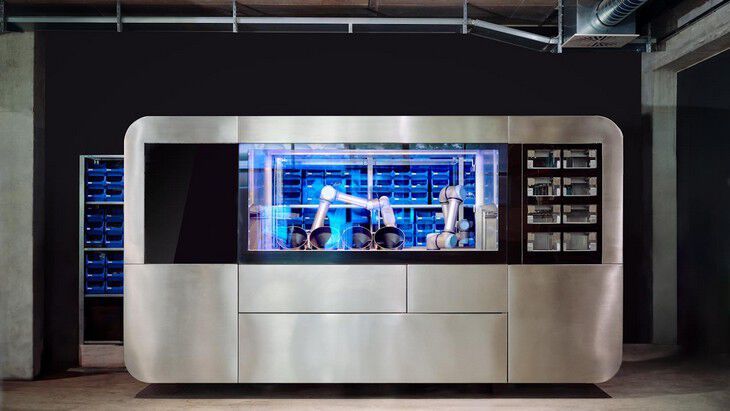
The automation of gastronomic processes constitutes one of the most advanced application frontiers of contemporaryindustrial robotics. The case of the CA-1 system, developed by German company Circus SE, offers a paradigmatic example of the integration of precision robotics, predictive artificial intelligence, and automated logistics within a high-throughput production environment.
Hardware Architecture and Construction Specifications
The CA-1 Series 4 is a self-contained production unit housed within a structure measuring roughly two by two metres, equipped with six interchangeable magnetic wheels, a localised induction heating system — active exclusively in zones of actual use, thereby optimising the overall energy balance — and an integrated washing module for autonomous management of the sanitation cycle.
In terms of volumetric efficiency, the unit occupies a footprint of approximately seven square metres, against a declared production capacity of 120 servings per hour, corresponding to an average cycle time of roughly thirty seconds per completed dish. The ratio between output and occupied floor space is markedly superior to the parameters typical of comparably scaled, human-operated kitchens.
CircusOS: Software Architecture and Decision Logic
The unit’s proprietary operating system, CircusOS, constitutes the control and coordination layer of the entire system. It is a software infrastructure that manages adaptive, real-time decision-making throughout the operational cycle, overseeing three primary process variables: the timing of preparation stages, thermal control, and workflow sequencing.
Unlike a numerically controlled system operating on fixed logic, CircusOS’s architecture incorporates learning mechanisms based on data collected during operation, allowing for progressive recalibration of cooking and preparation parameters. This approach places the system within the category of continuously learning cyber-physical systems, in which production output is constantly adjusted on the basis of operational feedback.
Field Validation: The REWE Düsseldorf-Heerdt Case Study
The system’s commercial validation phase has been conducted in a real operational context rather than a controlled laboratory environment. As of 29 October 2025, a CA-1 unit has been integrated into the REWE store in Düsseldorf-Heerdt as part of the retail chain’s “Fresh & Smart” concept, marking the first documented worldwide integration of a fully autonomous robotic kitchen system within a large-scale retail environment.
The user interface allows orders to be placed via touchscreen or voice command, with a declared waiting time of approximately three minutes and an entry-level price of six euros for the “first course” category. The system is currently in a commercial pilot phase, processing live customer orders across REWE’s supermarket network in Germany.
Performance Parameters and Stated Objectives
Circus SE explicitly cites, among the project’s objectives, addressing the structural labour shortage affecting the food-service sector and increasing overall operational efficiency. Functionally, the system has been engineered to fully replace the tasks traditionally assigned to four distinct professional roles — prep cook, line cook, expeditor, and dishwasher — positioning itself not as a tool supporting human labour, but as a complete operational substitute for an entire class of food-service positions.
This characteristic distinguishes the CA-1 from other assisted-kitchen solutions oriented toward a collaborative human-machine model, and defines its positioning as a system of total production-process automation.
Industrial Scalability and Corporate Trajectory
On the industrial front, Circus SE has completed the acquisition of Kitchen Robotics and initiated what the company describes as the world’s first industrial-scale production of autonomous robotic systems in this category, with the first fourth-generation units already in the delivery phase. In parallel, the company has relocated its global headquarters to Munich, identifying the city as a strategic hub for applied artificial intelligence development, advanced robotics, and pre-series production of the CA-M platform — a variant of the system intended for defence-sector applications.
It should be noted in this regard that the company has identified the defence sector as a further area of technological application, proposing a model of automated, standardised food preparation not confined to retail contexts.
Concluding Remarks
From an engineering standpoint, the CA-1 represents a significant case study in the convergence of compact robotics, precision thermal control, and continuously learning decision-making systems, applied to a process — gastronomic preparation — historically characterised by high variability and a strong manual component. The ongoing pilot phase at the Düsseldorf location will serve as a valuable empirical benchmark for assessing the system’s reliability under sustained production volumes and uncontrolled operating conditions.
Broader implications — relating to the employment impact within the food-service sector and the transferability of the model to large-scale institutional catering contexts — remain, at present, a matter for ongoing observation by industry operators, in the absence of sufficient longitudinal data to support robust quantitative projections.