
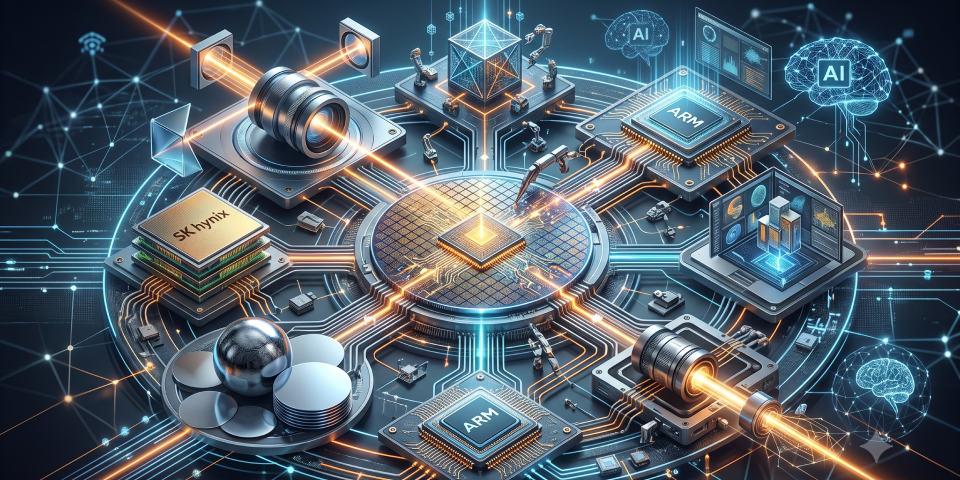
When we think about artificial intelligence, our minds jump straight to names like OpenAI, Google or Nvidia. Yet behind every chip that powers an AI model or a next-generation data center lies an industrial supply chain made up of a surprisingly small number of companies — many of them barely known outside specialist circles. It is actually these companies that hold the real power: the power to decide, through a single delay or production halt, how fast the world keeps innovating — a topic we follow closely in our Technology section on INT News.
The extreme-optics bottleneck: ASML
At the top of this pyramid sits ASML, the Dutch company that holds a global monopoly on extreme ultraviolet (EUV) lithography machines — the only technology capable of etching circuits onto the most advanced chips at the nanometer scale. Without ASML’s machines, today’s most advanced processors simply could not exist.
Turning designs into silicon: TSMC
If ASML supplies the tools, it’s TSMC (Taiwan Semiconductor Manufacturing Company) that turns them into finished products. The Taiwanese giant manufactures the vast majority of the world’s most advanced processors on behalf of companies like Apple, Nvidia and AMD, making Taiwan an even more strategic geopolitical hub than it already was. As detailed in our analysis of the SPAN XFRA project with NVIDIA, access to these processors has become a strategic factor for energy and residential infrastructure too.
The architecture that runs the planet: ARM
Nearly every smartphone in circulation — and a growing number of servers and AI devices — is built on architectures designed by ARM, the British company that licenses its designs to the world’s leading chipmakers.
The invisible software: Synopsys and Cadence
Before a chip can be manufactured, it has to be designed. That task falls to a very small number of EDA (Electronic Design Automation) software providers, including Synopsys and Cadence, which effectively hold a duopoly over one of the tech industry’s most critical — and least visible — tools.
German precision: ZEISS and TRUMPF
ASML’s EUV machines couldn’t function without components made by two other German companies. ZEISS manufactures the mirrors and ultra-precise optical systems needed to project circuits onto silicon with infinitesimal margins of error. TRUMPF, meanwhile, supplies the extremely high-power laser systems required to generate the EUV light the lithography process depends on.
The raw material: Shin-Etsu
At the foundation of it all is silicon itself. Japan’s Shin-Etsu is one of the world’s largest producers of silicon wafers, the physical base onto which every integrated circuit is etched.
The memory fueling AI: SK hynix
Finally, an increasingly central role in the AI race is played by high-bandwidth memory (HBM), essential to the GPUs used to train AI models. In this segment, South Korea’s SK hynix has established itself as one of the world’s leading suppliers, a component that’s becoming ever more critical for the next-generation data centers that house these systems.
A chain as powerful as it is fragile
What makes this scenario particularly delicate is the extreme concentration of power along the supply chain: each of these companies controls a link that, today, has no easily replicable large-scale alternative. An export ban, an industrial accident, or a geopolitical crisis at any one of these companies — or in the countries where they operate — could have immediate repercussions on the global production of advanced electronics, smartphones, data centers and AI systems.
It’s no coincidence that governments and companies around the world are investing billions to diversify and “reshore” parts of this supply chain, from the United States to Europe and Japan — as shown by the recent $30 billion deal between Google and SpaceX for AI infrastructure. But the road to genuine technological independence still looks long: for now, the fate of global digital innovation continues to rest in the hands of a handful of specialized companies, many of which operate far from the media spotlight.
Read also on INT News
Explore more coverage in the Technology and Economy sections of INT Newsendence still looks long: for now, the fate of global digital innovation continues to rest in the hands of a handful of specialized companies, many of which operate far from the media spotlight.
Data centers in extreme environments: from the seabed to orbit — 6 real case studies
AI Infrastructure Enters the Home: Strategic Analysis of the SPAN XFRA Project with NVIDIA
Google Outsources AI Infrastructure to SpaceX: $30 Billion Deal and ESG Concerns