
Key Takeaways
- Scenario | The Chinese Academy of Sciences has deployed stem cell-derived embryo models (blastoids) to the Tiangong space station utilizing the Tianzhou-10 cargo spacecraft.
- Business Impact | Empirical outcomes will establish the biological viability of long-duration colonization missions, heavily influencing private investments in the and life support infrastructure.
- Data Point | The orbital mission evaluates automated cellular development during a critical 120-hour cycle under microgravity and cosmic radiation conditions.
Space Biology: The Scientific Mission and the Role of Stemoids
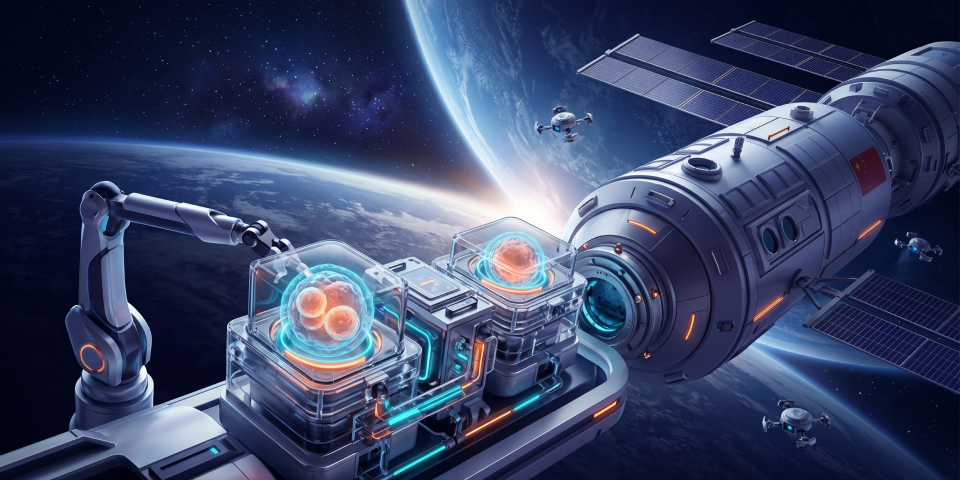
China has initiated a pioneering biological trial aboard the Tiangong space station to assess the viability of human reproduction in extra-atmospheric environments. The research team from the Institute of Zoology at the Chinese Academy of Sciences (CAS), led by Dr. Leqian Yu, coordinates the monitoring of artificial embryo models synthesized from human stem cells. These biological vectors, technically classified as stemoids or blastoids, accurately replicate the morphological dynamics of early human developmental stages without possessing the biological potential to evolve into full fetuses.
The biological payloads reached low Earth orbit on May 11, 2026, via the Tianzhou-10 automated cargo vessel launched from the Wenchang facility. Subsequently, robotic systems integrated into the station’s scientific modules activated the hydration and chemical nutrient protocols. Scientists utilize advanced microfluidic chips to manage culture fluids without direct crew intervention. Consequently, the experiment proceeds autonomously according to a standardized 5-day temporal roadmap.
The Obstacles of Microgravity and Cosmic Radiation
The primary barrier to cellular survival in deep space consists of the absence of gravitational loading and constant exposure to ionizing radiation fluxes. During the 120-hour programmed incubation period, the blastoids undergo cosmic radiation bombardment significantly higher than terrestrial parameters shielded by the magnetosphere. Automated high-resolution microscopy systems acquire real-time data on cellular reorganization, focusing specifically on peri-implantation and peri-gastrulation models.
In parallel with the orbital session, the Beijing laboratory conducts a mirror test under standard gravity conditions to isolate environmental variables. Scientists analyze the comparative data to determine whether microgravity alters the biochemical signaling that drives tissue differentiation. Moreover, the integration of actual rodent and zebrafish embryos within the same scientific payload allows for the verification of genetic mutations across complex multicellular organisms.
Commercial Impact on the Long-Term Space Economy
The data generated by this scientific research will establish technical requirements for future commercial habitat modules and deep exploration infrastructure. Companies operating in the aerospace sector must integrate advanced shielding systems should the data confirm structural alterations in cell division processes. Therefore, understanding these biological dynamics becomes a strategic asset for developing pharmacological countermeasures dedicated to long-duration crews.
China’s positioning in this scientific segment accelerates technology transfer toward the sector. The capability to automate complex cell cultures in orbit paves the way for biomimetic tissue manufacturing in microgravity, a potential market for the global pharmaceutical industry. The terrestrial return of the frozen samples will initiate the genetic sequencing phase, the results of which will define operational standards for upcoming permanent lunar settlements.
Artificial Embryos in Orbit: China’s Space Reproduction Experiment
China deploys stem cell-derived embryo models to the Tiangong space station. Technical analysis of the biological experiment reshaping space reproduction.