

Neuralink’s main rivals are Synchron, Precision Neuroscience, Paradromics, Blackrock Neurotech and China’s Neuracle, first to win commercial approval. Each bets on a different trade-off between surgical risk and signal quality.
Last updated: November 2026
Note: informational content on device engineering, not medical advice. Neuralink’s N1 implant is investigational and available only inside clinical trials.
On 30 October 2026 Elon Musk wrote on X that Blindsight, Neuralink’s vision implant, is ready “from an engineering standpoint” and only awaits regulatory approval (Tom’s Hardware, 1 November 2026). By then, the first implantable brain-computer interface (BCI) cleared for commercial use had already arrived from China, in March 2026. Neuralink’s last official headcount is 21 trial participants, reported on 28 January 2026 (Reuters). The company leads on attention and funding. On regulatory milestones, it does not.
Who are Neuralink’s main competitors?
| Company | Approach | Status, November 2026 | Source |
|---|---|---|---|
| Neuralink (US) | Intracortical: 1,024 electrodes on flexible threads, fully wireless, inserted by the R1 robot | Early feasibility studies in the US, Canada, UK and UAE; 21 participants (January 2026) | Reuters |
| Synchron (US) | Endovascular: Stentrode with 16 electrodes, delivered by catheter into a vein next to the motor cortex, no open-skull surgery | All 6 COMMAND patients met the primary safety endpoint over 12 months; 10 patients implanted in the US and Australia; pivotal trial planned for 2026; $200M Series D (November 2025) | Tech Times; Citeline |
| Precision Neuroscience (US) | Thin film resting on the brain’s surface, 1,024 electrodes, removable | FDA clearance (2025) for temporary implants up to 30 days; more than 110 procedures at 18 institutions; $250M Series D (September 2026) | Precision, 29 October 2026; MedTech Dive |
| Paradromics (US) | Intracortical, fully implanted, wireless transmission through the skin | Connect-One study cleared by the FDA in November 2025; first long-term implant in June 2026; real-time speech decoding announced in September 2026 | Paradromics, 14 September 2026 |
| Blackrock Neurotech (US) | Utah array: rigid grid of 96 silicon microelectrodes with a connector through the skin | Workhorse of academic BCI research since 2004; Tether took a majority stake for $200M in April 2024 | Reuters via The Star; arXiv, 2025 |
| Neuracle (China) | NEO: coin-sized implant placed above the dura, driving a pneumatic glove for hand grasping | Approved by China’s NMPA in March 2026 for people with quadriplegia from cervical spinal cord injury | CGTN; People’s Daily |
| Science Corporation (US) | PRIMA: photovoltaic chip under the retina, paired with infrared-projecting glasses | CE mark under the EU Medical Device Regulation; commercial launch across 30 European countries (July 2026) | Science Corp |
| Merge Labs (US) | Non-invasive: ultrasound and molecules instead of electrodes | No device tested in humans; $250M raised at an $850M valuation, OpenAI wrote the largest check (January 2026) | TechCrunch |
Which brain implant was approved first?
China’s. In March 2026 the National Medical Products Administration cleared Neuracle’s NEO, a coin-sized device placed outside the dura mater through a minimally invasive procedure (People’s Daily, April 2026). It reads motor intent and drives a pneumatic glove so that people with cervical spinal cord injury can grasp objects. The approval is narrow, but it is the first time a regulator has cleared an implantable BCI for commercial clinical use.
In the United States no implantable BCI is approved for long-term use. Precision holds an FDA clearance limited to 30 days; Synchron is preparing the pivotal trial that must precede a premarket approval application; every Neuralink study on the public registry is an early feasibility study. In Europe, the closest precedents are a retinal implant (PRIMA, CE-marked in 2026) and an adaptive deep brain stimulator from Italy, covered below.
How is Neuralink’s technology different?
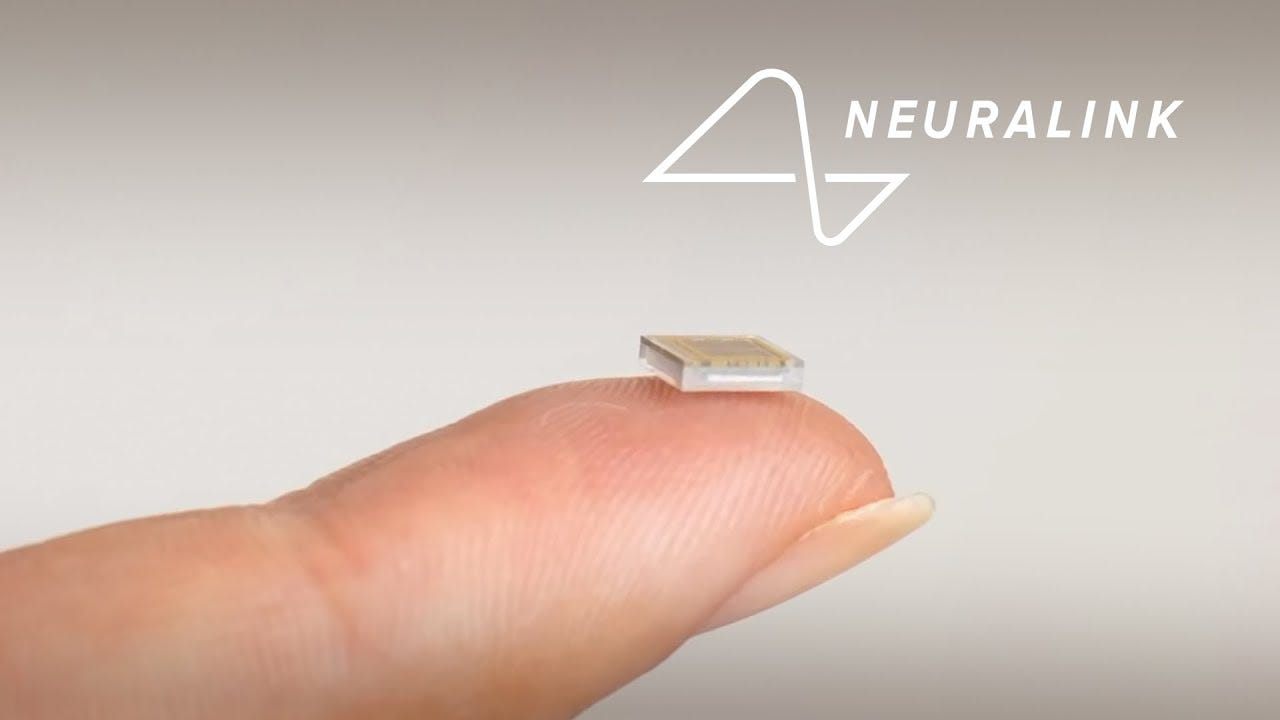
Neuralink’s N1 is a coin-sized implant fixed to the skull, wireless and inductively rechargeable (ClinicalTrials.gov, VOICE study). According to Neuralink’s specifications, 64 threads carry 1,024 electrodes into the cortex; University College London Hospitals describes them as finer than a human hair and placed by the R1 robot within microns of target neurons (UCLH, October 2025).
The bet is bandwidth. Penetrating electrodes pick up individual neurons, which carries more information than surface films or a stent in a vein, at the cost of more invasive surgery and a known long-term risk: tissue reaction that can degrade the signal. Neuralink met that risk early. Weeks after the first implant in January 2024, a number of threads retracted from the patient’s brain; the company recovered performance by changing its recording algorithm (The Register, May 2024).
Two changes arrived in 2026. Neuralink tested inserting threads through the intact dura instead of removing a section of it (ALS News Today, July 2026), and a September video showed a participant in its VOICE speech study with a 3,000-channel implant (iPhone in Canada, September 2026).
What has Neuralink actually shown?
In its two-year review, published in January 2026, Neuralink said several participants exceed 10 bits per second in cursor control, matching or beating an able-bodied person with a mouse, and that participants with ALS type up to 40 words per minute on a virtual keyboard (Mezha, 29 January 2026). It also reported zero serious device-related adverse events (Reuters via The Star).
These are company figures, and the studies behind them are small: GB-PRIME plans up to 7 participants, VOICE 6, UAE-PRIME 10, with safety as the primary endpoint (UAE-PRIME registry). Bits per second measure the signal and the decoder, much as a biomarker measures a biological process. Whether patients live more independently is a clinical endpoint, and it needs larger, controlled studies. For the VOICE participant shown in September 2026, Neuralink published no implant date, vocabulary size, latency or accuracy (Tesla North, September 2026).
Musk’s promises vs the record
| Promise | Made by, when | Record, November 2026 |
|---|---|---|
| First human Blindsight implant by end of 2025 | Musk, March 2025 (MobiHealthNews) | No human implant announced; “waiting on regulatory approval” (Musk, 30 October 2026) |
| “High-volume production” and almost entirely automated surgery in 2026 | Musk on X, 31 December 2025 (Reuters) | No public volume data; last official count 21 participants |
| 3,000 channels per implant in 2026 | Company roadmap, June 2025 | 3,000-channel implant shown in September 2026 |
| FDA approval of Telepathy by 2029; 20,000 implants a year by 2031 | Investor documents reviewed by Bloomberg, July 2025 (Reuters) | Only early feasibility studies registered; 21 participants in two years |
The valuation tells the same story from the investor side. Secondary-market trades have priced Neuralink between $29 billion and $42 billion, against $9 billion in its last funding round (Business Insider, 21 July 2026). This is context, not investment advice: Neuralink is private and secondary trades are not an official valuation.
What does the race look like from Europe?
Neuralink has no trial site in the European Union. Its nearest site is in London, where GB-PRIME runs at University College London Hospitals and Newcastle Hospitals under approval from the UK’s MHRA (BiopharmaTrend, July 2025).
To be sold in the EU, an implantable BCI needs a CE mark under the Medical Device Regulation (EU) 2017/745: implants in contact with the central nervous system fall into class III and require a notified body. The same regulation governs every smart medical device, from wearables to implants. Science Corporation’s PRIMA retinal implant took that route, certified by DEKRA in 2026 (Science Corp). INT News has covered PRIMA in detail.
A closed-loop brain implant developed in Italy has just entered its pivotal trial. Newronika, a spin-off of Milan’s Policlinico and the University of Milan, makes AlphaDBS, a CE-marked deep brain stimulator for Parkinson’s disease that records brain signals and adapts stimulation in real time. On 21 September 2026 the first participant in its ADVENT pivotal study was implanted at IRCCS San Gerardo dei Tintori in Monza. ADVENT is randomized and double-blind, enrolling 104 patients at up to 18 centers in Europe and the US (Newronika, 1 October 2026). It is the kind of controlled study Neuralink has not yet registered.
On data, European rules already apply. A June 2024 TechDispatch by the European Data Protection Supervisor and Spain’s AEPD found that neural data can qualify as health or biometric data, both special categories under the GDPR (Morrison Foerster, July 2024). UNESCO’s Recommendation on the Ethics of Neurotechnology, in force since 12 November 2025, adds non-binding guidance against non-therapeutic use on children and workplace monitoring (UNESCO UK).
Frequently asked questions
It depends on the yardstick. Synchron is closest to a US pivotal trial, Precision holds an FDA clearance for temporary use, Paradromics has shown real-time speech decoding, and China’s Neuracle won the first commercial approval for an implantable BCI.
No. The N1 implant is investigational and available only to participants in clinical studies in the US, Canada, the UK and the UAE.
The last official figure is 21 trial participants, reported by Neuralink on 28 January 2026. Higher numbers circulating since then come from unofficial trackers.
It makes a different trade-off. Synchron’s Stentrode reaches the brain through a blood vessel, without opening the skull, but records with 16 electrodes. Neuralink’s N1 needs neurosurgery and records with 1,024 or more, capturing far more detail.
Neuralink opened its patient registry to applicants worldwide in April 2025, but it has no trial site in the EU. The nearest is GB-PRIME in London and Newcastle, with its own eligibility criteria.
That is the stated goal. As of November 2026 Neuralink has shown no results in humans. The FDA Breakthrough Device designation it received in September 2024 speeds up regulatory dialogue; it is not an approval.
Sources
- Tom’s Hardware, “Elon Musk says Neuralink is ready to cure blindness”, 1 November 2026
- Reuters, “Elon Musk’s Neuralink says it has 21 participants enrolled in trials”, 28 January 2026; The Star reprint
- Reuters, “Neuralink plans ‘high-volume’ brain implant production by 2026, Musk says”, 31 December 2025
- Reuters, “Neuralink targets $1 billion revenue by 2031, Bloomberg News reports”, 24 July 2025
- Business Insider, “Some investors are valuing Elon Musk’s Neuralink at $42 billion”, 21 July 2026
- The Register, “Neuralink trial update”, 9 May 2024
- MobiHealthNews, “Elon Musk announces Neuralink’s first human implant of Blindsight coming this year”, March 2025
- ALS News Today, “Neuralink tests brain implant approach that leaves protective layer intact”, July 2026
- iPhone in Canada, “ALS Patient Speaks Again After Neuralink Turns His Thoughts Into Spoken Words”, 21 September 2026
- Tesla North, “Neuralink Patient Terry Speaks With Thoughts Using Grok Voice”, 19 September 2026
- Mezha, “Neuralink summed up two years of brain implant testing”, 29 January 2026
- Teslarati, “Neuralink Blindsight human trials expected to start in the UAE”, May 2025
- UCLH, “First UK patient uses thought to control computer hours after Neuralink implant”, 28 October 2025
- BiopharmaTrend, “Neuralink Begins UK Clinical Trial”, 31 July 2025
- ClinicalTrials.gov records: VOICE, NCT07224256; UAE-PRIME, NCT06992596
- CGTN, “China approves world’s first invasive BCI medical device”, 14 March 2026
- People’s Daily, “China approves world’s first implantable brain-computer interface for medical use”, 21 April 2026
- Tech Times, “Synchron Brain Implant Targets 2026 Pivotal Trial”, 6 June 2026
- Citeline Medtech Insight, “Synchron Secures $200M Series D”, 8 November 2025
- Precision Neuroscience, Abu Dhabi announcement, 29 October 2026
- MedTech Dive, “Precision Neuroscience raises $250M”, 25 September 2026
- Paradromics, “Paradromics Achieves Real-Time Speech with Connexus”, 14 September 2026
- Reuters, “Crypto company Tether invests $200 million in brain-chip maker Blackrock Neurotech”, 29 April 2024
- State of Brain Emulation Report 2025, arXiv, October 2025
- Science Corporation, PRIMA European launch, July 2026
- TechCrunch, “OpenAI invests in Sam Altman’s brain-computer interface startup Merge Labs”, 15 January 2026
- Regulation (EU) 2017/745 on medical devices, EUR-Lex
- Newronika, ADVENT first participant, 1 October 2026
- Morrison Foerster, “It’s All in Your Head? Not Anymore: EU Data Protection”, 22 July 2024
- UNESCO UK, “UNESCO adopts first global framework on neurotechnology ethics”, 18 November 2025