

Fog Computing represents the necessary evolution for data management in the era of the Internet of Things and ultra-fast connectivity. This network architecture, originally defined by Cisco and standardized by NIST, acts as an intermediate layer between physical devices (Edge) and remote data centers (Cloud), allowing for localized and immediate data processing.
Key Takeaways
- Minimum Latency: Data processing in milliseconds near the source.
- Bandwidth Efficiency: Only essential data is sent to the central Cloud.
- Advanced Security: Sensitive data can be analyzed locally without traversing public networks.
How Fog Computing works and why it is essential
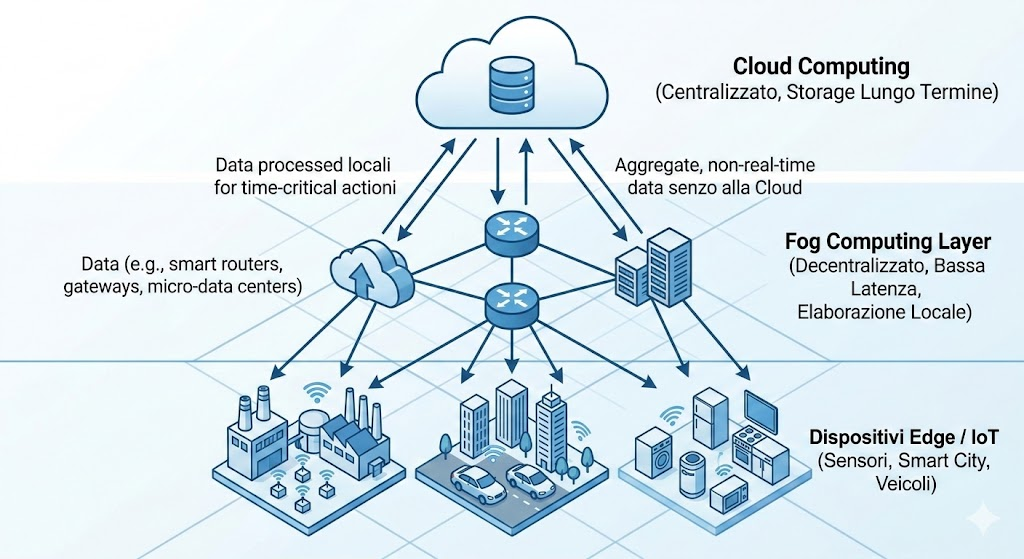
The functioning of Fog Computing is based on the distribution of computing, storage, and networking capacity across strategically positioned local nodes. Instead of sending every single data packet produced by a sensor to a server located thousands of kilometers away, the “fog node” (which can be an industrial router or a micro-data center) intercepts the information.
This structure is essential for “mission-critical” applications where the few-second delay typical of traditional Cloud would be unacceptable. Consider automatic braking systems in Smart Cities or real-time monitoring of electrical grids: in these scenarios, the response speed guaranteed by Fog is a fundamental security requirement.
The advantages of decentralized technology
The adoption of a Fog-type infrastructure brings tangible benefits in terms of both costs and operational performance. By reducing the volume of traffic that must reach the network core, companies save significantly on bandwidth costs and reduce bottlenecks in central data centers.
Furthermore, Fog Computing improves system resilience: even in the event of an Internet connectivity outage to the Cloud, local nodes can continue to operate and manage critical processes autonomously, ensuring business continuity.
Differences between Cloud, Edge, and Fog Computing
Although often confused, these three terms identify different levels of the digital hierarchy. While Cloud handles massive processing and long-term storage, Edge Computing occurs directly on the sensor or the end device. Fog Computing, instead, acts as the connective tissue that orchestrates data between local devices and the Cloud, managing the distribution of the workload over a local geographic area (Local Area Network).