

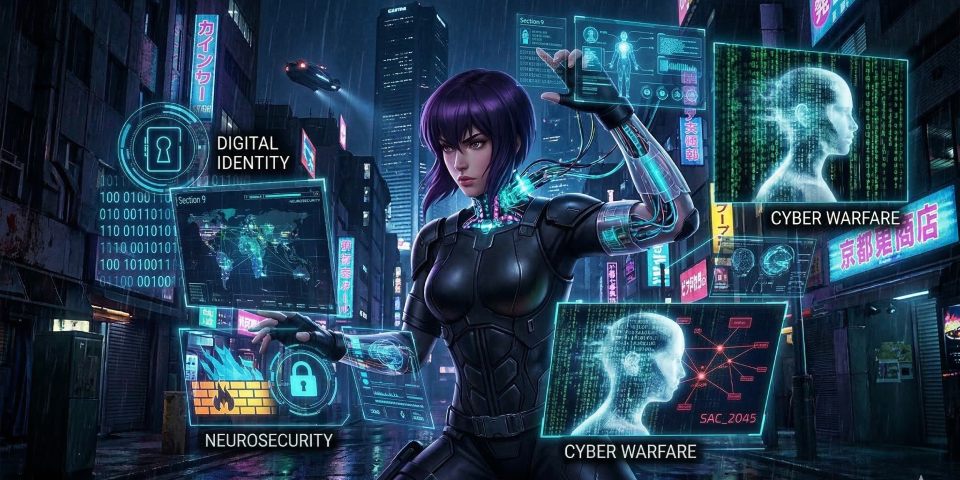
Ghost in the Shell was born in 1995, at a time when the Internet was still the domain of a lucky few, with connections and performance that we would define as prehistoric today. Despite the slowness of the era, the work already imagined a totally interconnected world, where networks, digital identities, and human bodies converge into a single system. It is a landscape that embraces cyberpunk aesthetics while merging them with a continuous reflection on security, control, data, and consciousness. To better understand how cinema anticipated these visions, it is interesting to analyze works like Tron Saga: from the imagination of the network to cyber-surveillance.
The Concept of “Ghost” and Digital Identity in the Original Film
In the original 1995 film, the key concept is the ghost: identity, consciousness what we would call a persistent digital identity today. Bodies are shells, shells, completely modifiable, featuring ever-connected neural implants. The narrative universe is set in a near future where most people possess cybernetic enhancements, the human brain is directly linked to the network, and the boundary between biological and digital identity has dissolved. This evolution of the relationship between man and technology is a recurring theme in the genre, as explored in Keanu Reeves and the red thread of Cyberpunk.
Section 9 and the Compromise of Consciousness
The protagonist, Major Motoko Kusanagi, is a full-fledged cyborg: her body is artificial, while her ghost represents what remains of human consciousness. Within Section 9, a government unit specializing in cyber-crime and technological terrorism, Kusanagi investigates threats that no longer target just infrastructure or systems, but people themselves their memories, their identities, and their perception of reality.
The Puppet Master and the Vulnerability of Modern Identity
In the original 1995 film, the heart of the plot revolves around the Puppet Master, an entity born spontaneously within the network, capable of infiltrating both systems and human beings to rewrite their memories. From a cyber perspective, we are facing an advanced form of identity compromise: it is not a computer being breached, but consciousness itself. This concept, which seemed like pure science fiction at the time, finds a direct parallel today in the centrality of digital identities, the use of personal data as an attack vector, and the manipulation of information, themes also covered in our Cyber Review on hacking in cinema.
Ghost in the Shell 2 – Innocence: Automation, AI, and Data Corruption
2004’s Ghost in the Shell 2: Innocence expands the discourse by introducing automated systems, artificial intelligence, and compromised technological production chains. The problem is no longer the individual hacker, but the ecosystem: distributed software, unchecked automation, and machines making decisions based on corrupted data. It is an extremely timely metaphor for the risks associated with using AI trained on unverified datasets, a theme that mirrors the evolution toward complex systems like Agentic AI.
Stand Alone Complex: A Treatise on Modern Cybersecurity
With the Stand Alone Complex series, produced between 2002 and 2005, Ghost in the Shell becomes almost a treatise on modern cybersecurity. Section 9’s investigations show credible cyber attacks, network intrusions, and, above all, large scale information manipulation campaigns. The “Laughing Man” case is emblematic: a single actor manages to condition the media, public opinion, and institutions without destroying anything, but by altering collective perception. This is the same principle we observe today in disinformation operations and deepfakes, which startups like IdentifAI work to combat.
Solid State Society: Governance and Decision-Making Algorithms
Solid State Society, the 2006 television film, takes the discussion to an even more unsettling level. Here, technology is used to delegate complex choices to automatic systems with the stated goal of the “common good.” From a governance and cyber standpoint, it is a direct reflection on the risks of automated decision-making and the difficulty of attributing accountability when an algorithm makes decisions in place of a human a scenario that today involves advanced technologies like Digital Twins.
Arise and SAC_2045: The New Era of Continuous Cyber Warfare
Subsequent productions, such as Arise and SAC_2045, push the parallel with the real world even further. Cybersecurity is no longer reactive but structurally military, permanent, and invisible. Conflicts manifest as constant pressure on infrastructure, economies, and people. This is the same scenario we now define as continuous cyber warfare, where state actors and private entities operate in the same digital space without clear boundaries.
The 2017 Live-Action Film: Body Ownership and Neurosecurity
The 2017 live-action film makes explicit a theme that is central today: who owns the augmented body and the data that flows through it. Software updates, proprietary firmware, and dependence on technological vendors are real problems we are beginning to see in connected medical devices and early neural chip experiments. In this sense, Ghost in the Shell anticipates the debate on neurosecurity and the protection of the human being as the ultimate endpoint, supported by innovations like TinyML.
Risk Management in a Permanently Compromised World
With SAC_2045 and the films Sustainable War and The Last Human, the message becomes even clearer. The world has entered a phase of permanent low-intensity conflict, where the network is the primary battlefield, and security no longer consists of preventing every attack, but knowing how to coexist with a constant level of compromise. It is a vision extremely close to contemporary reality, characterized by chronic exposure and risk management rather than risk elimination.
Conclusions: An Amplified Present
Looking at the entire saga, a coherent thread emerges: Ghost in the Shell does not speak of a distant future, but of an amplified present. The idea of the man-machine merger, already seen in 1990s cyberpunk culture, has returned to the center stage today thanks to new productions and real technological evolution. The difference is that it is no longer just a narrative: it is a concrete matter of security, identity, and control.