

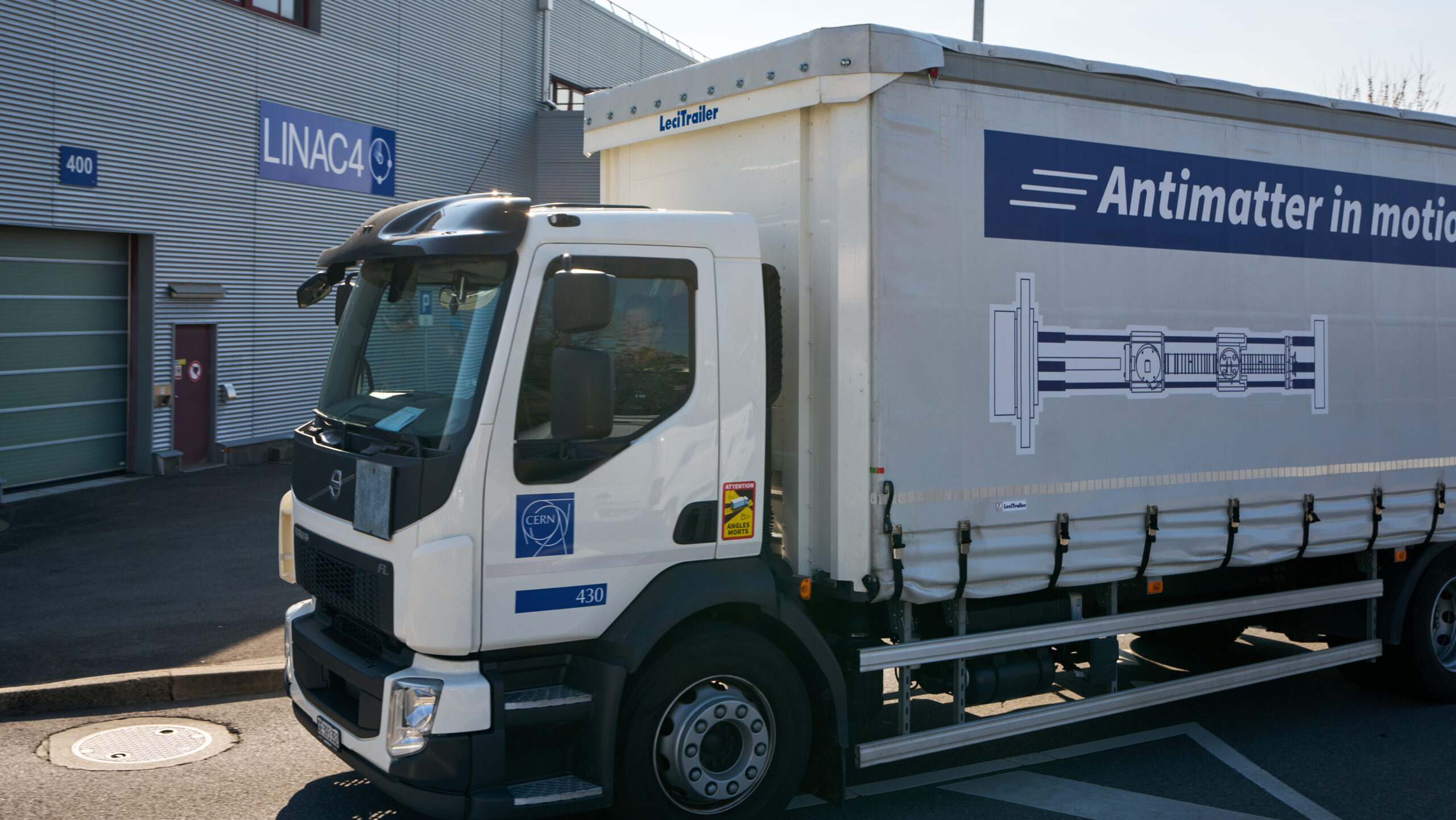
The Antimatter delivery by road has officially become a reality following the success of the BASE-STEP project coordinated by CERN. For the first time in the history of particle physics, a sample of antiprotons was extracted from the high-energy production area and transported via a standard truck to an external laboratory. This event marks the overcoming of one of the most complex technological barriers: maintaining antimatter stability outside massive accelerators.
Key Takeaways
- 70 antiprotons were extracted and transported over a distance of 600 meters.
- A cryogenic magnetic trap mounted on a truck was utilized for the move.
- The antimatter remained stable for approximately 70 hours during the operation.
The first success in Antimatter delivery
The Antimatter delivery took place by connecting CERN’s Antiproton Decelerator to Building 141, the site of the ISOLDE experiment. Although the distance covered was only 600 meters, the technical challenge was monumental. Scientists had to isolate the antiprotons from any contact with ordinary matter, which would have caused instantaneous annihilation.
The BASE-STEP magnetic trap technology
To make the movement possible, the team developed BASE-STEP, a one-ton portable Penning trap. This device maintains a deep vacuum and temperatures near absolute zero using liquid helium. Thanks to this mobile “magnetic bottle,” it is possible to study the fundamental properties of particles in environments with reduced electromagnetic interference, drastically improving measurement precision.
The future of Antimatter delivery in physics
Optimizing Antimatter delivery will allow researchers to bring rare samples to specialized laboratories worldwide. The success of the test demonstrates that we are no longer strictly bound by immediate physical proximity to production areas. This mobility paves the way for tests on matter-antimatter symmetry that could explain why the visible universe is predominantly composed of the former.