
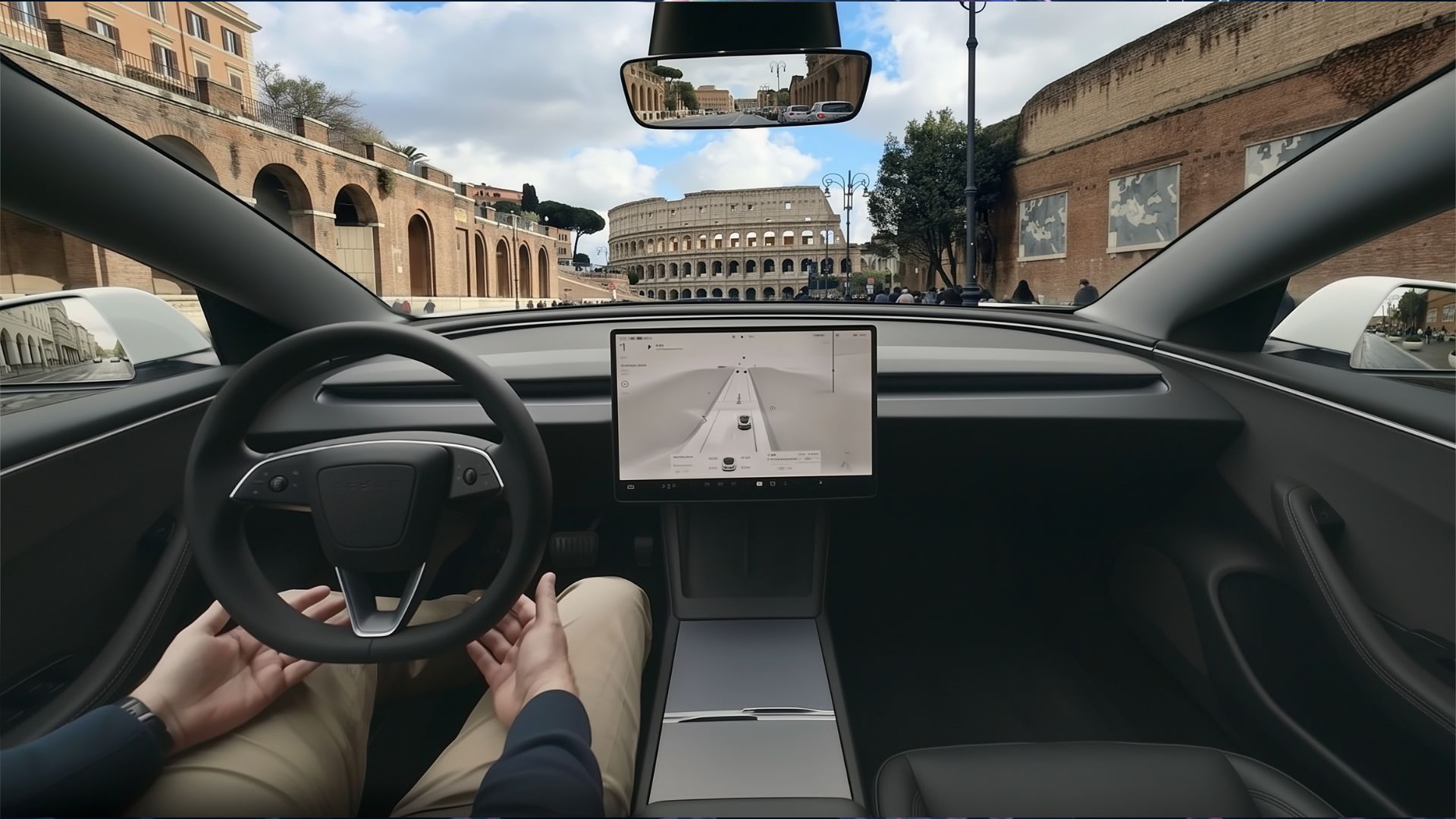
Tesla Assisted Driving (TAD) has been approved in Italy since November 20, 2026. The Italian Ministry of Infrastructure and Transport (MIT) granted provisional type approval to Tesla’s driver assistance system, previously known as Full Self-Driving (Supervised).
Last updated: November 23, 2026
Italy is the twelfth European country to clear the system and the first of the EU’s largest member states by population. The software handles steering, acceleration and braking in cities too, including intersections and roundabouts. However, it remains a Level 2 system: the driver must supervise the car at all times and is responsible for what it does.
What did the Italian ministry decide?
Transport Minister Matteo Salvini announced the decision on November 20 in a post on X. According to the ministry, the approval follows a technical feasibility check and comes ahead of EU-level recognition, which is still under way. Elon Musk then replied by thanking the minister.
Technically, Italy did not approve the system from scratch. Instead, it recognized the provisional approval issued on April 10, 2026 by the RDW, the Dutch vehicle authority. This is an EU type approval with national validity under Article 39 of Regulation (EU) 2018/858. It applies to technologies that current rules do not yet cover.
The RDW granted it after more than 18 months of track and road testing. Specifically, it assessed the system against UN Regulation 171, which covers DCAS (Driver Control Assistance Systems). Before Italy, Lithuania, Estonia, Denmark, Belgium, Slovenia, Czechia, Croatia, Slovakia, Latvia and Finland had recognized the same approval.
Tesla had already demonstrated the system in Italy. On December 3, 2025, for example, Rome Mayor Roberto Gualtieri tried the supervised version on the city’s streets.
How does Tesla Assisted Driving work?
The system relies only on the car’s external cameras, with no radar or lidar. Neural networks running on the onboard computer process the images and decide the path, speed and maneuvers. Our guide to neural networks (in Italian) explains how these models work.
With a destination set in the navigation system, Tesla Assisted Driving can:
- accelerate and brake according to traffic and speed limits;
- steer through bends and turns in town;
- cross intersections controlled by traffic lights or signs;
- drive through roundabouts and change lanes on its own.
The difference from standard Autopilot is where it works. Autopilot keeps the car in lane and at a safe distance, mostly on fast roads. TAD, by contrast, extends assistance to cities and complex rural roads. It is one piece of the smart mobility shift reshaping cities.
Can drivers take their hands off the wheel?
Yes, but only in some conditions. The Dutch approval does not require hands on the wheel. Still, they must be free and ready to take over immediately. Meanwhile, a cabin camera checks that the driver’s eyes stay on the road. If the driver looks away, the system issues warnings; if there is no response, it disengages and hands back control.
In November 2026 the RDW approved an update with stricter rules. Above 130 km/h, where allowed, hands must stay on the wheel. Warnings now come earlier, and looking away during a maneuver counts as a full strike. In addition, the maximum margin above the speed limit dropped from 50% to 10%.
Phones, reading and any other distraction are still banned. In other words, free hands do not mean free attention.
What is self-driving, really? The 6 SAE levels
In everyday language, “self-driving” covers any technology that helps with driving. Engineers and lawmakers, however, use the SAE J3016 classification. It is a scale from 0 to 5 that measures how much of the driving task moves from the human to the system.
| Level | Who drives | Example |
| 0 – No automation | The driver; the car can only warn or brake in an emergency | Automatic emergency braking |
| 1 – Driver assistance | The driver, helped with one function at a time | Adaptive cruise control |
| 2 – Partial automation | The system handles steering and speed while the driver supervises | Autopilot, Tesla Assisted Driving |
| 3 – Conditional automation | The system, in defined conditions; the driver takes over when asked | Low-speed motorway systems |
| 4 – High automation | The system, within a defined area, with no human input | Robotaxis |
| 5 – Full automation | The system, anywhere and in any conditions | No vehicle on sale |
Source: SAE International, J3016 standard.
TAD handles far more complex scenarios than Autopilot, so it is often called “advanced Level 2”. The category, though, stays the same. The real jump is Level 3: in certain conditions the driver can look away and liability shifts to the manufacturer.
Robotaxis, instead, operate at Level 4. In the United States the race is already on between Amazon’s Zoox, Waymo and Tesla.
Who is liable if the car gets it wrong?
The driver, always. TAD is approved as an assistance system, so fines, red-light violations and crashes remain the responsibility of whoever sits in the driver’s seat. The RDW said so explicitly: cars using the system are not autonomous.
In Italy the current Highway Code still applies, and it only recognizes human driving. The 2018 Smart Road decree allows testing of more automated vehicles, but only with specific permits. The ministry has also drafted a new Highway Code, which was open for public consultation until September 13, 2026. For the first time, it introduces dedicated rules for automated driving. Until it is passed, however, the existing rules apply.
How much does Tesla Assisted Driving cost and which cars support it?
In Italy TAD will cost €99 per month, or €1,188 a year. Since May 2026, in fact, Tesla has sold the package in Europe only as a subscription. In the Netherlands there is also a €49 monthly rate for owners who had already bought Enhanced Autopilot. Tesla has not yet said whether the same discount will apply in Italy.
The feature will arrive through an over-the-air (OTA) software update. However, it only runs on cars with the Hardware 4 computer, also called AI4. Teslas with the older Hardware 3 are excluded, even if the owner had paid for Full Self-Driving. Tesla has not yet given an activation date for Italy.
| Feature | Autopilot (standard) | Tesla Assisted Driving | Level 3 / 4 |
| SAE level | 2 | 2 | 3 / 4 |
| Where it works | Mostly fast roads | City, rural roads and motorway | Predefined conditions or areas |
| Intersections and roundabouts | No | Yes, with supervision | Yes, handled by the system |
| Hands | Always on the wheel | Ready to take over; on the wheel above 130 km/h | Not required while active |
| Eyes on the road | Always | Always | Not required while active |
| Liability | Driver | Driver | Manufacturer or operator, while active |
| Cost in Italy | Included | €99/month | Depends on the manufacturer or service |
Sources: RDW; Tesla; Il Sole 24 Ore.
What happens next?
- Launch in Italy. Tesla still has to announce the update date.
- EU vote. The Technical Committee on Motor Vehicles (TCMV) is expected to vote in December 2026 on extending the approval EU-wide. To pass, it needs at least 15 member states representing 65% of the population.
- Possible withdrawal. If the EU vote goes against Tesla, national approvals based on the Dutch one could lapse.
Frequently asked questions
Yes, since November 20, 2026. The Italian ministry recognized the provisional Dutch approval. It is a Level 2 system: the driver must supervise the car and remains liable.
With assisted driving (Levels 1 and 2) the software helps with steering, acceleration and braking, but the driver stays responsible. With autonomous driving (Levels 3 to 5) the system drives and is accountable, within the limits of its approval.
€99 per month, as a subscription only. It works on Teslas with Hardware 4 (AI4) and is enabled through a software update.
In some conditions, yes: hands must be ready to take over and eyes must stay on the road. Above 130 km/h they must be on the wheel.
Sources
- Il Sole 24 Ore, Guida autonoma, il Mit autorizza il sistema di Tesla, November 2026
- Reuters via Investing.com, Ministero Trasporti dà ok a sistema guida assistita Tesla prima di via libera Ue, November 20, 2026
- RDW, RDW explanation of European type approval Tesla with provisional validity in the Netherlands, 2026
- Not a Tesla App, Tesla TAD in Europe to Require Hands on Wheel Over 130 Km/h, November 2026
- Electrek, EU delays Tesla ‘Full Self-Driving’ vote to December at the earliest, September 25, 2026
- SAE International, J3016: Taxonomy and Definitions for Terms Related to Driving Automation Systems