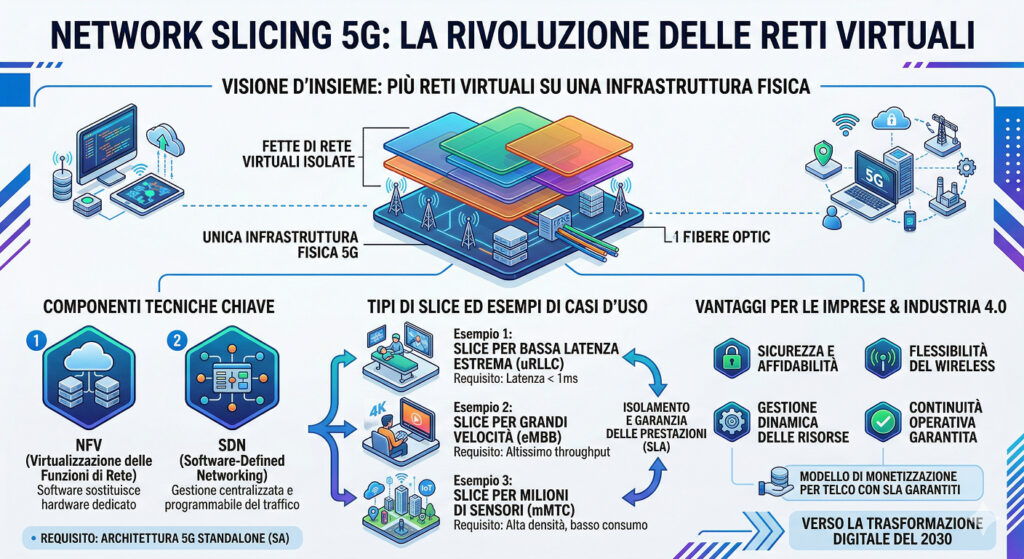


5G Network Slicing represents the technological pillar for the customization of digital infrastructures, allowing the coexistence of multiple independent virtual networks on a single physical platform. This innovation, defined by 3GPP standards, surpasses the limitations of previous generations by offering network segments (slices) optimized for specific requirements of latency, speed, and connection density.
Key Takeaways
- Enables the creation of isolated virtual networks on a single 5G physical infrastructure.
- Optimizes resources for critical use cases such as autonomous driving and industrial IoT.
- Requires a 5G Standalone (SA) architecture to be fully operational.
What is 5G Network Slicing and how it works
The functioning of 5G Network Slicing is based on Network Functions Virtualization (NFV) and Software-Defined Networking (SDN). Instead of providing a “one-size-fits-all” service, operators can configure each individual network slice with dedicated parameters. For instance, one slice can be dedicated to extreme low latency for remote surgery, while another can manage millions of low-power sensors (mMTC). Isolation ensures that a traffic spike on one slice does not compromise the performance of others.
The advantages for businesses and Industry 4.0
The adoption of this architecture allows companies to have a virtual private network with the security and reliability of a wired network, but with the flexibility of wireless. Thanks to segmentation, smart factories can separate critical robot traffic for production from internal communication services, ensuring unprecedented operational continuity and dynamic resource management based on the instantaneous workload.
Why 5G Network Slicing is the future of telecommunications
5G Network Slicing is considered the primary monetization driver for telco operators in the coming years. According to GSMA reports, the ability to offer guaranteed Service Level Agreements (SLAs) to enterprise customers transforms connectivity from a simple commodity into a premium personalized service. With the global transition toward 5G Standalone, this technology will become the de facto standard for managing the data explosion expected by 2030.