
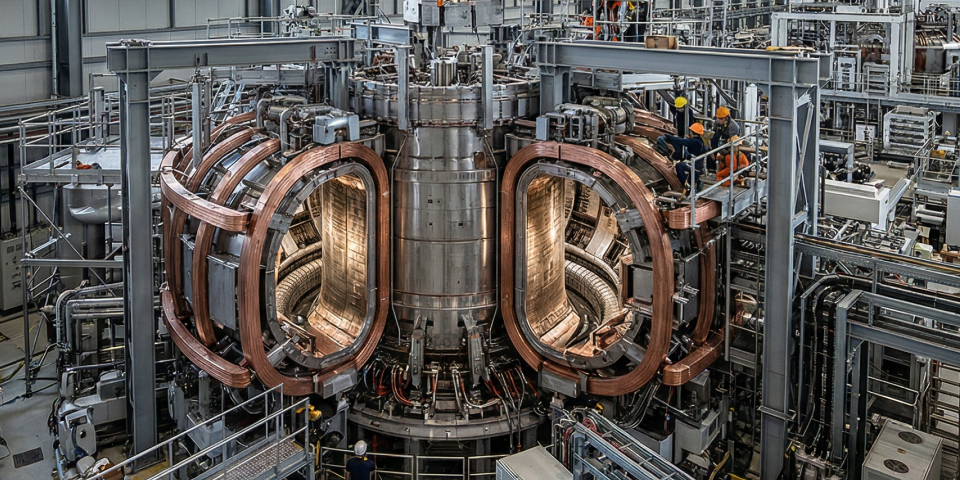
Italy is currently consolidating its global scientific leadership in the field of magnetic confinement nuclear fusion. At the ENEA center in Frascati, the DTT (Divertor Tokamak Test) project is gaining momentum, effectively setting the standards for thermal management in future commercial reactors.
Key Takeaways The Event | Construction of the DTT (Divertor Tokamak Test) research infrastructure. Strategic Impact | Solving the heat exhaust challenge in plasma for ITER and DEMO. Metrics | Approximately €600 million investment; managing heat fluxes exceeding 20 MW/m². Current Outlook | Under construction; operational readiness expected by 2030.
The heat challenge: why the Frascati divertor is the missing link for ITER
Creating an “artificial Sun” on Earth requires maintaining plasma at temperatures exceeding 100 million degrees Celsius. However, the critical issue is not just ignition, but rather the disposal of extreme exhaust heat loads. Consequently, the Divertor Tokamak Test (DTT) acts as an advanced “thermostat”: an experimental machine specifically designed to test various configurations of the divertor, the component that extracts heat and impurities from the plasma.
Furthermore, without the technical solutions currently being developed in Italy, the international ITER project would risk facing structural delays in its net energy production phase. This Italian-led research will allow for the testing of materials and magnetic geometries capable of withstanding extreme energy fluxes, thereby ensuring the reactor’s long-term structural integrity. For more on sustainable technology impacts, visit intnews.it.
Superconductivity and advanced materials: the excellence of the Italian industrial chain
The project represents far more than just an academic milestone; it is a strategic victory for the national high-tech industry. In addition, the production of superconducting magnets involves Italian centers of excellence already collaborating with the DTT Consortium and ENEA. By utilizing advanced alloys and cryogenic cooling systems, Italy is defining the state-of-the-art in materials engineering. As a result, Italian companies are now in a prime competitive position for future contracts regarding DEMO reactors.
Roadmap 2025-2030: towards commercial fusion energy production
The integration of DTT into the Eurofusion European roadmap remains essential for the transition from experimentation to commercialization. While the 2020-2030 decade is dedicated to technological validation in Frascati, the data collected will serve as the fundamental pillar for designing the first fusion power plant. Ultimately, this path confirms Italy’s commitment to a deep energy transition, focusing on a safe, virtually limitless, and CO2-free source. Follow the latest in tech-economy at intnews.it.