

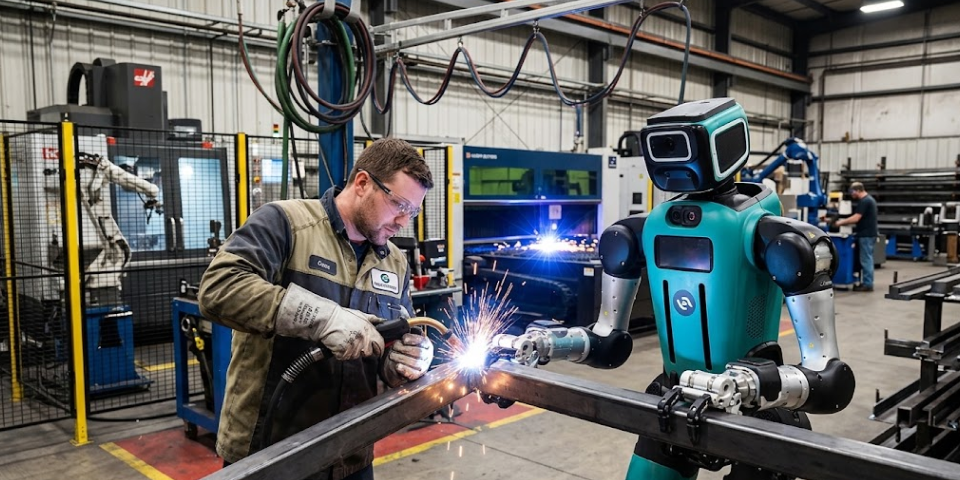
The cage-free Digit 5 raises a fundamental question: what does it take for a robot to work alongside a factory worker safely? On September 15, 2026, Agility Robotics unveiled its new model, which the company describes as its first humanoid designed to work in close proximity to people without the physical barriers of traditional automation. The U.S. company says it holds more than $300 million in multi-year orders for Digit 5, subject to certain contractual milestones being met. The figure dates from May 2026 and had already been disclosed when the listing deal was announced.
In brief
- According to Agility, Digit 5 repeatedly lifts 22.7 kg (50 lb) and recharges in 9 minutes, for more than 20 hours of productive work in a 24-hour day.
- The company plans to go public through a SPAC at a $2.5 billion valuation, and expects to obtain CE marking for Europe.
- From January 20, 2027, the new EU Machinery Regulation applies, covering safety systems with self-evolving behavior. The international ISO standard for humanoids, however, is not yet ratified.
Cage-free Digit 5 and the stock market ambitions
Beyond its technical performance, the project has a strong financial dimension. Digit 5 can repeatedly lift 50 lb (22.7 kg). Its battery lasts 90 minutes and recharges in just nine minutes, which Agility says enables more than 20 hours of productive work in a day.
Agility has announced plans to go public by merging with the SPAC Churchill Capital Corp XI, at a pre-money valuation of $2.5 billion. The deal has not closed and requires approval from the SPAC’s shareholders.
On orders, some caution is warranted. According to TechRepublic, citing SEC filings, the $300 million figure stems from a single agreement for 1,000 robots over three years, classified as a related-party transaction. The commercial roadmap calls for early access in the first half of 2027 and general availability by the end of 2027.
On the operational side, the real test is robots working in actual warehouses and plants: we cover it in our in-depth piece on Logistics Tech 2026: Warehouse Robots, Drones & AI.
The data reported is for informational purposes only and does not constitute financial advice.
New EU Regulation 2027: what changes for intelligent machines
What does Europe require of a robot for it to work without barriers? For the European market, Agility plans to obtain CE marking. From January 20, 2027, Regulation (EU) 2023/1230 applies, replacing the Machinery Directive 2006/42/EC.
The text is not limited to humanoids. Among the high-risk products listed in Annex I, it adds safety components with self-evolving, machine-learning-based behavior, as well as machinery that incorporates such systems. Notified body involvement is required for the high-risk categories. Public information does not indicate whether Digit 5 will fall into this category.
There is also still no reference standard for humanoids. ISO 25785-1, the first international standard dedicated to the category, is under development, as is the ANSI/A3 TR R15.108 technical report for the United States and Canada. Agility is contributing to both. Early adopters will therefore have to face case-by-case conformity assessments. For further reading on regulatory topics, our Ius Tech column collects our content on law and technology.
Cage-free Digit 5 and Italy’s RoBee
While the market debates regulation and integration, Italy already has a company betting on safe collaboration. Brianza-based Oversonic Robotics has developed RoBee, which is presented as the only humanoid certified for industrial and medical-healthcare use. The claim comes from the company and has been repeated by the press. Oversonic says RoBee is already operating in manufacturing companies and in clinical trials, with an R series for industry and an M series for healthcare.
The exact type of certification has not been made public. To learn about the company’s journey, its history and its hospital projects, read our article on Oversonic’s RoBee and cognitive humanoid robots.