

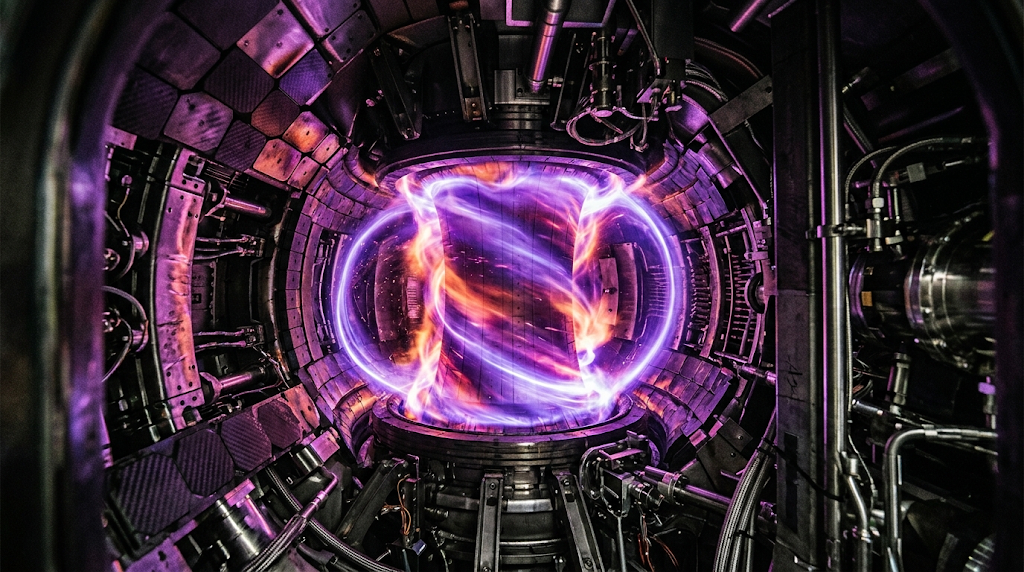
An instability that has been considered a major challenge for fusion reactors for decades may actually enhance their performance. This is shown in a new experimental study conducted at the DIII-D National Fusion Facility in San Diego.
What Really Happened
A team led by W. W. Heidbrink (University of California, Irvine), alongside researchers from General Atomics, University of Texas at Austin, Lawrence Livermore National Laboratory, University of Wisconsin–Madison, and UCLA, published the first direct observation of electric currents generated by instabilities known as Alfvén eigenmodes (AEs) inside a tokamak in Physical Review Letters (vol. 137, article 095101, August 25, 2026).
Alfvén eigenmodes are plasma oscillations triggered by high-energy particles produced by the reactor’s heating systems. Historically, they were considered undesirable because they tend to scatter these energetic particles before they can transfer their heat to the surrounding plasma, reducing confinement efficiency.
The study demonstrates that above a certain energy threshold, these same modes generate “zonal” flows and currents. This shear flow effect suppresses micro-turbulence—the primary mechanism responsible for heat leaking from the plasma core out to the edges. The measured outcome includes higher temperatures for both electrons and ions, accompanied by a clear reduction in heat transport toward the plasma boundary.
How It Was Measured
To isolate this phenomenon, researchers utilized the Motional Stark Effect (MSE) diagnostic: a beam of neutral deuterium atoms is injected into the plasma, and the polarization of the emitted light reveals changes in the internal magnetic field. From this measurement, the safety factor ($q$) was derived—a parameter describing how magnetic field lines wind around the plasma, which dictates its stability.
| Parameter | Measured Value / Detail |
| Safety Factor Variation ($\Delta q/\bar{q}$) | $\approx 5\%$ |
| Time Window of Variation | $\approx 20\text{ milliseconds}$ |
| Research Facility | DIII-D National Fusion Facility (San Diego, CA) |
| Diagnostic Tool | Motional Stark Effect (MSE) |
Note: The authors specify that the observed variation is consistent with a rough estimate based on the measured zonal flow and should be understood as an order-of-magnitude calculation rather than an absolute precise measurement.
Why This Is Not (Yet) a Commercial Breakthrough
This study represents a fundamental physics proof-of-concept on a research machine, not an immediate leap toward a commercial power plant. Neither the original paper nor the media coverage offers quantitative estimates for how much this effect could boost the net energy output of future power plants.
DIII-D is an experimental facility operated by General Atomics for the U.S. Department of Energy (DOE) since 1986. The device does not produce net electricity; instead, it serves to refine plasma physics models to support next-generation global projects, including ITER.
What This Means Internationally and in Europe
Europe contributes heavily to fusion research through EUROfusion and Fusion for Energy, operating key facilities like JET (historically) and supporting the development of test centers such as Italy’s DTT (Divertor Tokamak Test) in Frascati.
| Program | Location | Primary Role |
| DTT (Divertor Tokamak Test) | Frascati (Italy), ENEA | Heat exhaust and divertor power management tests |
| FTU (Frascati Tokamak Upgrade) | Frascati (Italy), ENEA | Historical plasma physics research (decommissioned) |
| ITER | Cadarache (France) | Global flagship experimental fusion reactor |
There are no direct co-authorships from European laboratories on this specific experiment; the connection is contextual. Understanding Alfvén eigenmodes and thermal transport dynamics is essential for optimizing all tokamak designs worldwide, including ITER and future DEMO facilities.
Frequently Asked Questions
What are Alfvén eigenmodes?
They are plasma oscillations triggered by high-energy particles. Historically, they have been known for prematurely scattering energy-carrying particles before they can heat the surrounding plasma.
Does this study completely solve the problem of turbulence in tokamaks?
No. The study identifies a specific mechanism observed under precise experimental conditions on a test device, paving the way for better turbulence control rather than offering an instant engineering solution.
When will this discovery be applied to a commercial fusion power plant?
The authors have provided no specific timelines. This is an advance in fundamental plasma physics intended to refine predictive models for future fusion designs.
Does DIII-D produce electricity?
No. DIII-D is an experimental tokamak operated by General Atomics for the U.S. Department of Energy since 1986, dedicated purely to scientific research.
Sources
ScienceAlert, “Breakthrough Evidence: Nuclear Fusion ‘Flaw’ Could Actually Be Part of The Solution”, September 1, 2026.
W. W. Heidbrink et al., “First Observation of Currents Induced by Alfvén Eigenmodes in a Magnetic Confinement Device”, Physical Review Letters 137, 095101, August 25, 2026. DOI: 10.1103/1kzf-4n8n