

Key Takeaways
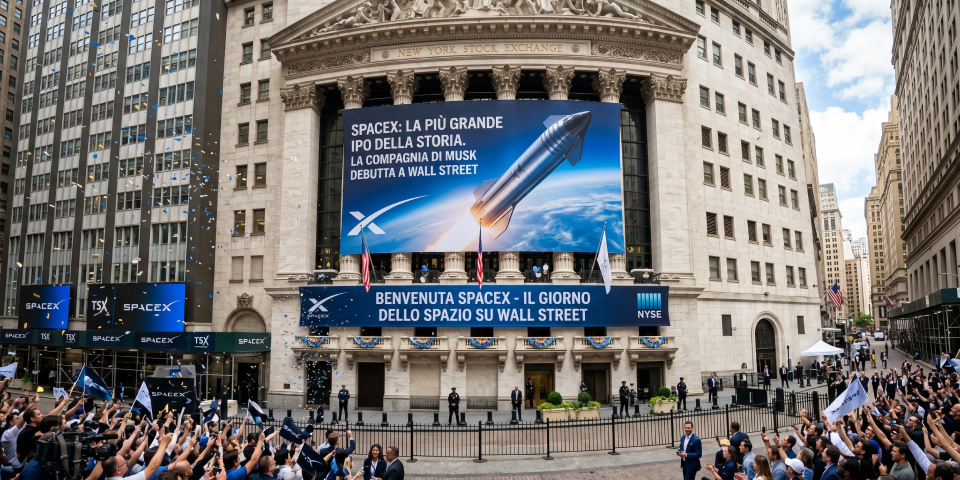
- Scenario: SpaceX officially debuts on Wall Street under the ticker SPCX, marking the largest equity public offering in global financial history and surpassing the record previously held by Saudi Aramco.
- Business Impact: The capital raise accelerates the vertical integration between the Starlink satellite constellation and orbital data centers dedicated to the xAI subsidiary, reshaping the competitive landscape of edge cloud computing and global connectivity.
- Data Point: The transaction structured the issuance of 555.56 million common shares priced at $135 per share, valuing the company at $1.77 trillion against a trailing Price-to-Sales (P/S) multiple of approximately 94x on 2025 revenues.
The Financial Architecture of the SPCX Operation: Surpassing Saudi Aramco’s Records
The debut of SpaceX on the Nasdaq regulated market represents a structural turning point for global capital markets. Through the issuance of 555.56 million common shares at a fixed public offering price of $135 per share, the company led by Elon Musk generated total gross proceeds of $75.06 billion. Consequently, this transaction has officially surpassed the historical global record set in 2019 by the oil giant Saudi Aramco, which had closed its listing at a aggregate raise of $25.6 billion.
The total opening market capitalization of the corporation reached $1.77 trillion. However, the specific metric attracting the attention of institutional analysts resides within the composition of the order book. Contrary to traditional listings of this magnitude, 30% of the total offering was extraordinarily reserved for retail investors, thereby introducing a high level of distributed liquidity into the equity structure. Regarding corporate governance, the adoption of a dual-class share architecture guarantees Elon Musk the retention of 85% of total voting rights, effectively securing strategic control of the entity despite a rigid 366-day lock-up period post-listing.
Extreme Multiples and Cash Flows: The Crossroads Between Starlink’s Profit and xAI’s Costs
Financial fundamentals extracted from the SpaceX prospectus reveal a sharp asymmetry between individual divisional performances and overall market valuation. Having reported consolidated revenues of $18.7 billion for the fiscal year 2025, the $1.77 trillion market valuation projects the stock at an unusual Price-to-Sales (P/S) multiple of approximately 94x. This valuation metric sits significantly above the historical averages found within the Big Tech cohort, where high-growth companies such as Nvidia and Apple traditionally trade at multiples ranging between 20x and 10x respectively.
METRICHE FINANZIARIE SPACEX (Consolidato FY 2026)
| Valutazione di sbarco (Market Cap) | $1.770 Miliardi |
| Raccolta Totale IPO | $75,06 Miliardi |
| Ricavi Totali Consolidati | $18,7 Miliardi |
| Utile Operativo Starlink | $4,0 Miliardi |
| Perdita Netta Consolidata | -$4,9 Miliardi |
| Multiplo Price-to-Sales (P/S) | 94x |
Internal profitability demonstrates deeply divergent dynamics. On one hand, the Starlink satellite constellation generated an operating profit of $4 billion in 2025, accounting for over 60% of total group revenues and proving the commercial viability of the orbital broadband business model. On the other hand, the consolidated financial statements recorded a net loss of $4.9 billion due to the massive capital intensity required by developmental programs. Heavy infrastructure investments in next-generation data centers, combined with integration costs for advanced computing systems allocated to the xAI subsidiary, absorbed the vast majority of operational cash flows.
Governance Architecture and the “Elon Premium”: Asymmetry Risks for C-Level Executives
For chief financial officers and institutional portfolio managers, the listing of SpaceX forces a complete reassessment of capital allocation strategies within the aerospace and advanced cloud services sectors. Disregarding the ongoing transition of SpaceX from a pure launch service provider to a dominant orbital computing infrastructure vendor carries the operational risk of miscalculating the evolution of technology supply chains over the next decade. Low-latency connectivity integrated directly with edge artificial intelligence represents, in fact, a natural monopoly that traditional competitors cannot easily replicate.
At the same time, the high concentration of voting power held by the founder introduces an “Elon Premium” variable that exposes shareholders to equity volatility tied to unilateral strategic shifts. Nevertheless, the competitive advantage derived from securing direct exposure to SPCX equity lies in the corporation’s proven capability to scale launch economics through the fully reusable Starship architecture. The immediate availability of the $75 billion raised will accelerate the execution of enterprise B2B infrastructure contracts, strengthening the $15 billion-per-year computational capacity agreement signed with leading international artificial intelligence research laboratories.