
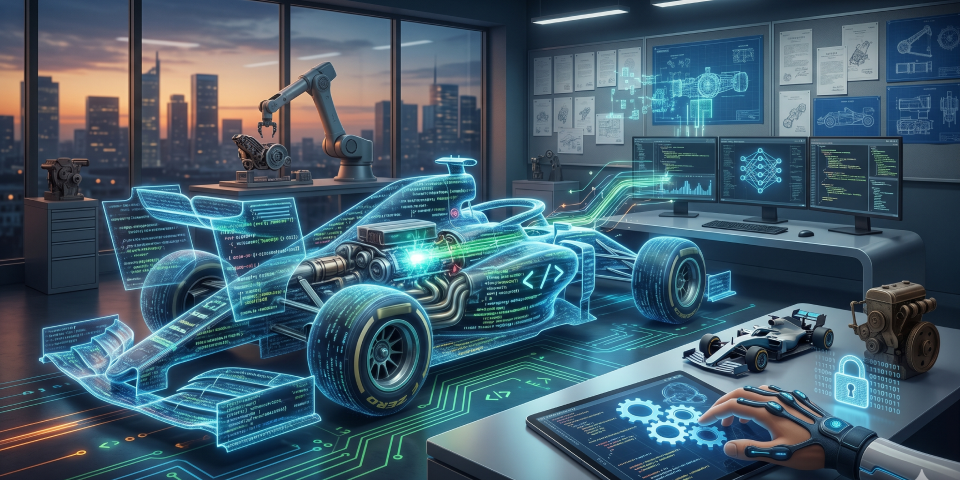
The recent Formula 1 season has sparked a heated debate—not without controversy among fans and The recent Formula 1 season has sparked a heated debate among fans and drivers regarding battery management. Specifically, the focus has shifted to the algorithms that decide in real-time when to recover energy and when to release it. Because these systems must coordinate perfectly with aerodynamics and race strategy, we are witnessing an invisible software that is now worth as much as a traditional engine, if not more.
However, this is just one part of a much broader phenomenon. The same transformation is currently taking place in sectors like automotive, energy, robotics, and manufacturing, where competitive advantage is migrating toward “code.” Consequently, a pressing question arises for those working in innovation: how can you effectively protect this digital “brain” made of data strings?
The Myth of Non-Patentable Software
People often claim that software cannot be patented, but this statement is almost always false. Although the European Patent Convention excludes computer programs “as such,” the operational reality is quite different. In fact, over the years, the European Patent Office (EPO) has significantly widened the criteria for this possibility.
Currently, the deciding factor is not whether code exists, but what that code produces. Software is potentially patentable if it generates a concrete technical effect. This means it must be something that goes beyond pure abstract data processing and interacts with the physical world. For instance, we can think of an algorithm that improves vehicle stability or one that controls a robotic arm in real-time. In these cases, the software represents the mind of a measurable technical solution rather than a mere mathematical exercise.
Technical Requirements and Practical Impact
In short, you do not patent the source code itself, but rather the technical solution implemented via software that solves a problem in a new way. To pass the examination by patent offices, you must first prove that the program interacts with physical elements like sensors or control systems. Furthermore, it is essential that the impact on reality is significant and not obvious to an expert in the field.
This centrality of software is particularly evident in the automotive sector. Here, algorithms manage physical systems with tangible effects, such as predictive active aerodynamics. By using these technologies, the software anticipates road conditions to proactively adjust the vehicle’s surfaces. Such an approach not only optimizes performance but is also applicable to energy grid management and complex industrial machinery control.
The Real Dilemma: Patent or Trade Secret?
Once you understand the feasibility of a patent, you must ask whether it is actually worth doing. A patent transforms an idea into an exclusive right, but it requires the public disclosure of the invention in exchange. In addition to this, you must consider that this protection has a limited lifespan of 20 years, after which the technology enters the public domain.
On the contrary, trade secrets follow an opposite logic. This method involves no publication, offers immediate protection, and has no fixed expiration date. Therefore, it appears to be the ideal choice when the competitive advantage evolves rapidly and is difficult for others to replicate. Unfortunately, a secret does not protect against independent discovery by a competitor. Moreover, maintaining confidentiality requires constant investment in security protocols and non-disclosure agreements (NDAs).
Designing a Strategic Protection Plan
In the end, these two tools can be complementary. Many innovative companies choose to patent solutions destined to scale while keeping the hardest-to-intercept technical details secret. For those developing technology today, intellectual property should not be a final bureaucratic step; instead, it must be an essential part of the design process.
Before launching a product, it is vital to reflect on the duration of your competitive advantage and its replicability. Because patents and trade secrets are different tools for different moments, understanding which one to use represents a fundamental strategic choice for business success. Leggi altri articoli come questo.
Article in collaboration with AW LEGAL and VISIUS
AW LEGAL is a law firm specializing in Intellectual Property, Privacy, and Legal Tech. VISIUS offers legal assistance and strategic advice to individuals and businesses, in the areas of white and corporate criminal law, Swiss law, and new technology law.