
Key Takeaways
- Scenario: The Orion capsule successfully splashed down in the Pacific Ocean following a 10-day mission beyond lunar orbit, marking the first crewed success for the Artemis program.
- Business Impact: Successful re-entry validation enables the operational phase of Artemis III, accelerating the contract pipeline for the industrial consortium led by Lockheed Martin and Boeing.
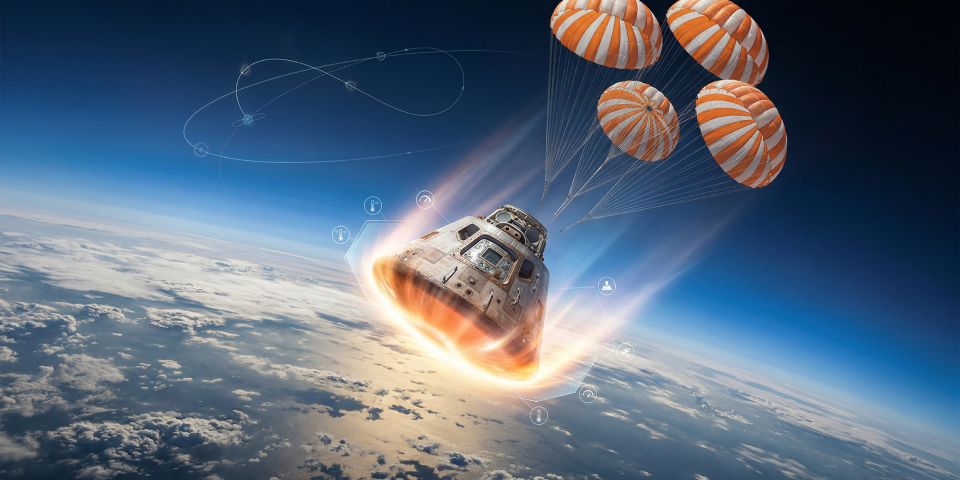
- Data Point: The AVCOAT heat shield dissipated thermal loads of 2,760°C while traveling at a re-entry velocity of 11 km/s.
Technical Analysis of Orion’s Atmospheric Entry
The Artemis II mission validated critical Environmental Control and Life Support Systems (ECLSS) within a deep-space radiation environment. During the re-entry phase, the spacecraft executed a precise skip-entry maneuver, which allows for refined landing targeting and reduced G-loadings for the crew. Consequently, the command module’s structural integrity remained well within the nominal parameters established by NASA Standards.
The parachute system’s efficiency ensured a final impact velocity of less than 30 km/h. Nevertheless, post-flight inspections will prioritize the heat shield’s erosion patterns, addressing minor anomalies observed during the uncrewed Artemis I mission. Furthermore, the seamless integration between the Deep Space Network and onboard avionics maintained consistent telemetry, minimizing blackout durations during atmospheric ionization.
Geoeconomic Impact on the Aerospace Supply Chain
Artemis II serves as a primary catalyst for the burgeoning Lunar Economy, effectively pivoting the cis-lunar orbit into a strategic logistical hub. Defense and space contractors have now seen the SLS (Space Launch System) architecture’s viability reaffirmed. Moreover, international cooperation regarding the ESA-built European Service Module reinforces the necessity of transatlantic partnerships in managing Aerospace Costs.
Next Steps: Moving Toward Gateway and Artemis III
Biological data harvested from sensors worn by Wiseman, Glover, Koch, and Hansen will establish the baseline for extended stays aboard the Gateway space station. Subsequently, NASA will initiate a critical review of docking systems for SpaceX’s Human Landing System (HLS). The trajectory toward a 2026 lunar landing now appears technically robust following the successful validation of optical navigation systems during this mission.
Artemis II: Crucial Lunar Return Test Successfully Completed
In-depth analysis of the Artemis II mission return. Technical data on heat shields, economic impact on the aerospace industry, and next steps for lunar exploration.