
The Riemann hypothesis, a prime number problem open since 1859, now has a proof built with Claude and certified by a computer, but not yet understood.
Last updated: 26 November 2026
On 20 November 2026, Anthropic mathematician Levent Alpöge announced that he had proved the Riemann hypothesis while working with Claude. For anyone outside mathematics, the natural question is simple: so what?
The sharpest answer came from Alexandr Wang, Meta’s Chief AI Officer and head of Meta Superintelligence Labs. In Wang’s view, if AI can solve a problem like this, it can handle most intellectual work. To outperform humans in every field, all it still lacks is domain knowledge, infrastructure and the ability to experiment in the real world. This article looks at what happened, what Wang argues and what would change in practice.
What happened with the Riemann hypothesis?
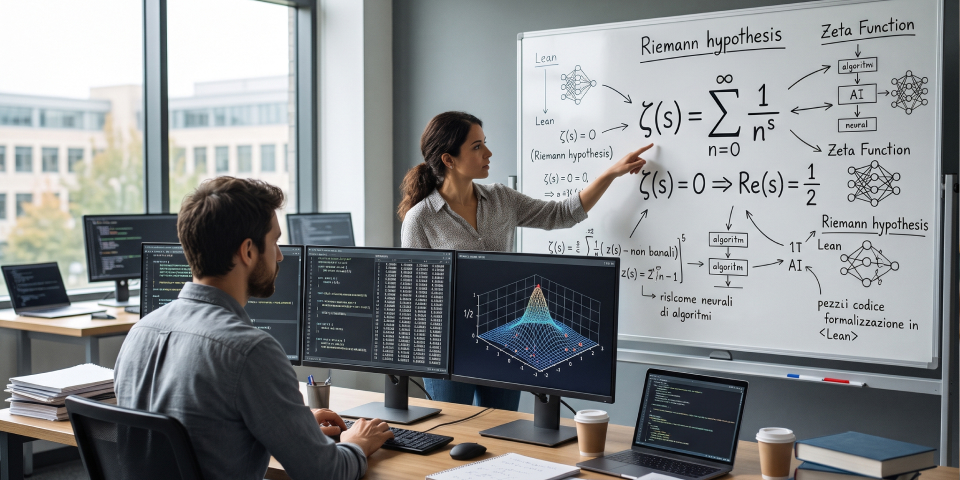
The Riemann hypothesis now has a formal proof verified by a computer, but the mathematical community has not accepted it yet. The hypothesis states that the special points of the zeta function, the non-trivial zeros, all lie on a single line. If it is true, prime numbers are spread out as evenly as they can be. It is also one of the seven Millennium Prize Problems of the Clay Mathematics Institute.
Alpöge’s proof is not a paper to read. Instead, it is an archive of about 17 million lines of Lean, according to Nature. In this language, a computer checks every single step. On 21 November, the Lean FRO and the Mathlib Initiative said they had “full confidence” that it is correct. James Maynard, a Fields medallist at the University of Oxford, told Nature it would be a historic milestone if it fully checks out.
| Item | Status as of 26 November 2026 |
| Lean proof | Certified on 21 November by the Lean FRO and the Mathlib Initiative |
| Readable version | Does not exist; Alpöge says he will write one |
| One million dollar Clay prize | Not awarded |
| Claude’s role | Described only in Alpöge’s note, with no official Anthropic report |
Source: Nature; Matweb; SiliconANGLE.
So what? Alexandr Wang’s answer
For Alexandr Wang, the Riemann hypothesis proof means superintelligence is arriving. He wrote it on 22 November 2026 in the essay “Superintelligence is Arriving”, published on X. He opens by warning that humanity’s choices over the next year will have great consequences for the future.
His reasoning starts from a comparison. For Wang, solving Riemann takes more raw intelligence than almost any programming, cybersecurity or business task. As a result, an AI that can do it already has what it takes to handle most human intellectual work. Wang also recalls a similar moment: in December 2024, models began acing the AIME maths competition, and since then they have filled in many gaps.
The key point, therefore, is that intelligence would no longer be the bottleneck. According to Fortune, Wang names three remaining obstacles: domain-specific know-how, infrastructure and experimentation. Once these are overcome, Wang argues, AI would become the main driver of progress in almost every field.
What does AI still lack to outperform humans?
According to Wang, AI lacks three things, and none of them is intelligence. Here is what they mean in practice, with our own examples:
- Domain knowledge. A model can reason well in the abstract, but it often does not know the unwritten rules of a trade. Examples include hospital procedures or the constraints of a factory.
- Infrastructure. It needs data centres, energy and links to real tools, from business software to machinery. This is why Meta expects between $135 billion and $145 billion in capital spending this year, largely for AI, according to Fortune.
- Real-world experimentation. An idea, after all, has to be tested. Biology needs labs and time, while economics needs data and real decisions.
Wang’s message, then, is that these obstacles are practical and can be overcome. Mathematics was a special case because it needs no experiments: reasoning is enough, and a computer can check it step by step.
What happens if AI learns to improve itself?
If AI learns to improve itself, progress could move faster than humans can follow. This is Wang’s most concrete prediction. He sees AI research as far less difficult than Riemann. Therefore, he writes, models will become smart enough to automate it and improve themselves.
Experts call this process recursive self-improvement. Each version of a model designs a better version of itself, which in turn designs another. The pace, as a result, would no longer depend on the work of human researchers.
Wang himself sees the risk, however. He wrote that it is hard to imagine humanity keeping control over fully unconstrained self-improvement. In his view, the same goes for a superintelligence a thousand times more capable than people in every field.
Biology, economics and weapons: what would speed up?
Wang also names three fields that AI would massively accelerate: biology, economics and weapons research. The table sums up what he predicts and what remains open.
| Field | What Wang predicts | What is still needed | Open question |
| Biology | Much faster research | Labs, clinical trials, approvals | How much real timelines shrink |
| Economics | Faster analysis and decisions | Reliable data and policy choices | Who uses the results, and how |
| Weapons | Accelerated research | Controls and access limits | How to prevent dangerous uses |
| AI research | Models that improve themselves | Computing power and energy | Who controls the process |
Source: INT News analysis of Alexandr Wang’s essay and Fortune.
The key word is speed. In biology, for example, AI could propose far more hypotheses than labs can test. On weapons, instead, the same speed becomes a security problem. As a result, the debate on the existential risk of artificial intelligence is back in focus.
Do Wang’s predictions hold up?
Wang’s predictions are one possible reading, not a proven result. The Riemann proof shows an effective collaboration between a mathematician and an AI. However, it does not show that an autonomous superintelligence already exists, as Decrypt pointed out.
The main criticisms, therefore, are threefold:
- One single result. The essay rests on a proof that still has no readable version. Andrew Gordon Wilson of New York University noted that calculus, relativity and quantum mechanics remain deeper achievements, according to Raw Story.
- Human credit. Abhishek Saha of Queen Mary University of London credited the result mainly to Alpöge, Yahoo Finance reports. Wang, by contrast, never names Alpöge or Anthropic.
- Conflict of interest. Wang runs one of the labs most committed to the race for superintelligence, while asking the industry to change course.
Still, Wang does not present the future as inevitable. He criticises the “lazy thinking” of those who take superintelligence for granted and only work on making it safe. In his view, society should not accept handing its future over to AI. Jon Favreau, a former speechwriter for Barack Obama, replied that elected governments should decide, according to Newsweek. Wang answered that this path is not inevitable, citing Meta’s months-long delay of its Muse model.
Timing also matters. The proof arrived one day after Anthropic’s Nasdaq debut. Alpöge called the timing “horrible” and denied that the announcement was planned for the markets.
What is still unknown?
- The idea behind the proof. No one has explained it yet in a readable text.
- Claude’s share of the work. The account comes only from Alpöge’s note, with no official Anthropic report.
- Whether AI will improve itself. It is Wang’s central prediction, but no lab has shown it yet.
- What Meta will do. The essay asks the industry to change course, but it does not say what concrete choices the company will make.
Frequently asked questions
A formal proof built with Claude was certified in Lean on 21 November 2026. However, the mathematical community has not accepted it yet, because there is no readable version.
Meta’s Chief AI Officer argues that superintelligence is arriving. In his view, AI can already handle most intellectual work, and the next year will be decisive.
According to Wang, it only lacks domain knowledge, infrastructure and the ability to experiment in the real world. Intelligence, he says, is no longer the bottleneck.
It means a model designs better versions of itself without help from researchers. Wang warns that such a process, if unconstrained, would be hard to control.
No. The Riemann proof shows a collaboration between a mathematician and an AI. The arrival of superintelligence is still Wang’s forecast, not a proven fact.
Sources
- Alexandr Wang, Superintelligence is Arriving, X, 22 November 2026
- Nature, Mathematicians astounded by AI and human-written proofs of iconic Riemann hypothesis, 20 November 2026, updated 23 November 2026
- Nature, ‘If we can solve Riemann, what can’t we do?’: mathematicians shocked and excited by AI breakthroughs, 25 November 2026
- Fortune, Meta AI chief Alexandr Wang warns ‘superintelligence is arriving’, 23 November 2026
- Decrypt, Why One Math Proof Has AI Experts Warning Humans Might Soon Lose Control, November 2026
- Newsweek, Meta AI chief makes dire warning over impact of superintelligence on humans, November 2026
- Yahoo Finance, A 167-Year-Old Math Problem Just Became Meta’s Case That Superintelligence Is Near, November 2026
- Raw Story, ‘Disaster movie’: Horror as Meta exec lays out what AI math breakthrough means for humans, November 2026
- Matweb, Riemann hypothesis: how do you check a proof nobody can read?, November 2026
- SiliconANGLE, Anthropic researcher claims to have proven Riemann hypothesis using Claude, 20 November 2026